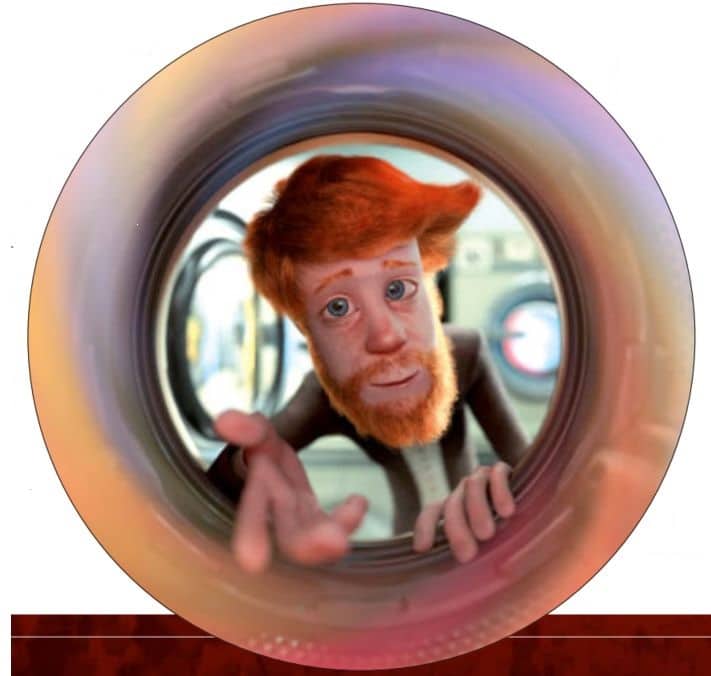
With the “Gooseberry” project, the Blender Institute wanted to produce a feature-length film that would be created in parallel by several studios around the world. Although the funding fell through, the project is far from being buried. Instead, the decision was made to produce only the first ten minutes as a pilot film. The result is the impressive first instalment of “Kosmos Waschsalon” – which also won the “Special Jury Prize” at the animago AWARD 2O15.
The coveted trophy was accepted by none other than Ton Roosen- daal himself – and the loud cheers from the audience once again confirmed that the Blender project is producing a lot of interesting things.
The Blender Foundation also sees the future of the CG industry in small studios that co-operate with other studios and freelancers worldwide on larger projects. The Blender Network, a website where developers, trainers, artists and consultants can network around Blender and become visible to outsiders, has already been founded to support such studios.
But they want to go much further to support collaborative work across studio boundaries. Tools for managing shots and assets online and offline are planned, as well as software for setting up a render farm with the option of interconnecting the farms of several studios if required.
A cloud that supports but does not control the user
There is also the issue of the cloud, which is currently a big topic in the industry. But not always in favour of the user. This is because the virtual cloud can also become a virtual prison – with software that can only be rented or enables storage services for your own projects from a single provider. For an open source project like Blender, such an approach is of course not an option. However, the tools mentioned could be easily integrated under the umbrella of a cloud solution. For this reason, the Blender Foundation is also working on a cloud infrastructure. However, as an open source solution that can also be installed on its own servers in order to remain independent of external providers.

Passing the practical test
So the plans are in place and could certainly be realised by simply developing the planned tools. Feedback on usability et cetera could come from users scattered around the world. What sets Blender apart from other open source projects, however, is that the feedback loops are as tight as possible. In other words, the developers are supported by local artists who can also communicate with them directly on site.
In this way, new features and tools can undergo intensive practical testing during their development and not only be freed from annoying bugs, but also be tailored to the needs of users from the outset. The Blender Institute’s Open Projects provide the framework for this maturing process. There have been seven short films and one computer game so far. A feature-length film is planned for “Project Gooseberry”, on which several studios worldwide are working at the same time. The project is to be coordinated by a core team in Amsterdam.
How to finance?
Creating a feature-length film is of course a much larger project than working on a short film, and therefore also involves significantly higher costs. The previous open movies were successfully financed with a combination of crowdfunding, sponsorship and film funding, but the first point in particular was critical for “Gooseberry”. Although several studios were supposed to work on the film in parallel, the production would still have taken a very long time.
After pre-ordering a DVD or Blu-ray, it would have taken a good two years for the film to be sent out. The Blender Institute therefore decided to make the pre-financing possible by selling accounts for the Blender Cloud. To this end, an early version of the Blender Cloud was put online, which offered all previous Open Movies, including the assets and all training DVDs produced by the Blender Institute, for streaming and download. All assets that would be created during the production of the film were also to be made available via the cloud – on a daily basis. In addition, you could make a direct donation or buy a mention in the credits if you didn’t want a cloud subscription (the mention in the credits would also be given to anyone who didn’t cancel their cloud subscription for at least 18 months).

Target missed
The aim was to have at least ten thousand cloud subscribers who would pay ten euros per month for a minimum term of three months. This number of supporters was to be used to recruit potential sponsors. If ten thousand users are prepared to pay ten euros a month for a project, then sponsors would also recognise that there is a broad base of interested parties behind the project who are even prepared to support it with money.
Unfortunately, the goal was not achieved; only just over three thousand cloud subscribers were gained. The hoped-for film funding from the Dutch Film Fund also failed to materialise. This made it clear that the project could no longer be realised as a feature-length film. However, there was a plan B. Only the first ten minutes were to be produced and the result was to serve as advertising for other users and possible sponsors. To this end, the supporters were asked whether they would agree to this plan, and most of them did. The team was reduced to a group of developers and artists at the Blender Institute in Amsterdam, but the collaboration tools were still to be developed, not least because funding from EU funds could be obtained.
A pilot film for a feature-length film?
Project “Gooseberry” is conceived as a feature-length film with a continuous storyline, albeit told in episodes. Each episode is set in a different world or universe. Each studio was to be responsible for one episode, giving them a great deal of freedom in the design of the individual worlds and allowing them to leave their own design mark on the film. This concept made it possible to initially produce only the exposition. If there is sufficient interest in the project, further episodes could then be added step by step until the entire film is completed at some point. Or you could switch from a film to a web series.
A sheep wishing for a more exciting life
The background to the story is Franck the sheep, who wants a more exciting life. In his current situation, he won’t be able to do much about it because he lives on an island where there is only grass, sheep and a tree. The film begins with Franck having already given up on achieving his goal. Suddenly, a man appears on the island offering Franck a product that will solve Franck’s problems. The pilot ends with Franck waking up as a caterpillar in a strange world. In the course of the film, Franck is supposed to travel to other worlds. Franck is not alone in these worlds. In addition to the red-haired businessman Victor, he meets another traveller, which forms the framework story that links all the different episodes.
Find out more in the animago special edition 2015.