



After quite a long time in the waiting room for the 11.3 version, Foundry has finally released version 12.0 of their compositing software series. The Nuke 12.0 update comes with various new nodes, such as the previously announced inpaint tool, a new grid warp tracking system, performance and pipeline improvements and more. Here is an overview of the most important new features:
Soft Selection Node
Soft Selection extends the editing of geometry and cards in Nuke’s 3D viewer. The node makes it possible to set a user-defined fall-off for the selection of vertices, faces or edges. In combination with the lasso tool, this makes it easier to deform cards for matte painting projections, for example, or to adjust geometries without having to use a DCC tool again afterwards.
Inpaint Node
The new Inpaint tool (GPU accelerated) is designed to simplify common compositing tasks such as clean-up work. The main areas of application are therefore marker removal, beauty or removing objects in a shot. According to Foundry, you can work with the Node in a similar way to Phgotoshop Healing Brush – but over time. In addition to a “stretch” parameter, you can also control the level of detail.
Edge Extend Node
Edge Extend makes it possible to reduce or extend the sample area in order to use pixels from within the respective alpha. Details and noise can also be restored without artefacts.
Grid Warp Tracker
The new Grid Warp Tracker helps with creating match moves, tracking warps and morphs. Customised grids can be used to apply deformations and smart vectors. You can copy tracking data back and forth between the grids.
Cara VR Integration
Six Cara VR nodes are directly integrated into NukeX from the 12.0 update. However, Cara VR will remain available as a standalone. The integrated nodes include
- Solver and Stitcher for corresponding footage with multiple camera setups
- CameraIngest for working with cameras in Nuke’s 3D environment
- Spherical Transform for advanced spherical transforms (GPU accelerated)
- STMap Node for working with STMaps, using position passes and more
- Disparity Generator for creating disparity maps for stereo images
Playback and performance
In addition to the new features, Nuke 12.0 also has a number of performance optimisations, including for Nuke Studio, Hiero and HieroPlayer Playback. In large projects with over a thousand nodes, the user interface should also remain significantly more interactive, as demonstrated in this example. The performance when reading or writing EXR files has also been improved.
Further new features
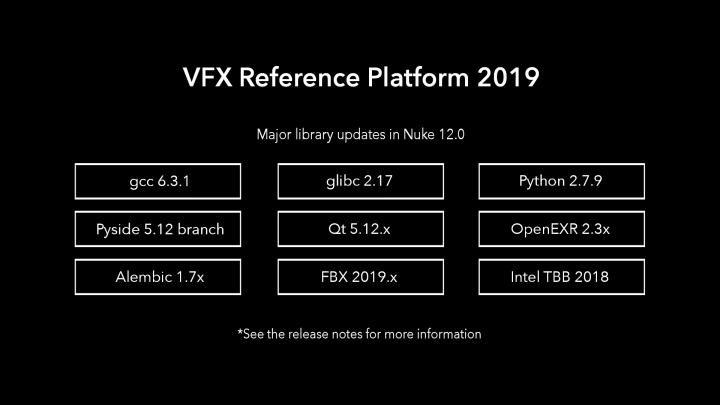
Nuke 12.0 now also supports new OpenColorIO “Role” features. For example, studios can now create custom names and presets for different colour spaces to better organise which LUT to use when importing. In addition, the software now also supports the current 2019 version of the VFX Reference Platform.
Availability
Further information: To the Foundry website and release notes
