



The short film “Sundays” by Post Panic Pictures from Amsterdam packs more high-quality VFX, full CG shots and story into 15 minutes than many a film with a budget of millions into three hours. The project, which was financed by Kickstarter and other means, received an animago AWARD for best post-production this year.
The end of the world seems close enough to touch in “Sundays”: the gap between rich and poor has become unbearably wide and for protagonist Ben, his surroundings seem like a nightmare come true; when memories of a woman return, he begins to get to the bottom of the truth about his surroundings. The main roles are played by Brian Petsos and Sofia Sisniega. The Post-Panic team(www.postpanic.com) released the 15-minute trailer this year(vimeo. com/122325664), the full story of which is soon to be made into a feature film.
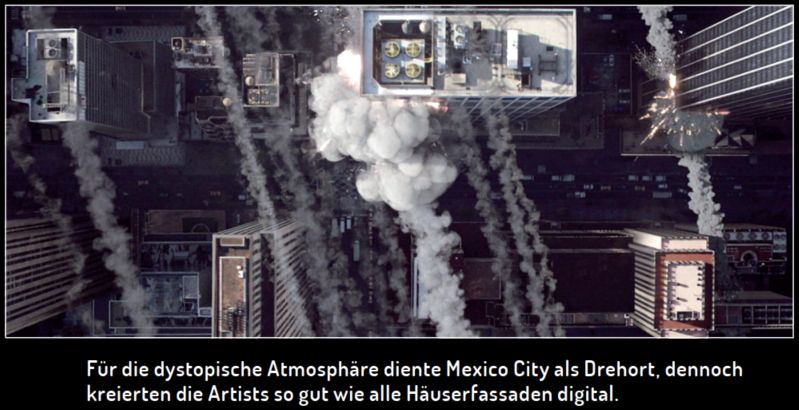
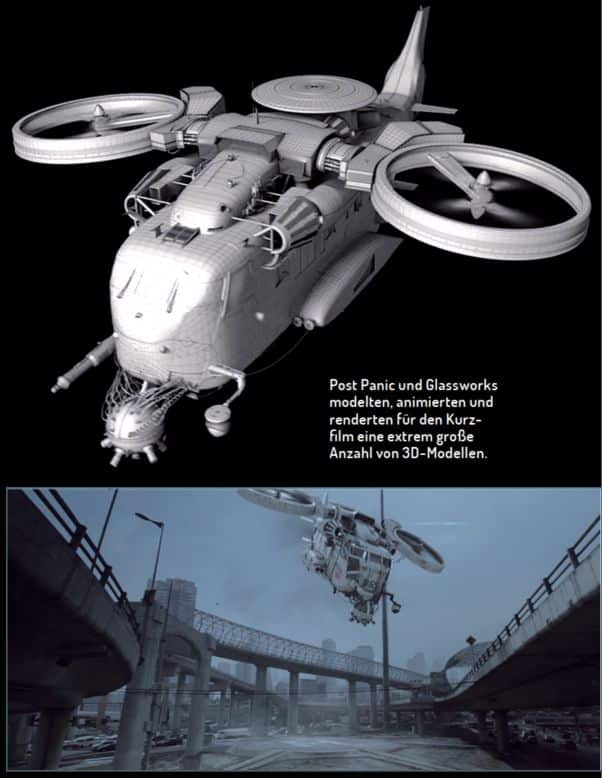
Director Mischa Rozema has been working on “Sundays” for a very long time: seven years ago, he presented the idea for the dystopian science fiction film to his Post-Panic team; shooting then followed in Mexico City in 2012, which was realised with the 50,000 US dollars generated on Kickstarter. In the almost three-year post-production phase that followed, Post Panic mastered around 100 VFX shots, 24 of which were full CG, with the voluntary help of artists from all over the world. For the first part of the extremely elaborate final scene, the team brought Glassworks from Amsterdam(www.glassworksamsterdam.nl) on board, as the number of shots exceeded Post Panic’s capacity. The team, which is based in the neighbourhood of Post Panic, created a further 100 shots for this grand finale of the film alone. As the second part of the final scene, a low-poly landscape, was a very personal vision of Post Panic, the team took over again for this.
Post Panic has been around for almost 18 years; the Amsterdam-based studio was previously known for its commercial projects. However, the team’s favourite projects are independent feature films and with the help of “Sundays”, a new film branch is to be established in the future. With this ambitious project, the team wanted to prove that impressive visual results are possible without a large budget and that visual effects combined with a sophisticated story are not a contradiction in terms. As Hollywood will finance and produce the feature film for the short film, it is to be hoped that Hollywood will not ultimately have the last word again in the realisation of the story and final look.
Director Mischa Rozema, producer Ania Markham and Head of Post & VFX Supervisor Ivor Goldberg explained in an interview how the process for “Sundays” went.
DP: How did the idea for “Sundays” come about?
Ania Markham: Post Panic was originally founded with the dream of one day making a feature film. It was through commercials that we learnt our art and how to tell memorable stories. When Mischa first talked about “Sundays” seven years ago, we always knew that one day we would realise the project – no matter what.
DP: How long did you work on the film?
Ania Markham: Apart from brainstorming in 2008, we filmed for a fortnight in Mexico City at the end of 2012 and then started post-production, which lasted until February 2015. This process took so long because we could only work on the project in the little free time we had between our commercial jobs and on weekends and evenings.
DP: Who was part of the post-production team?
Ania Markham : The Post Panic in-house team and our fantastic 50 volunteer artist helpers from the international VFX community, who also all had normal day jobs. Post Panic is a hybrid production company, which means that we oversee and produce projects from start to finish: We shoot the live action and do all the post-production, the whole team is used to the multi-tasking role. We’re not a big studio either: we have 18 permanent employees made up of producers, directors, VFX artists, editors and motion designers.
DP: Why did you bring in Glassworks for the final scene of the film?
Ivor Goldberg: We quickly realised that we couldn‘t do all the shots for this scene with our team. The finale is divided into two parts: The main reveal in the first part and the subsequent journey into the gradually changing low-poly mountain landscape. Even the first part was a mammoth task and a project in itself: there were so many things – vehicles, buildings and other models – that had to be designed and worked out. Glassworks are our neighbours in Amsterdam and our friends – we really appreciate their work. When they said yes to “Sundays”, we were so happy because their work guaranteed fantastic quality. To let another studio edit the climax of the story, the most important moment of the film, would have been unimaginable for us. If that scene had gone wrong, it would have ruined the whole film. But if there’s anyone you can trust, it’s Glassworks.
DP: How did you finance the project beyond the Kickstarter campaign?
Ania Markham: Post Panic is organised in a particular way in terms of that: We invest our profits, which we realise with commercials, in personal projects – as we did with “Postman”(vimeo.com/7592311) or “Stardust”(vimeo.com/58626695) before. As we all agreed that “Sundays” had to be made, we checked in advance how much the project would cost us. From the post-production side, we had the resources and the people, but the shoot in Mexico City was very expensive; we couldn’t afford that amount on our own. That’s where Kickstarter came in as an idea. It was our preferred route as it gave us creative control over the project and allowed Mischa to shape his vision exactly how he wanted it. We didn’t want to make the compromises to the creative process that are necessary with conventional funding methods.
DP: How quickly were you able to generate the money on Kickstarter?
Ania Markham : We set a fixed timeframe and generated the amount in about a month. The social media campaign was very time-consuming, but at the same time extremely satisfying. We expected people to donate 10 US dollars to the project, but we could never have imagined that some would even give up to 5,000! The support and sympathy we received from the international creative community during the Kickstarter campaign simply blew us away. But with that also came the responsibility to make a film that lives up to the expectations and the money raised.
Mischa Rozema: The immense support of the Kickstarter community was the most important factor for me in the project, otherwise everything would not have happened with absolute creative freedom. Furthermore, I didn’t feel like I was making the film alone as a director, but together with a group that wanted the film to be made. The fact that people believed so much in the project was a great responsibility and set the bar even higher than I had already set it. Kickstarter was not only a communication platform for us, but also for the online community: we never expected the number of artists who offered their services for the project – it was quite overwhelming to be honest. Although Kickstarter made financing easier, it also placed a huge burden on us.
DP: “Sundays” feels like a visual trip and every shot looks well thought out and designed. How many scenes for the film were you actually able to shoot?
Ivor Goldberg: The shoot itself was also like a trip and was great fun because we were finally able to create all the images we had been waiting so long to realise. The CG content grew continuously during the process and the real camera shots became fewer and fewer. Despite the several hundred VFX shots, the visual effects do not dominate the film. They only provide the world of “Sundays” with an extremely detailed background in which the story can unfold.

DP: Why Mexico City as a filming location?
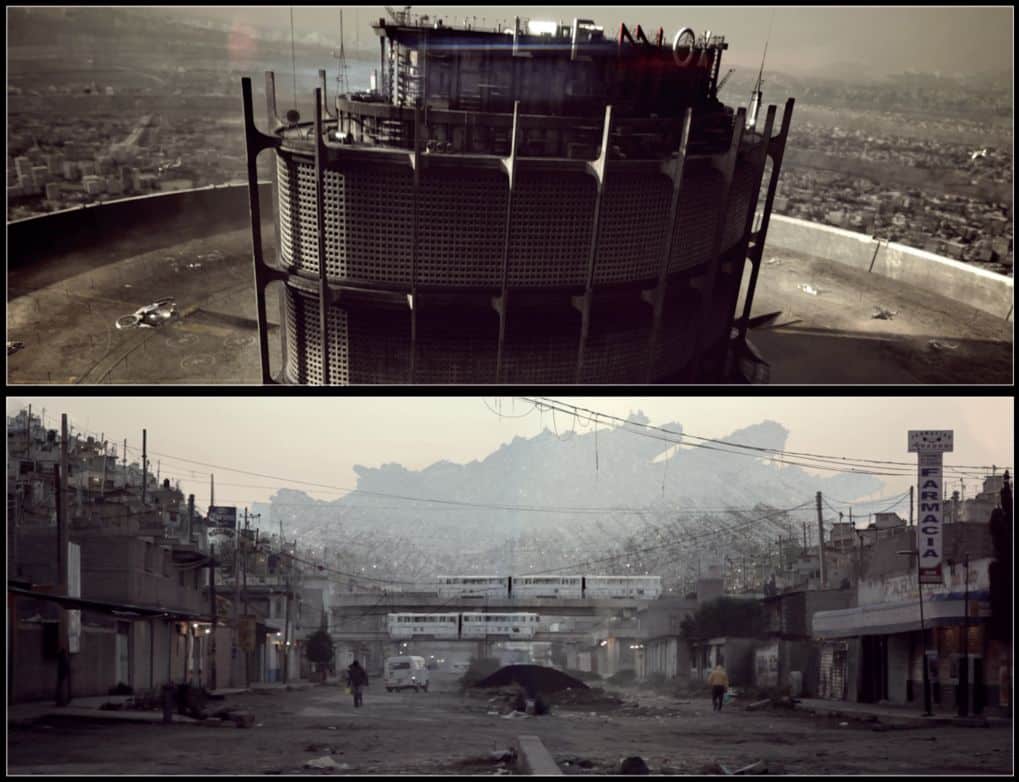
Mischa Rozema: First and foremost, I needed a city structure that could serve as the foundation for the “Sundays” future. Mexico City offered the extreme contrasts of poverty and wealth. The architecture with its many ghetto structures was also an important aspect: these self-built urban areas that from a distance look like architectural structures with their own legal system – as if hills and mountains were completely enveloped by these forms. I needed a believable environment for the plot that the viewer would buy that extreme things could happen there. Cities like Amsterdam or even Los Angeles would not have achieved the same effect. A different culture and an unfamiliar environment like in Mexico City or Tokyo means that the average viewer from the West doesn’t immediately understand the situation. A perfect starting point for my story.
DP: What camera did you shoot with?
Ivor Goldberg: Our main camera was the RED Epic as we needed a customisable camera with many features that was also portable. We shot in different frame rates, in different environmental conditions and sometimes had to capture snapshots – almost always in 5K. As a second camera, we had the Canon 5D with us for both the first team’s camera shots and the second unit’s images.
DP: How was your pipeline organised?
Ivor Goldberg: I see the post-panic pipeline as an organic element that we build around the artists. Our artists are all-rounders who are not assigned to a specific position. For us, everything revolves around the creative and not the technical process, which is why an artist supervises a shot from start to finish. Managing the VFX shots globally with the international freelancers was certainly the biggest, but also the most welcome challenge. The money from Kickstarter was used up after the shoot, and the fact that all these artists sacrificed their free time for the project was fantastic. But of course you never knew when or even if a shot was going to happen; specific deadlines were not an option.
DP: How did you create the sun intro scene?
Ivor Goldberg: The sun scene at the beginning was complicated because the footage of solar activity has many levels of complexity. Our process was as follows: We started by throwing everything we could into the scene in every possible way and kept adding more and more until we got the level of detail we were looking for. There was a basic 3D setup for all elements in Nuke, 3ds Max or Maya. For the surface displacement, we matched technical footage to the actual surface of the sun and then added the projection of a combination of 2D, 2.5D or 3D footage onto geometry and cards, or just created an overlay for the reflective lights and other surface details. We also composited this footage from a variety of different sources: 3D, 2D material as well as heavily edited and distorted stock footage. Our workflow for this was not very organised; we worked rather “dirty” and used everything that helped.
DP: How did you approach the transition from the fire shot to the eye shot of the main character?
Ivor Goldberg : We had to approach the final result of the shot with a plan: First, we figured out how close we could get to Brian’s eye with the camera in real life and at what point CG became necessary. We shot various takes, stitched them together and then blended the whole thing with footage that we projected onto geometry for the ultra-close shots of the eye. We shot the main footage as close to Brian’s eye as possible, then filmed some locked-off plates of the eye extremely close with different lenses and created a CG eye. We created the base of the eye and the sunspot in 3D with blended 3D displacements; the displacement maps were animated matte paintings. At the very end, we added reflections of the fire apocalypse from the environment to the eye using simple tracked geometry.
DP: How were the city environments created?
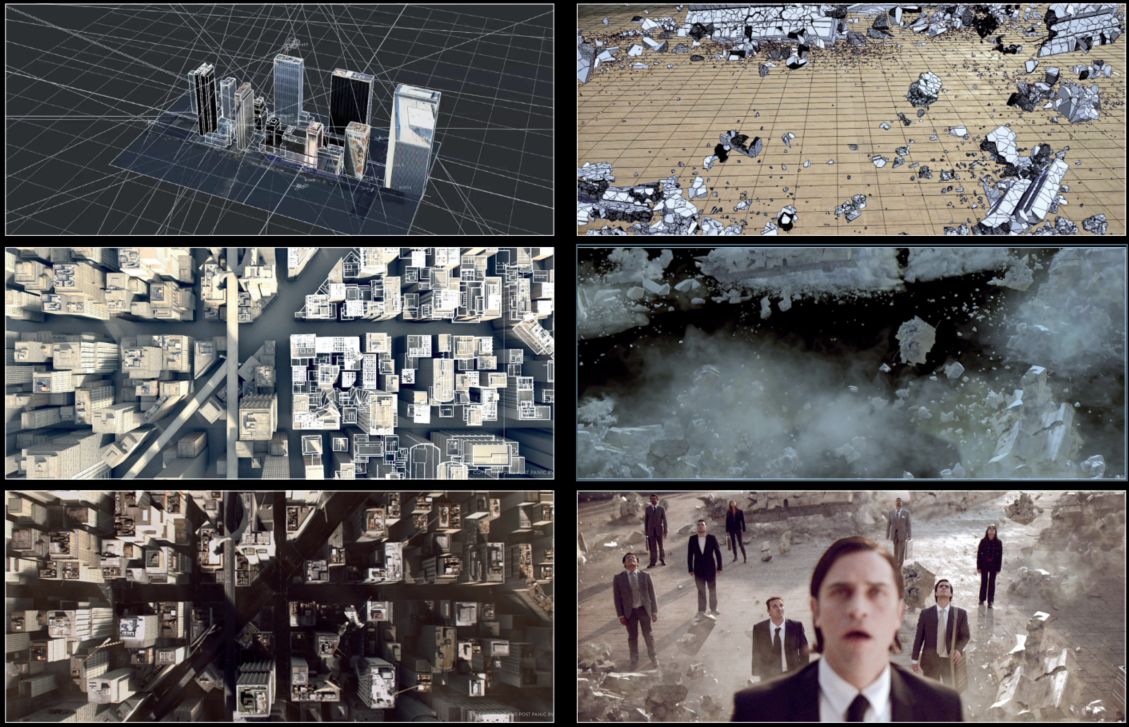
Ivor Goldberg: The city environments were very typical of our project workflow: to avoid long hours of realism in 3D, we focussed on matte painting refinement. To keep the 2D process and streamline the compositing process, a basic 3D render and Photoshop matte painting were projected onto geometry in Nuke.
DP: How did you realise the destroyed concrete blocks?
Ivor Goldberg : Creatingthese 3D models was a lot of fun. We started with a hand-animated animatic to choreograph the movement and treat the blocks almost like characters. We created the breaking apart with Rayfire in 3ds Max and the smoke with Fume FX.
DP: How was the rendering done?
Ivor Goldberg : From a 3D point of view, we rendered almost everything with V-Ray. The engine offered us stability, power and reliability – qualities that are important for a project like “Sundays”. We edited material from the shoot in 5K and rendered it in 2K. In the end, we had a data volume of around 5.5 TB of final renders. The funny thing is that the more powerful computers become, the render times remain the same. This is because the more resources you have at your disposal, the more you throw into it. On average, one frame takes us 20 minutes to render.
DP: Why did you only release the film online and skip the festivals?
Mischa Rozema : We had a long discussion before the release about how we wanted to proceed once the film was finished. There is always the opinion to go the festival route first; but “Sundays” is an unusual film, not typical or compatible with the masses and doesn’t really fit in with the content of most festivals. Also, you have to abide by the rules of the individual events – such as no online release. And that would have contradicted the entire concept of the project. In my opinion, a Kickstarter project should not remain in the cinema for over a year and only then be released online. In addition, we are already negotiating with the film industry in Hollywood, so we are not dependent on the contacts and relationships that a festival situation brings for future funding. In this advantageous situation, it was more important to us that as many people as possible could see the film.
DP: What do you hope the high VFX quality of your work, which you produced independently and at feature film level, will inspire in the film industry?
Ivor Goldberg : It’s an incredible feeling to have secured the film deal. The film was made as a proof of concept and to have it validated in this way is great. We hope to prove with the project what is possible from the art and production side. But “Sundays” is not the end of this endeavour: many film projects with incredibly talented directors are currently being created under the Post Panic Pictures banner. Our mission continues ..
Mischa Rozema: Basically , I hope that people will want to see more of it after the short film. I created these mysteries with all the eye candy and spread out a world in front of the audience without answering anything. We will give all the answers in the feature film.

