



3D-Info is a free, open-source and cross-platform tool that enables the visualisation of 3D scenes in USD format. It is aimed in particular at department heads in filming (camera, set decoration, staging etc.) and in the animation sector such as production management and direction. Other users who want to view USD 3D assets also benefit from the user-friendly interface, which does not require any additional dependencies.
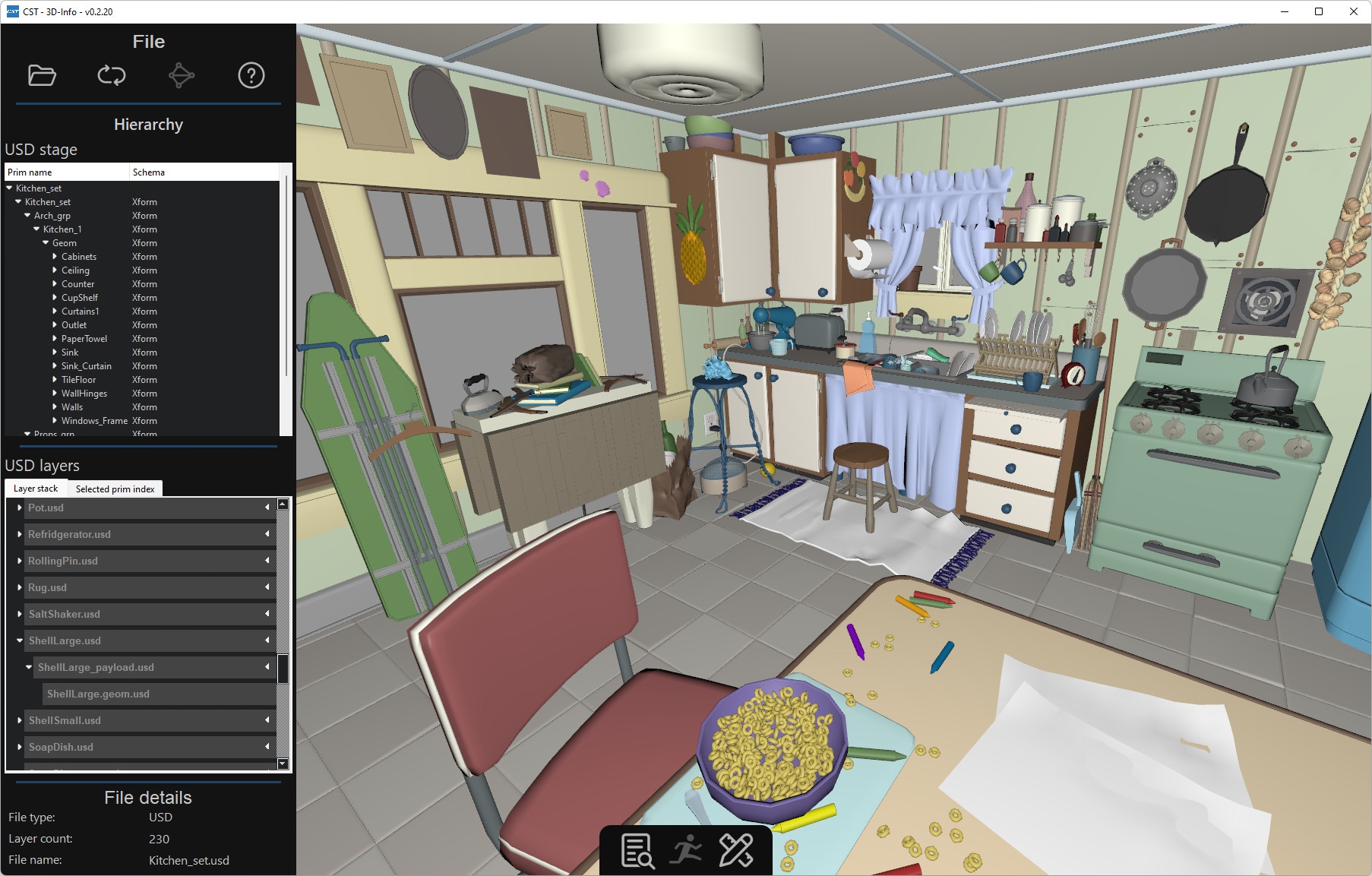
With 3D Info, users can adjust and export cameras and images, take measurements on set, share notes or play animations. Props, animated characters or sets can also be opened. Technically, the tool allows you to view the hierarchy of “stages” and “layers”, which are specific concepts of the USD format.
Current limitations
The first beta version of 3D-Info currently offers limited functions. The focus was on ease of navigation and consistency of visualisation. The visual rendering in 3D-Info is identical to that in usdview and Nvidia’s Omniverse Composer, as the same Storm rendering engine from Pixar is used. The development process required considerable effort to implement the USD framework correctly. The developers prioritised the features requested by partner studios Loops Creative Studio and Plateau Virtuel, which already work with the USD format.
CST’s goal is to support the film industry. With the increasing use of virtual production, the need to validate 3D assets in pre-production is growing. 3D-Info is intended to remedy this situation and facilitate the use of 3D for everyone involved. The idea for 3D-Info was born when Frédéric Fermon, one of the main developers, was looking for a tool that could visualise 3D assets in an understandable way without having to open a DCC. After discussions with artists, TDs and virtual set designers, it became clear that an easily accessible viewer with annotation capabilities was needed.
Development challenges
The USD format documentation is extensive but scattered in places. The file format lacks a formal description, which makes development difficult. Different parts of the Pixar library were created by different people at different times, resulting in slightly different architectures. The choice fell on the Qt framework for the graphical interface, which facilitates the implementation of certain widgets. However, this also brings challenges, for example in the handling of keyboard events. Another issue is the evolution of the library versions. Currently the version used is frozen, but in the future it will be necessary to adapt to new versions.
Public roadmap and support
The developers are calling for the beta version to be tested and feedback to be provided. 3D-Info should at least be useful as a viewer for models or the hierarchy of USD stages and layers. Here you can find the Git, information, images and more: trello.com3d-info
