



DreamWorks Animation has released version 1.7 of MoonRay, its open-source Monte Carlo ray tracing renderer. This update introduces several enhancements aimed at improving rendering workflows for digital production professionals.
New Features in MoonRay 1.7
MoonRay 1.7 introduces a new light type called PortalLight. While the official documentation lists its control attributes, portal lights in other renderers are typically used to improve global illumination in indoor scenes by guiding sampling in specific areas. This addition is expected to enhance lighting fidelity in complex scenes.
The update also adds support for the min_shadow_distance parameter, providing artists with more control over shadow rendering, particularly in scenarios requiring fine-tuned shadow detail.
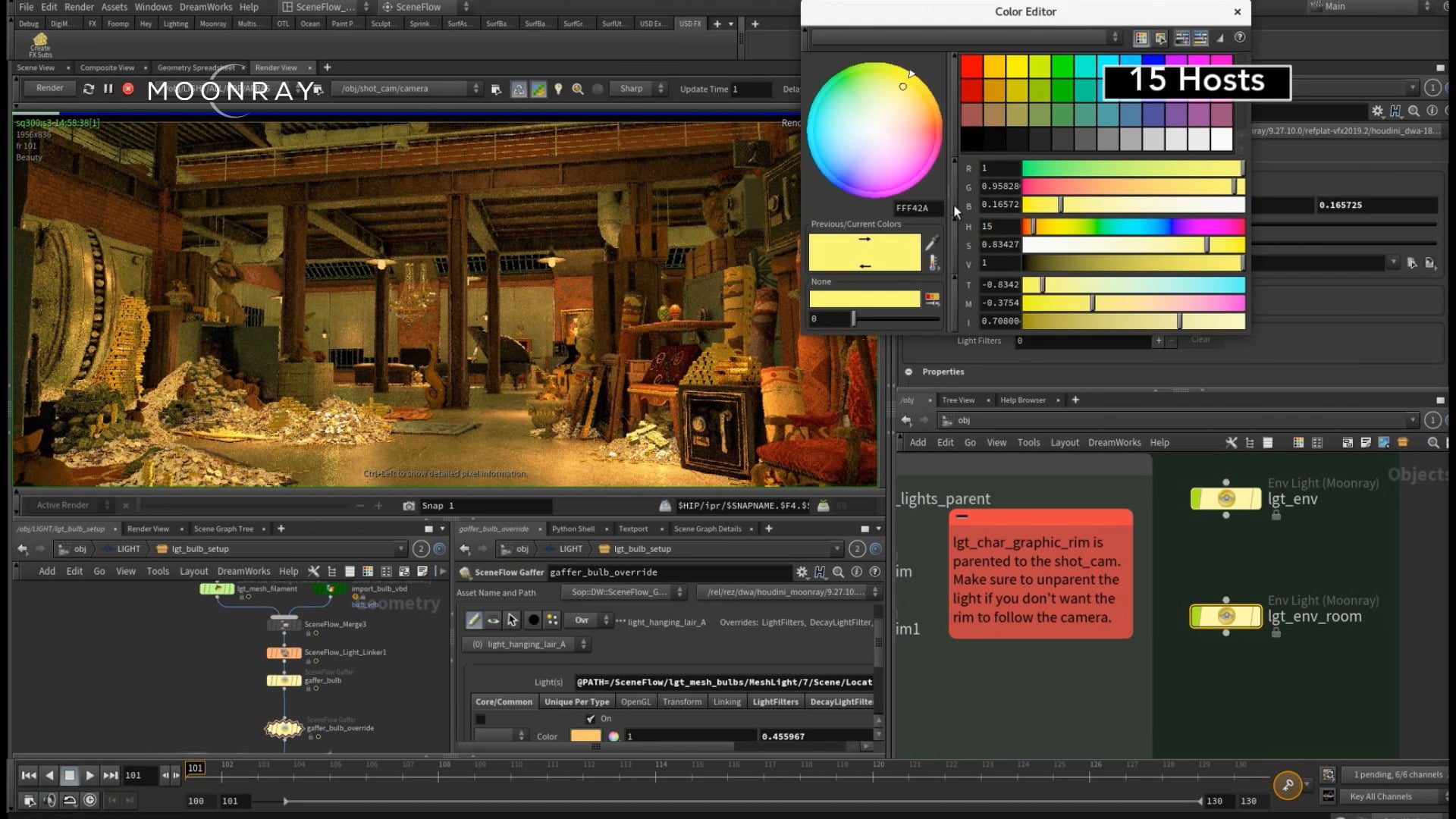
In XPU mode, which leverages both CPU and GPU resources, MoonRay now accelerates both regular rays and occlusion rays for NVIDIA GPUs. This enhancement aims to improve rendering performance, especially in scenes with complex lighting and shading.
Additionally, hdMoonRay, the Hydra render delegate for MoonRay, now includes support for Cryptomatte. Cryptomatte is an industry-standard ID matte generation system that simplifies the process of creating masks for compositing. This integration is expected to streamline compositing workflows for artists using MoonRay.
A new shared memory framebuffer interface has been introduced, facilitating the transfer of framebuffer data between processes. This feature is designed to improve efficiency in rendering pipelines that require inter-process communication.
Integration and Availability
MoonRay 1.7 is available for download under an open-source Apache 2.0 license. The software can be compiled from source on Linux and macOS, with build instructions provided in the online documentation. XPU mode requires an NVIDIA GPU that supports CUDA and OptiX on Linux, and an Apple Silicon processor on macOS. For more detailed information and to access the source code, visit the MoonRay GitHub repository.
