



Unity Technologies is gearing up to release Unity 6.1, the latest iteration of its renowned game engine and real-time renderer, scheduled for April 2025. This update brings a host of enhancements aimed at refining rendering capabilities and overall performance.
Enhanced Rendering with Deferred+ and Variable Rate Shading
One of the standout features in Unity 6.1 is the introduction of the Deferred+ rendering path within the Universal Render Pipeline (URP). This advancement optimizes the rendering process, particularly in complex scenes with numerous light sources, by efficiently managing resources to maintain high frame rates. Additionally, support for Variable Rate Shading (VRS) has been incorporated, allowing developers to allocate GPU power more effectively by varying the shading rate across the screen, thereby enhancing performance without compromising visual quality.
Boosted DirectX 12 Ray Tracing Performance
Unity 6.1 also focuses on improving compatibility and performance with DirectX 12, specifically enhancing ray tracing capabilities. This enhancement ensures more realistic lighting and reflections, contributing to immersive visual experiences in games and applications.
Future Developments: Mesh LOD System and Animation Overhaul
Looking beyond the immediate release, Unity’s 2025 roadmap outlines several exciting features slated for future 6.x updates:
Automated Mesh LOD System: Unity plans to introduce an in-editor Level of Detail (LOD) generation system, simplifying the process of creating LODs for both static and skinned meshes. This tool aims to streamline asset optimization, reducing the need for external 3D modeling applications.
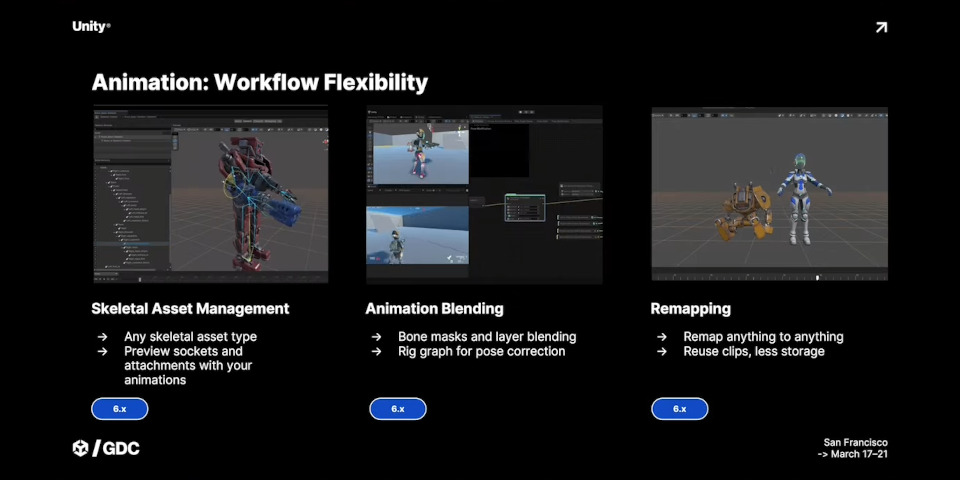
Revamped Animation System: An experimental animation system is on the horizon, featuring procedural rigging applicable to any skeletal asset, not limited to character models. This system will support animation retargeting across assets with varying sizes, proportions, and hierarchies, and will include advanced blending techniques with per-bone masking and layer blending. A restructured hierarchical State Machine is designed to handle animations for extensive character sets, enhancing scalability for large-scale projects.
Physics System Enhancements: Future updates will allow for swappable physics backends, providing developers with the flexibility to choose between different physics engines such as Havok Physics and PhysX. Additionally, Unity’s native physics system is set to receive new solvers to handle more intricate and reliable behaviors, expanding the toolkit for developers working on complex simulations.
UI Toolkit Advancements
The UI Toolkit is also set for improvements, including the capability to render user interfaces directly in world space, facilitating more immersive XR experiences. Other enhancements involve support for vector graphics, which will allow assets to scale across various device screen sizes without losing visual fidelity, and the ability to modify the ubershader without reconstruction, enabling detailed adjustments to text, graphics, and textures through familiar Shader Graph workflows.
Pricing and Availability
Unity 6.1 is slated for release in April 2025. Developers can access the beta version through the Unity Hub to explore the new features ahead of the official launch. Unity offers various subscription plans to cater to different user needs:
- Unity Pro: Designed for professionals, this plan is priced at $2,200 per seat annually, reflecting an 8% increase effective from January 1, 2025. It is required for customers with more than $200,000 in total annual revenue and funding.
- Unity Enterprise: Tailored for larger organizations, this plan has seen a 25% price increase and is required for customers with over $25 million in total annual revenue and funding. Specific pricing details are available upon contacting Unity’s sales team.
- Unity Personal: A free plan suitable for beginners and small developers, offering access to core features with certain limitations.
For detailed information on pricing and to choose the plan that best fits your needs, visit Unity’s compare plans page.
As with any new technological advancements, it’s advisable for production artists to thoroughly evaluate these features within their specific project contexts to ensure they meet the desired usability, simplicity, and stability standards before full-scale implementation.
