



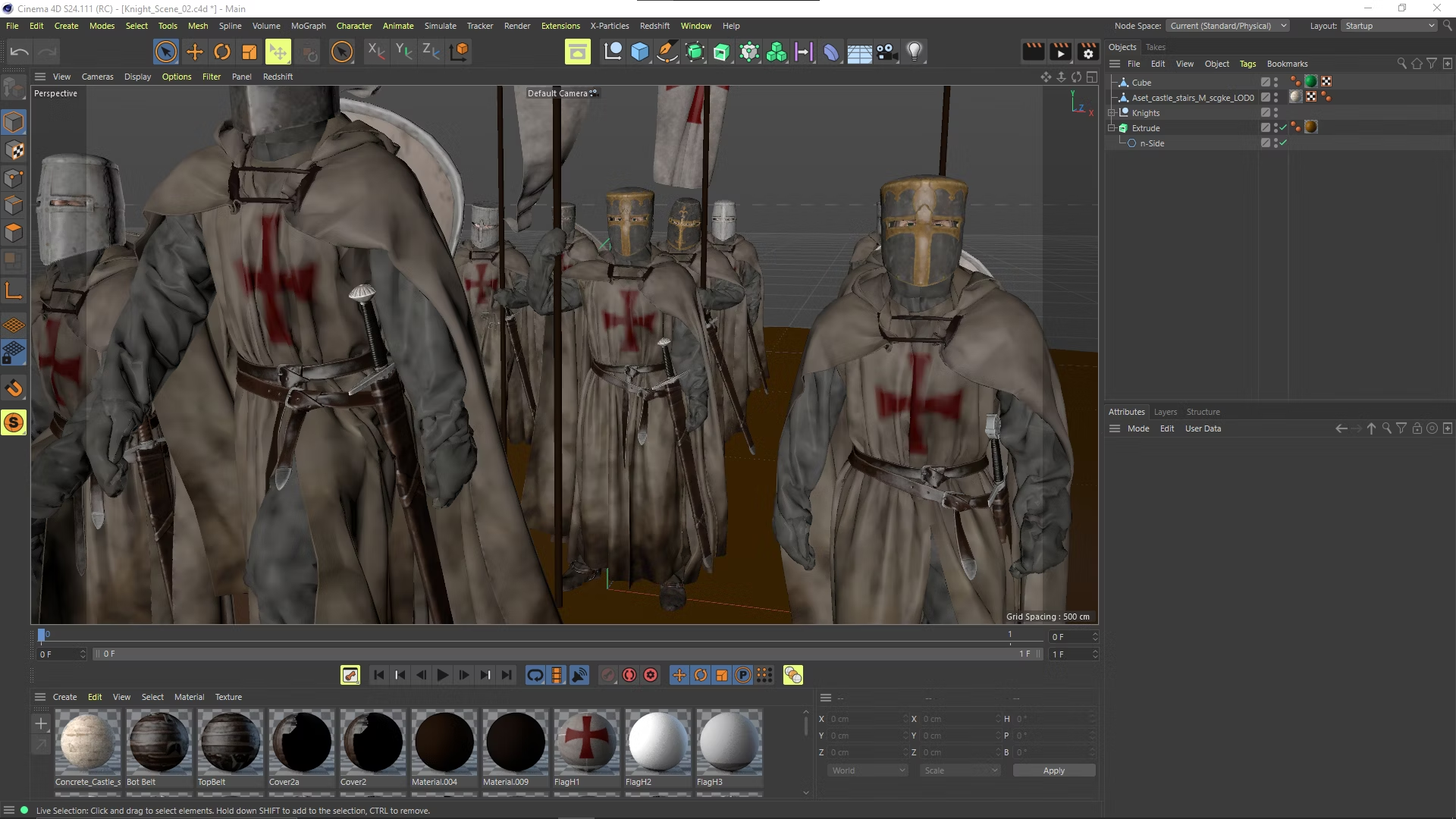
Maxon’s Cineware for Unreal Engine 2025-2 update, released on April 2, 2025, represents a significant evolution in bridging Cinema 4D with Unreal Engine. As confirmed by the official support article, this version goes beyond simply transferring static scenes—it now robustly supports character animation workflows by exporting fully rigged and skinned characters directly from Cinema 4D into Unreal Engine. The plugin leverages Cinema 4D’s native rigging system, ensuring that joint hierarchies, bone matrices, and associated skin weight data are faithfully interpreted, meaning that rigged characters arrive in Unreal with all the technical nuance intact. For seasoned production artists tired of the traditional FBX workaround and endless baking processes, this update is a welcome injection of efficiency with a side of cheeky defiance.
Detailed Animation Data Transfer and Real-Time Preview
Digging deeper into the technical specifics, Cineware for Unreal 2025-2 now includes support for exporting full animation data. This covers keyframe-driven motion and time-based transformations with careful preservation of interpolation types—be it linear or cubic—ensuring that the intended dynamics in Cinema 4D are directly reproduced in Unreal. Advanced users will appreciate that the plugin reads complex rig hierarchies natively, which translates into smooth integration with Unreal Engine’s Sequencer. Moreover, real-time preview capabilities mean that as you tweak your Cinema 4D scene, you can see immediate feedback in the Unreal viewport. This tight integration not only accelerates the iterative process but also minimizes the risk of translation errors—a technical safety net for projects where every frame counts.
Native Integration with Unreal Engine’s Workflow
For those already deep into Unreal Engine’s ecosystem, the 2025-2 update introduces enhanced blueprint connectivity. The plugin now supports direct integration with Unreal’s native blueprint system, allowing developers and technical directors to quickly incorporate imported animations and rig data into their game logic and cinematic sequences. This seamless coupling means that the rigged characters and animated scenes are not only imported intact but can also be manipulated in real time using Unreal’s familiar control systems. The integration capitalizes on the engine’s new Skeletal Mesh Component system, ensuring that even intricate character rigs maintain their structural fidelity and perform reliably under the engine’s real-time constraints.

Technical Requirements and Considerations
While Cineware for Unreal Engine 2025-2 offers an impressive leap forward, it does come with technical prerequisites. The plugin requires a recent version of Cinema 4D (R25 or later) and is fully compatible with Unreal Engine 5.0 and above. It supports only Cinema 4D’s native rigging system, meaning that those employing third-party rigging tools or mocap retargeting systems should verify compatibility before diving in. Additionally, the update incorporates advanced parameter optimization techniques, ensuring that even complex rigs—with multiple layers and constraints—are processed efficiently without bogging down system performance. It also supports morph target data for facial animation, a feature that will certainly delight character animators looking for precision in lip-sync and expression work.
Integration, Experimentation, and Production Readiness
Maxon has been transparent about the fact that Cineware for Unreal Engine 2025-2 is still under active development. While the update brings substantial improvements to the character animation pipeline, it remains essential that users perform thorough testing in their specific production environments. This is particularly crucial for projects with strict deadlines or high-stakes deliverables. As with any innovative tool, rigorous validation is advised before integrating it fully into a production pipeline. The promise of a streamlined, FBX-free workflow is enticing, but seasoned professionals know that the devil—and occasionally the delightful quirks—lie in the technical details.
Final Thoughts
Cineware for Unreal Engine 2025-2 stands as a bold step toward a more integrated, efficient production pipeline, offering native support for rigging, skinning, and animation data transfer from Cinema 4D directly into Unreal Engine. By eliminating the need for intermediate baking and FBX exports, this update not only simplifies the workflow but also maintains high fidelity in rig and animation data. For digital production professionals, VFX artists, and game developers, this is an opportunity to reimagine the production process—provided that thorough testing is carried out before deploying it in a live environment. To dive deeper into the technical specifications or to download the free plugin, visit Maxon’s Cineware for Unreal page and review the official support article.
