



For those who don’t know the tool: Shapelab is Leopoly’s hybrid desktop and VR sculpting app for artists who prefer to get their hands virtually dirty. It runs on Windows and PCVR headsets and mixes voxel sketching with polygon sculpting. Users can block out rough forms like digital clay, then refine them with precise brushes, remeshing tools and PBR vertex painting. The Max edition is the full version for professional desktop and VR use, distinct from the Lite or Vision Pro releases.
Gizmo re-engineering
The 2026 release completely rebuilds the transform gizmo. Artists now get non-uniform scaling and improved local-to-world switching. Movement, rotation and scale transformations share a consistent logic between desktop and VR, reducing accidental distortions. The update also expands keyboard shortcuts and controller bindings for transform tools, though Leopoly has not published the full shortcut list.
Elastic Move deformation
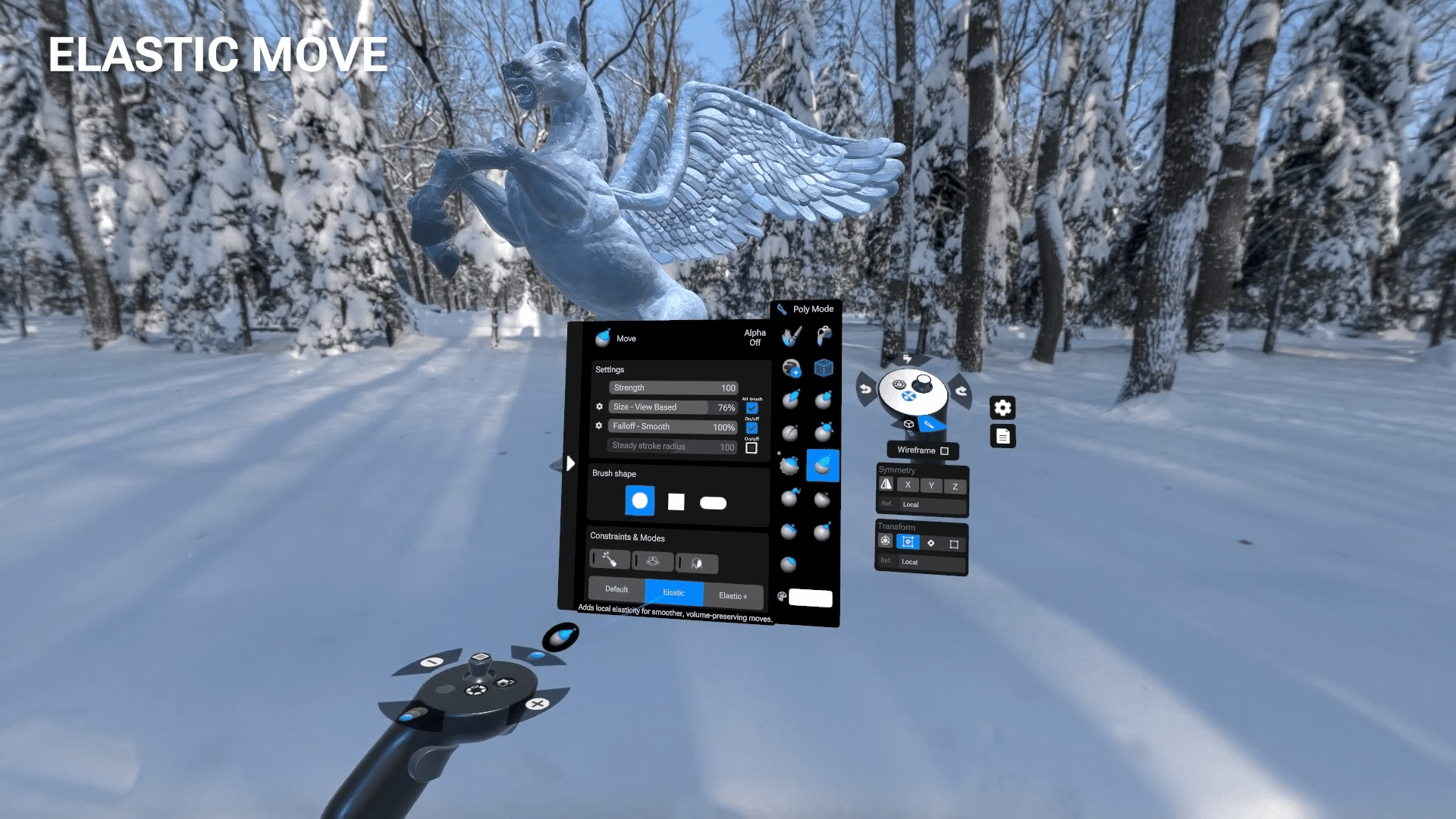
The new Elastic Move tool is based on a real-time elastic deformation model first developed at Pixar. It lets artists grab and bend meshes as though they were made of rubber, maintaining volume and continuity. The tool is designed for quick posing of characters or broad shape changes without breaking form.
Symmetry and topology
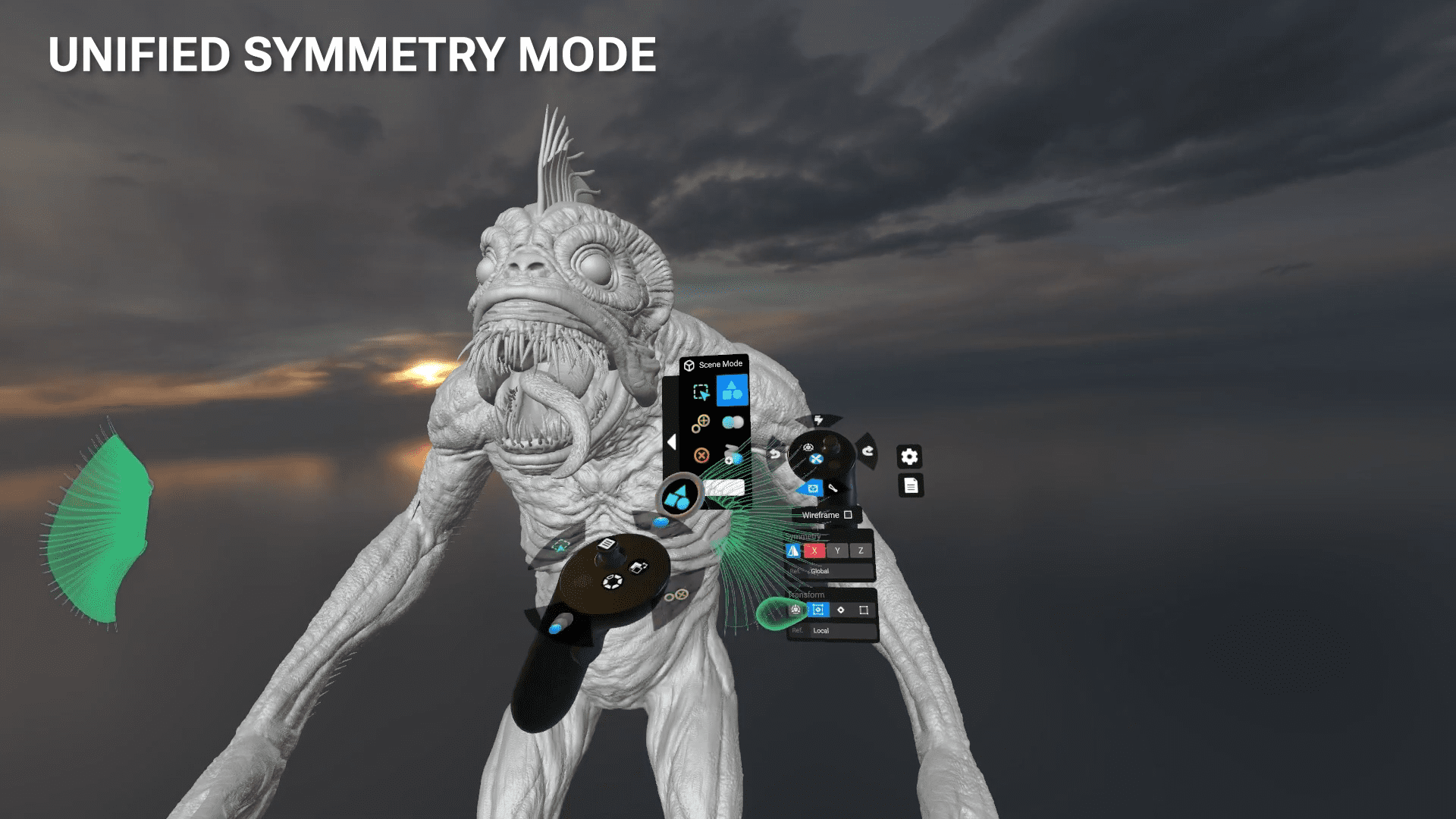
Shapelab Max 2026 unifies symmetry operations into one coordinate reference, meaning mirrored sculpting behaves consistently across all axes and tools. Voxel remeshing has been rewritten for better speed and quality, though Leopoly has not disclosed specific algorithmic changes. The hybrid engine still supports both voxel and polygon workflows, so artists can sculpt freely between detail stages.
Workflow and modelling tools
Brushes include Clay, Standard, Mask, Crease, Smooth, Pinch, Inflate, Snakehook, Flatten, Trim, Regularise and 3D Stamp. Multiresolution sculpting and dynamic tessellation support high-detail workflows. Remeshing and topology tools cover subdivide, decimate, regularise, mirror, weld, fill holes, merge vertices and quad remesh. The workspace can be customised with HDRI environments, ambient lighting and floor visibility toggles. Built-in and user-defined primitives simplify kitbashing and prototyping. Grid and angle snapping, constraints, grouping, cloning and boolean operations aid accurate layout. Scene hierarchy management now allows multiselect and grouping for cleaner scene organisation.
VR and interface upgrades
VR interaction receives controller haptics for interface feedback and adjustable viewport momentum for smoother navigation. Pen and tablet users gain tilt, twist and pressure support via both Wintab and Windows Ink drivers. Vertex painting now supports PBR parameters such as colour, roughness, metalness and emission. Texture export options include normal maps and vertex colours. Materials include PBR and MatCap shading for real-time visualisation. Import and export formats cover FBX, OBJ, GLB and STL. Project scenes are saved in the SL3D format, preserving geometry and shading data.
Platform, pricing and compatibility
Shapelab Max 2026 runs on Windows 10 or later and supports tethered PCVR systems including HTC Vive, Valve Index, Oculus Rift, Quest (via Link) and Windows Mixed Reality. Licences cost 69.99 US dollars for perpetual use or 49.99 US dollars per year by subscription. The price marks a five-dollar increase over the 2025 version. Some bundle offers include standalone Quest editions until early 2026.
Studios should test Shapelab Max 2026 on in-house hardware before adopting it in production.
