



Epic Games has published Automotive Substrate Materials as a free download on Fab. The pack is built entirely on Substrate and is positioned as a production-ready material foundation for automotive visualization, with the explicit goal of delivering consistent results across Lumen and Path Tracing workflows. In practical terms: it is a big, curated library meant to reduce the amount of time artists spend reinventing “car paint, but again” in every new project.
Compatibility is spelled out, too: the materials are compatible with Unreal Engine 5.7.3 and later. If your studio is still emotionally attached to an older engine branch, this pack is not going to negotiate with you.
What is inside the pack
Epic’s own breakdown is specific, which is always a good sign on a Monday (We prefer small words in the Mornings, and even smaller words and easy, short sentences on a Monday Morning.). Automotive Substrate Materials includes 280 automotive-focused materials covering common vehicle material types. It also includes 150 material setup assets and roughly 50 reusable material templates (Fab’s listing calls this 47 templates).
On top of the materials themselves, there are two maps meant to serve as reference and validation spaces: a “zoo-style” overview map organised by material type, plus a calibrated look-development map built for high-quality automotive rendering.

The pack is not just a dump of nodes and textures. Epic frames it as a ground-truth reference for game development as well, meaning you can use it as a baseline for physically plausible values and repeatable results, even if the end product is not a configurator shot of a hyper-polished BMW coupe turning slowly in a void, without any other cars, which is the preferred state of being for BMW drivers. Otherwise, I can’t explain their behaviour on the streets.
Why Substrate matters here
Substrate is Unreal Engine’s newer material framework, designed to support more modular and expressive material authoring than the older fixed shading model approach. In this pack, Epic leans on that flexibility to cover surface and layering behaviour that was described as difficult or impractical with previous material systems. The examples are the usual automotive suspects, but done with the kind of detail that tends to break “generic” shaders: multi-coat car paints (single-, dual-, and triple-coat), waxed leathers, and advanced translucent materials with renderer-specific behaviour. (Indicators, which is useless if you render BMWs, but useful for all other cars.)
Epic also calls out complex surface responses, including glints and coloured glints, thin-film interference, anisotropy, perforation with masking, plus controlled imperfections such as fingerprints and scratches. There are also production-friendly controls for colour (tint and HSV) and map-driven parameters such as roughness and specular, alongside flexible mapping options, including UV and triplanar workflows. That is a long list, but the short version is: the pack is built to survive close-ups and does not assume your camera will politely stay far away. And this time, we are avoiding the BMW-in-the-rearview-mirror-joke.
One detail that will matter for pipeline sanity is that Epic says the materials are built on a shared library of reusable material functions encapsulating common behaviours such as base colour handling, roughness and specular control, triplanar projection, imperfections, anisotropy, emissive behaviour, and perforation. That modular architecture is presented as a way to keep results consistent and reduce duplication, which is the unglamorous kind of promise that actually saves teams money. Money you could spend on a company car, like a BMW.
Measured data, Blueprint lookup, and the “trust me, it’s calibrated” problem
Epic states that material parameters are derived from lab experiments and real-world measurements, providing physically accurate defaults for automotive scenarios. For metals specifically, measured data is exposed through a Blueprint lookup tool intended to help teams select and compare metal presets while keeping values consistent across a project.
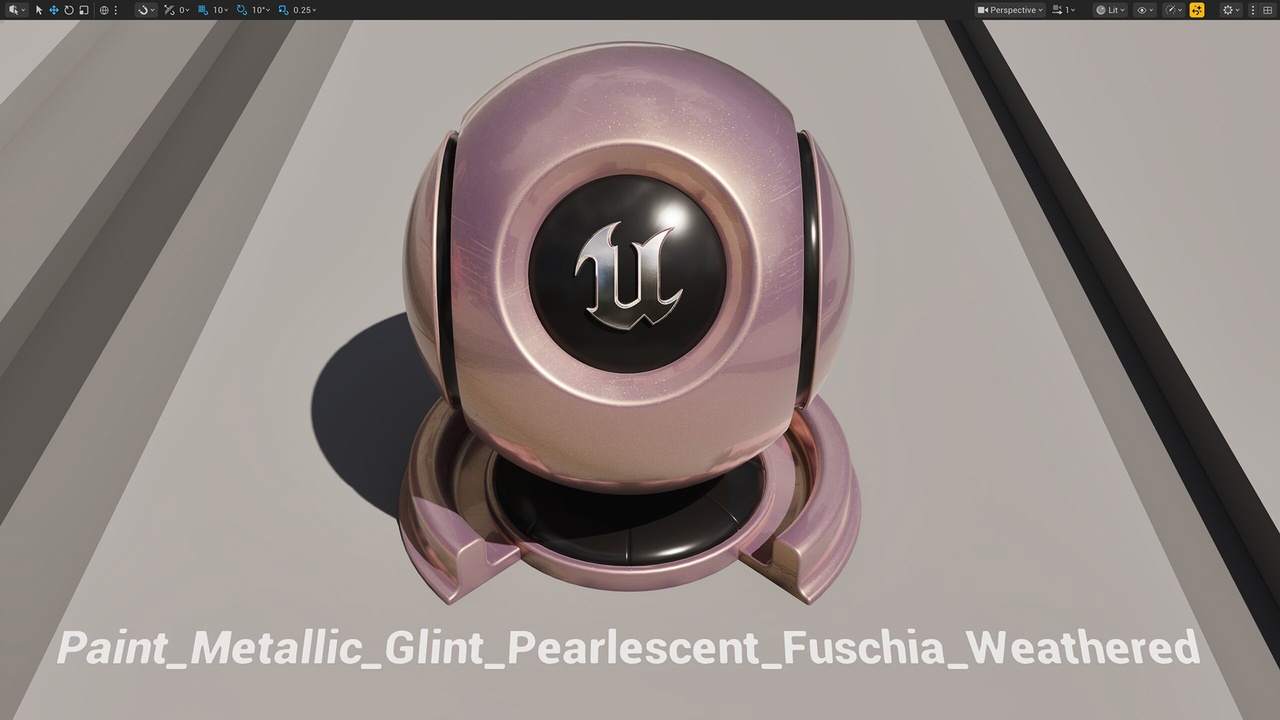
The calibration story continues on the environment side: Epic says the lighting in the look development map has been cross-checked using luminance and colour temperature meters, along with photogrammetry-based measurements, and calibrated for both Lumen and the Path Tracer. The stated intent is that you can use the map as a reproducible validation environment for automotive visualisation and game development.
This is the quiet subtext of the whole release: the pack is not only “free materials” but it is also Epic handing you a reference lab in project form. Your future self, debugging why a clear coat looks different between render modes, may send you a thank-you card. Or a passive-aggressive Jira ticket. And I’ve run out of BMW jokes.
Fab listing: Automotive Substrate Materials on Fab (Fab.com)
Additional Notes:
Uses standard texture samplers (Virtual Textures not enabled by default).
Substrate must be enabled with Adaptive GBuffer.
Separate materials provided where Lumen and Path Tracing differ.
Includes calibrated physical camera exposure based environment for validation.
Emissive values support physically accurate luminance (nits).
Decals suggest using Decal Actors.
