



This article originally appeared in DP 03 : 2016. On 16 June this year, we presented the accompanying short film as part of our Animago Afternoon series.
All people are united by mortality. This is often suppressed, and people are also very reluctant to think about the reuse of their own organs after death. The organisation “Young Heroes” advocates an individual and reflective decision on the subject of organ donation. To this end, Uhsless from Berlin produced a five-minute 3D animated film explaining the lengthy and complicated process of organ donation.
The project “Young heroes: The organ donation process” was nominated for an animago AWARD in the “Best Visualisation” category in 2015. In this category, Uhsless founder Uli Streckenbach(www.uhsless.de) is a regular on the list of award winners and nominees, as he impresses the jury with his films on important topics almost every year: Streckenbach’s graduation film “Ending Overfishing” at the University of Art and Design Halle was honoured with an animago trophy in 2012, as was “Let’s talk about soil” a year later. “Peseta” received a nomination in 2014.
The animago jury was particularly impressed by the current project’s endless transitional narrative style through the opening and closing of the 3D environments as well as the courage to tackle a complex topic such as organ donation: from the appearance of the first symptoms, the diagnosis, the anxious wait for a suitable organ to the successful transplant.
The film also shows how difficult it is to get an organ and how statistically unlikely it is to be considered as a donor in the first place. Many prominent personalities were involved in the film: The voice-over of the animated film is spoken by presenter Joko Winterscheidt, while actor Jürgen Vogel and politician Frank-Walter Steinmeier were also involved in the project.
The core team for the 3D animation film consisted of Uli Streckenbach, Robert Pohle(www.schnellebuntebilder.de) and Ronny Schmidt(www.rosch.xyz). For special tasks such as cloud shading or compositing individual scenes, the team enlisted the support of individual artists. The sound was designed by Jochen Mader from Audionerve(www.audionerve.de), the music was composed by the Berlin studio Kling Klang Klong(www.klingklangklong.com). The production time was spread over around six months, with work on other projects in between or waiting for feedback on content.
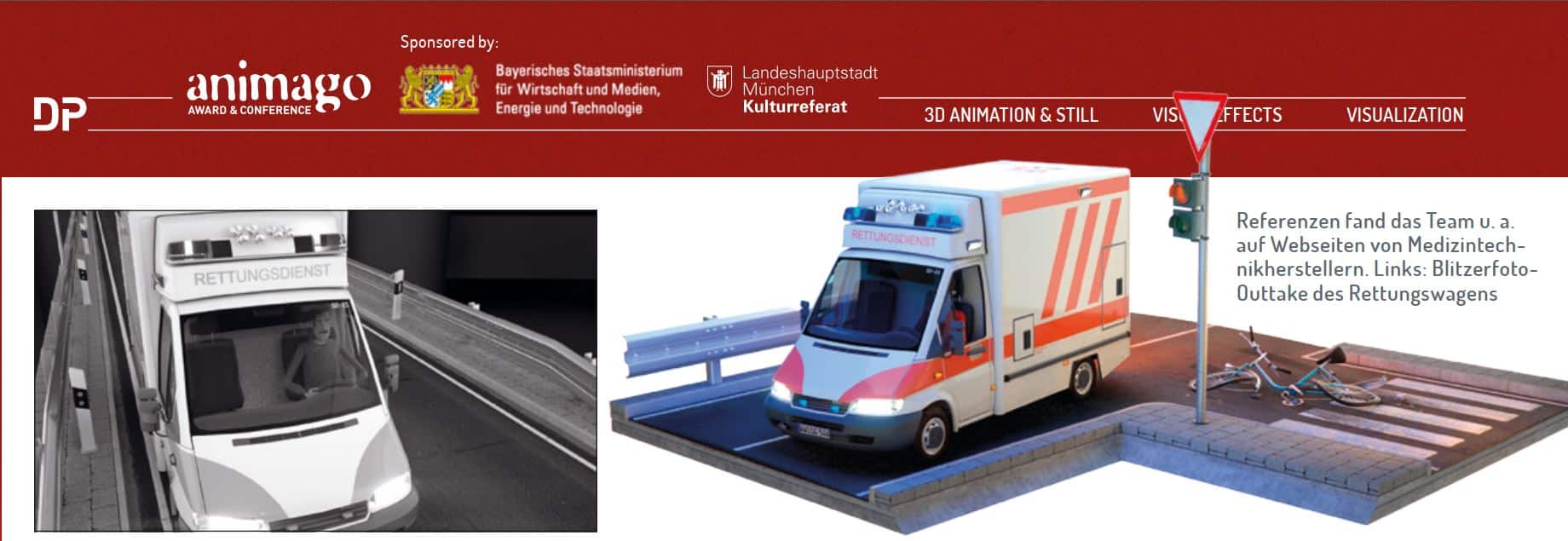
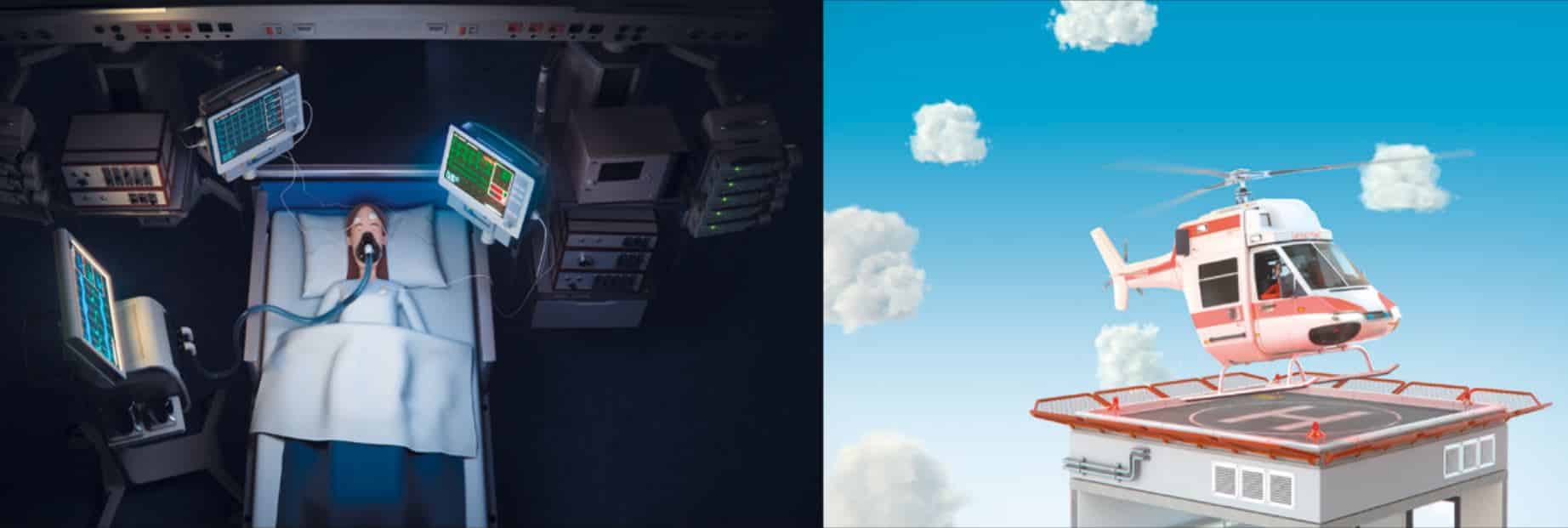
An initial draft script was provided by screenwriter Arend Remmers from Lopta Film. The team reworked this together and used it as the basis for a storyboard. While working on this, the design concept and the central design element for the film also emerged – the room that opens up for the various phases of the plot. At the same time, the first style frames were created to give the client a feel for the look of the film. The team modelled the 3D assets in Cinema 4D and used the Octane render engine for lighting and texturing. “Octane’s Live Viewer made lighting and testing different camera settings much more intuitive, as you got direct feedback from the expected end product,” recalls Uli Streckenbach. But as it was the first time the team had used Octane for a large project, there were also a few problems in the 3D process (more on this below). Medical technology manufacturer websites, hospital series and carousel vehicles served as references for the assets.
3D production
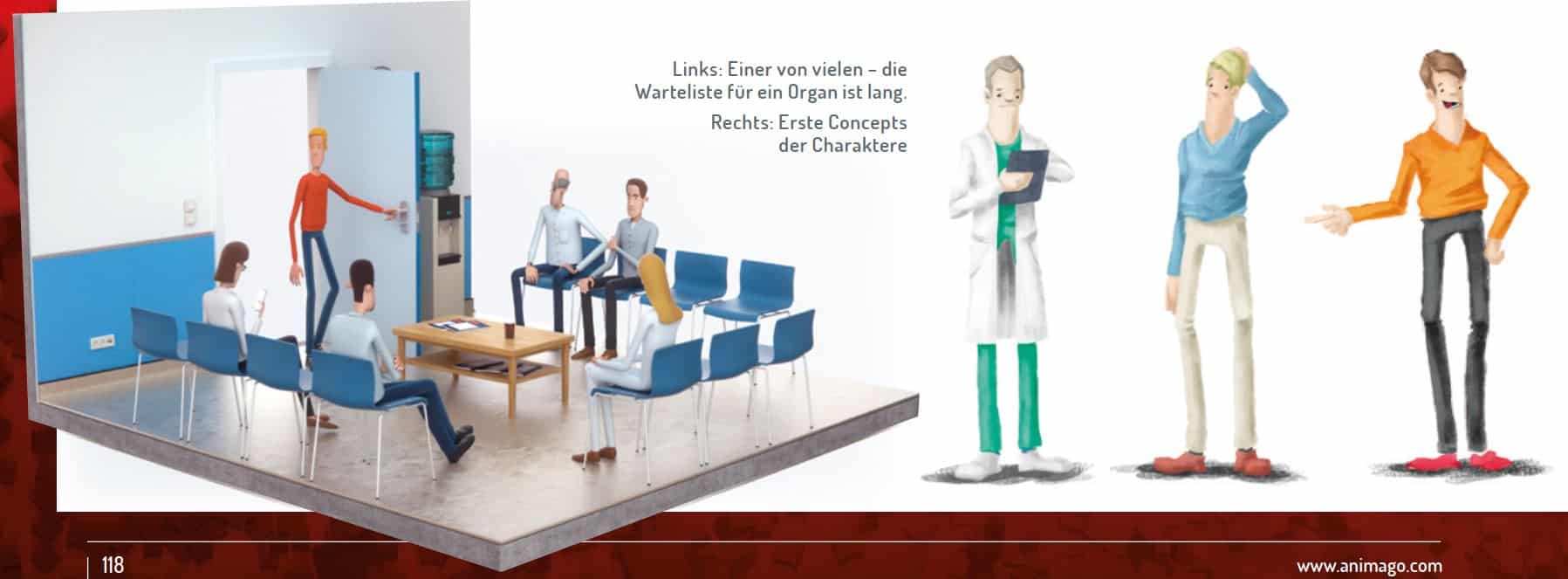
Once the storyboard and style frames had been approved, it was time for the actual production. The team created a 3D animatic and modelled the assets and characters; here too, Cinema 4D was the program of choice. The 3D artists also realised the rigging and animation with the Maxon tool, while the team used Mixamo’s online service for weighting the 3D characters, which Streckenbach is delighted with: “Mixamo did an excellent job. Simply upload the character as a .fbx file to the website and set the joint points – the rest is magic. After a short time, you can see the character running, jumping or dancing Gangnam Style in the browser window.” Getting the successful weighting into the Cinema 4D character object, on the other hand, was more difficult or fiddly. “To do this, Robert transferred the weighting for each bone weighed in Mixamo to the unweighted bones of the Cinema character – the hands in particular were an exercise for the fingers. We would also like to take this opportunity to thank David Weidemann for introducing us to this workflow. For Maya and 3ds Max, there are certainly more direct ways of transferring the rigged character from Mixamo to character tools such as Biped,” says Streckenbach. For efficient layer management, the CV Layer Comps plug-in(www.cineversity.com) for Cinema 4D was added to the pipeline.
The team used the Octane render engine for the first time for a five-minute animated film, which naturally led to some problems due to the unfamiliar workflow: Until animated textures were actually recognised as animated textures by Octane, one or two tick combinations went by. Streckenbach explains: “It is best to name the image sequence as simply as possible, for example “001.png”, “002.png”, “003.png” et cetera. Sometimes individual objects were not rendered – the doctor’s beard in particular caused problems. This was mostly a question of the correct assignment of Octane object tags.”
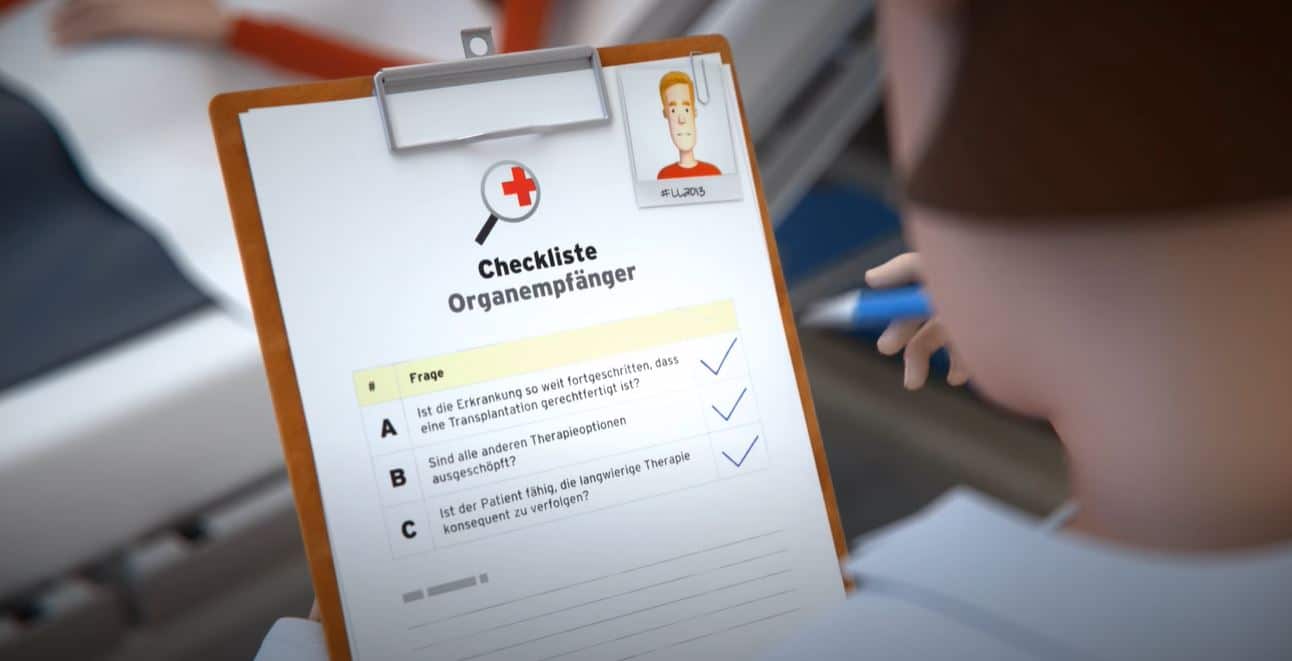
After Effects was used for compositing and editing – if you can call it that for this film – as well as for animating the screen design elements (such as ECG, EEG, centrifuge). Photoshop helped with minor colour corrections. Each of the three artists had different strengths for the project, so the team complemented each other well. “In between, Ronny taught himself Marvelous Designer(www.marvelousdesigner.com) to sew a blanket for the convalescent – which is then thrown on the floor as a thank you,” laughs Streckenbach.

Challenges
A major challenge of the project was, of course, the sensitive topic of organ donation and the factual approach to it: How do you show the topic of death and the associated grief of the relatives without becoming too striking or making the film too burdensome?
Furthermore, the explanation of the necessary requirements for a donation as well as its procedure, including the legally regulated testing mechanisms, was a sensitive point – especially in view of the various organ donation scandals in Germany. As a result, the joint development of the script with the production company Lopta Film and the client “Junge Helden” was a lengthy process. Again and again, the script had to be coordinated down to the last detail with the consultant transplant doctor Dr Warnecke. The involvement of numerous well-known personalities in the half-hour educational film naturally also had a major impact on the schedule. However, as with most projects, the biggest problem was time. But, according to the team: “We simply took our time.”
Further plans for the film
The “Young Heroes” are using the video intensively for educational work on the subject of organ donation – especially in presentations at schools. The next step for Uhsless is to produce the English version so that the clip can finally be presented to an international audience. Although there are major legal differences between the individual countries, general education on this topic is still important, regardless of the specific procedures in each country. “And if all we achieve with the film is that more people ride their bikes with helmets, we’ll be satisfied,” the team reveals.

