



Silentmaxx in Rheinbach has been developing and producing PC components for over 15 years and – as the company name suggests – has specialised in particularly low-noise, passively cooled power supply units and CPU coolers. Silentmaxx also offers a wide range of silent, passively cooled workstations, including Xeon workstations with 44 cores and Nvidia Quadro cards. The workstation we tested is based on the Kenko S-595i, which is completely passively cooled in its basic version and does not require a fan.
The silent Max was delivered for testing “true rock ‘n’ roll” style in a flight case with butterfly fasteners and ball corners, extremely well padded and packaged. This is not the normal packaging, but is only used for test devices. The graphics card was attached to a housing plate with a cable tie for transport, the large heatpipe heatsink was not specially secured.
Case
The Silentmaxx Big Tower case, like the CPU and graphics card cooler, is a product that was developed and manufactured in-house. Unlike most other tower cases, the Silentmaxx case is made of plastic, which is lighter and probably cheaper, but unfortunately does not convey the same feeling of quality and stability as aluminium, for example. There are two USB 3.0 and two USB 2 ports on the front top, along with a power and reset button. Practical if you need to quickly import data from a mobile hard drive.

The question of whether a MIDI tower wouldn’t have done as well is answered automatically after opening the housing. No, because the entire space between the first PCIe slot, where the graphics card is located, to the top of the case is filled by a huge passive CPU cooler with ten heatpipes. The passively cooled graphics card, also equipped with heatpipes and a large heat sink, sits directly underneath. Actually passively, because directly one slot below the graphics card is a plastic tray with two large, slowly rotating fans that gently fan the graphics card’s heat sinks – but unfortunately cover a PCIe x-16 slot in the process. A narrow fan is also hidden between the two blocks of the CPU heatsinks, attached to the upper cooler via a metal clip.
There are three free 5¼ slots behind the case door, one of which is already occupied by a DVD multi 22x drive, with eight completely free HDD cages/slots underneath in the case.
Equipment
Silentmaxx has equipped the workstation with an Intel i9-9900K CPU with 8 cores and 32 Gbytes of RAM memory. Unlike the i7-9700K CPU, the Intel i9-9900K installed in the Silentmaxx has hyperthreading in addition to the 8 cores, which is certainly not a disadvantage for HD video, 3D and audio applications. The GeForce RTX 2070 with 8 Gbyte is not the most powerful graphics card, but it is one that offers a good price-performance ratio. In addition, the 175 watts of power consumption of the 2070 are probably easier to cool passively than the 260 watts of the 2080 Ti.
Silentmaxx has installed an M.2 SSD module with a Tbyte capacity for mass storage and, as already mentioned, there is even a DVD-R multi drive in the 5¼ slot. In terms of interfaces, the silent Max offers everything you could possibly need for everyday use: two Gigabit LAN ports, four USB 3.0 ports, two USB 3.1 ports and two USB 2.0 ports, two Thunderbolt 2.1 ports and one USB C port, three Displayports plus one Mini Displayport and HDMI on the RTX 2070.
How quiet is “Silent”?
Is the workstation really silent when computing? Not quite, because on the one hand you could hear the fan working quietly between the two CPU heat sinks. On the other hand, the fan began to rattle audibly once the heat sinks had warmed up a little. Although the problem could be quickly resolved by moving the fan, it revealed a problem with the fastening and mechanical decoupling of the fan. The graphics card, on the other hand, cooled effectively, quietly and smoothly at around 72°C under full load.

Performance
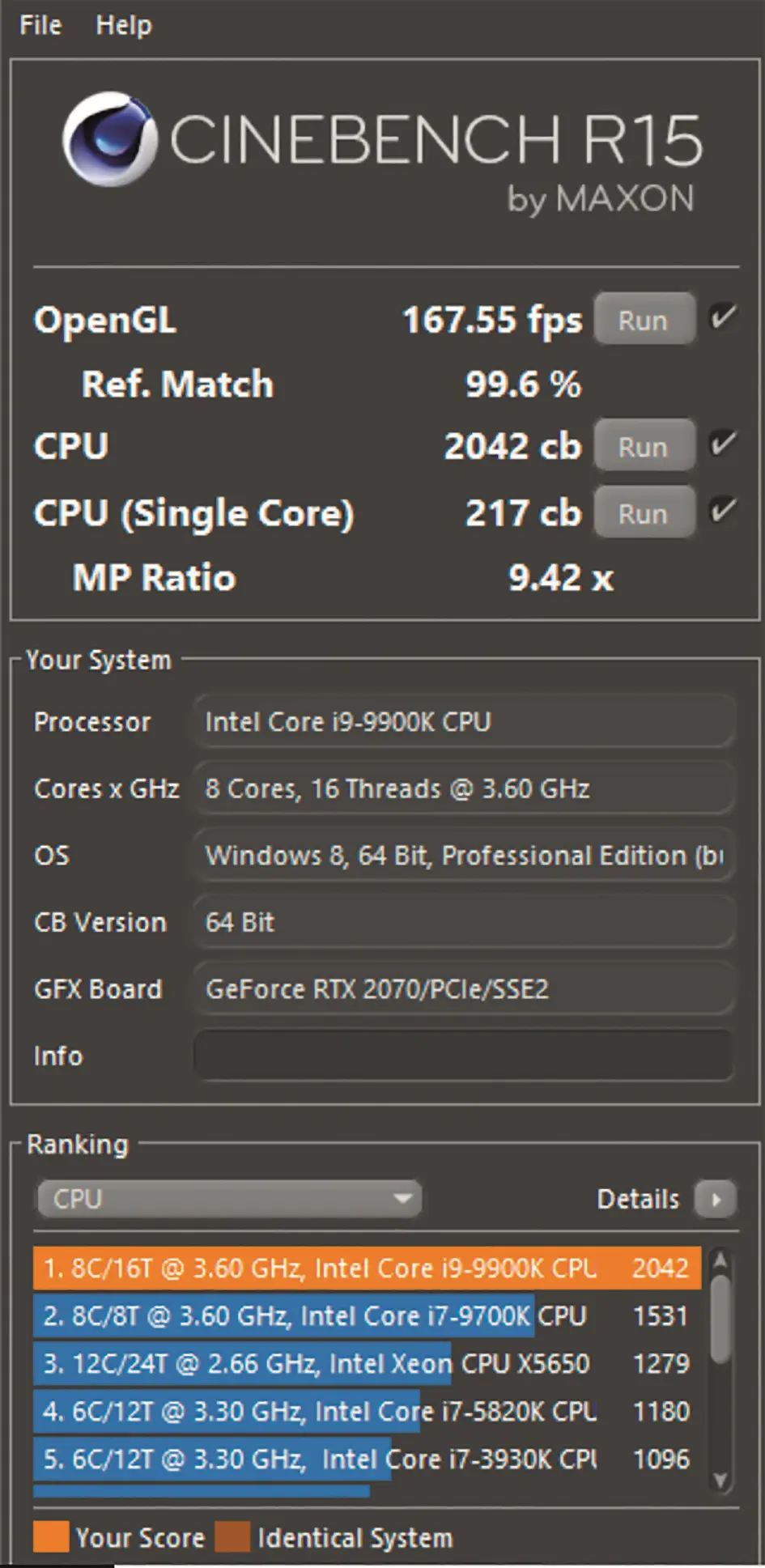
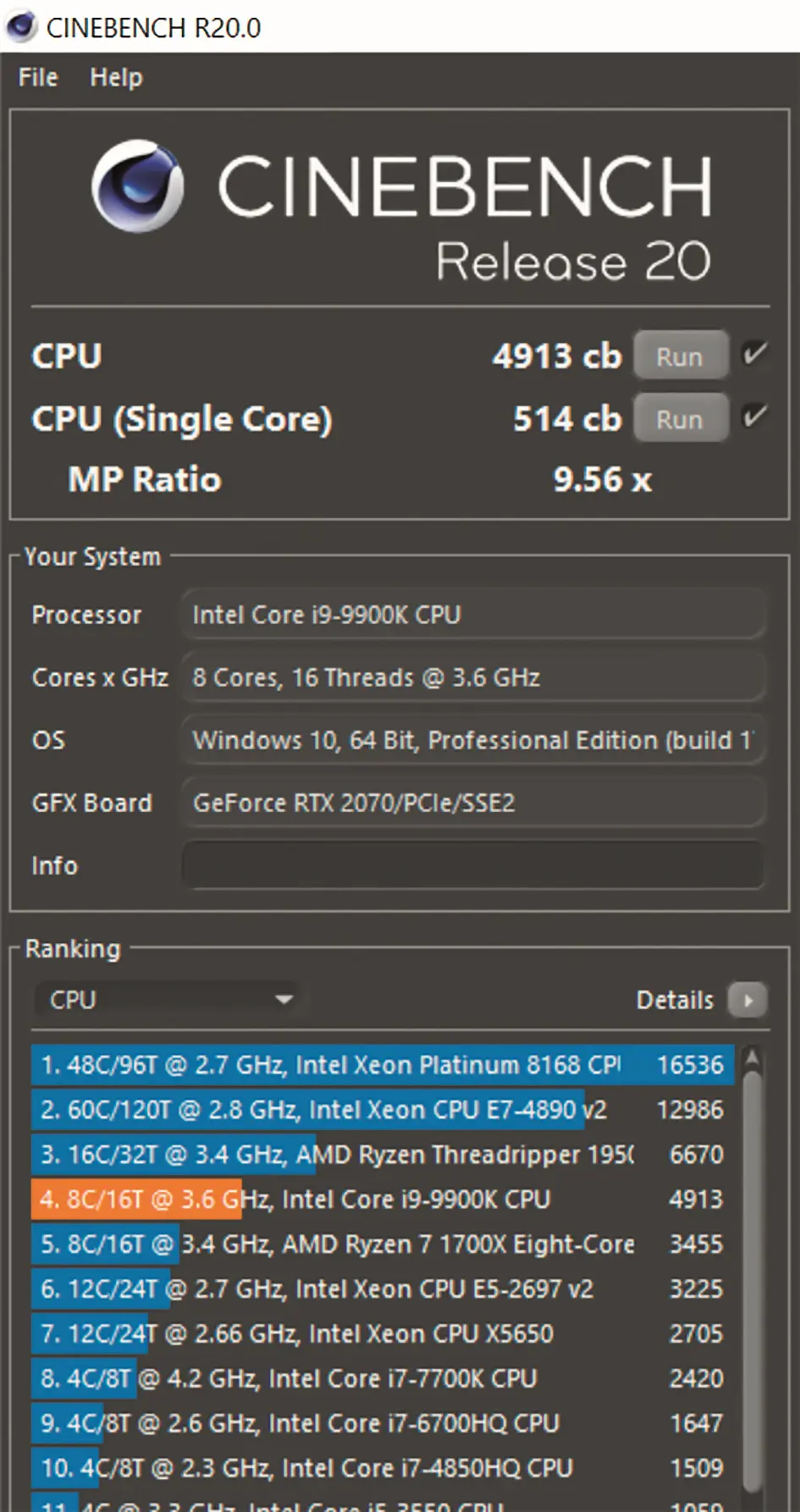
With a Cinebench 20 CPU score of 4,913 and 2,042 points in Cinebench 15, the Silentmaxx workstation took second place directly behind the significantly more expensive Xi-Machines Animate X2. The CPU was also only 3 seconds behind the Animate X2 in the V-Ray render test with 1 minute and 3 seconds. The Nvidia RTX 2070 achieved the top value of 168 frames per second in the OpenGL benchmark of Cinebench 15 and needed 1 minute and 7 seconds for the V-Ray scene.
The results of the Blender Classroom tests were interesting. In the CPU test with version 2.7, the i9-9900K of the Silentmaxx workstation was only 14 seconds slower than the Xeon CPU of the Xi-Machine at 12 minutes and 2 seconds. If the same scene was rendered with Blender 2.8, the i9-9900K was even 22 seconds faster than the Xeon W 2155 at just 8 minutes and 27 seconds. At 3 minutes and 14 seconds, the Nvidia RTX 2070 required a good 1 minute and 2 seconds more computing time than the 2080 Ti.

The one Tbyte SSD delivered the expected transfer speeds of 3,001 Mbytes per second read rate and 2,970 Mbytes per second write rate in the Aja system test. The test with HD-Tune determined a continuous transfer rate of 2,248 Mbytes per second. With these transfer speeds and capacities, many tasks from HD video and 3D to large audio projects can be realised. We measured a maximum DPC latency of 304 microseconds, which, together with the good benchmark results, indicates that Windows 10 Pro is running smoothly with the latest drivers and without disruptive utilities.

Conclusion
Admittedly, the case of the Silentmaxx workstation is not as stylish as that of the Xi-Machines Animate X2, and it is not much quieter under full load. On the other hand, it only costs about a third of the price, but still plays in the same league in terms of CPU performance. After all, the Silentmaxx Worksation was the second fastest computer in the test field, but at 3,110 euros it was the second cheapest. If you can do without the stylish casing and additional security provided by Enterprise Edition components, the Silentmaxx is a powerful, well-configured workstation that offers excellent value for money.
