With its animated musical “More Stuff”, Blue Zoo from London got to the heart of the true spirit of Christmas last year. This year, the studio submitted the short film to the animago AWARD. Here, Blue Zoo explains how the project with the singing and dancing elves came about and how Brexit could affect the studio’s day-to-day work.
The British team specialises in the animation of CG characters for broadcast, advertising, VR and mobile games. The name Blue Zoo was chosen for the animation studio, which was founded in 2000, primarily because it is easy to remember. An animation reference was deliberately omitted from the name to make it more SEO-friendly. The entire team consists of 120 artists, the majority of whom work on TV series projects; around 15 people are involved in commercial commissions and VR and app development.
Blue Zoo likes to hire people from all over Europe, which may become more difficult in the future once Brexit is finalised. The team is waiting to see whether there will actually be restrictions on the recruitment of international staff. The fall in the pound sterling exchange rate is currently at least resulting in more orders from countries outside the UK, which the team sees as a big plus.
Blue Zoo’s biggest project to date, which has just been completed, was the children’s TV series “Digby Dragon”. The commission consisted of 52 episodes, each 11 minutes long. With “Digby Dragon”, Blue Zoo set itself the goal of raising the quality of animation content for the pre-school age target group to a new level.

More stuff!
Why do children look forward to Christmas in particular every year? Because that’s when they get the most presents! In “More Stuff”, Blue Zoo takes an ironic look at the capitalist realisation of the once fundamental Christian idea.
The project was launched when Blue Zoo commissioned a song for an animated musical as part of its in-house short film programme. Blue Zoo has worked for many years with Ben Champion(www.benchampion.co.uk), who in addition to being a qualified composer also works as a musical comedian, on the music for children’s TV shows – so he was the perfect choice for the job of writing the song for an animated musical that doesn’t take itself too seriously. Ben composed and wrote the song “More Stuff” in just a few weeks. Everyone in the studio was then invited to develop a visual design for the song and direct the animation.

Shortly before the end
Animators Simone Giampaolo and Joe Kinch only came up with the idea of the cheeky elf characters shortly before the end of the pitching phase, so they were only able to present a few quick sketches to the team in advance. Nonetheless, they won the most votes in the studio’s internal voting, after which they got straight to work on the actual production due to the tight schedule. The animatic created was also approved in less than a week, as decisions had to be made quickly in view of the tight December deadline.
The film, which is just over two minutes long, was completed in around 8 weeks, with the core team consisting of 8 artists. So that as many employees as possible could share in the experience of the project, numerous artists also created just one 3D model, animated a few shots or realised the compositing of a sequence.
Special elves
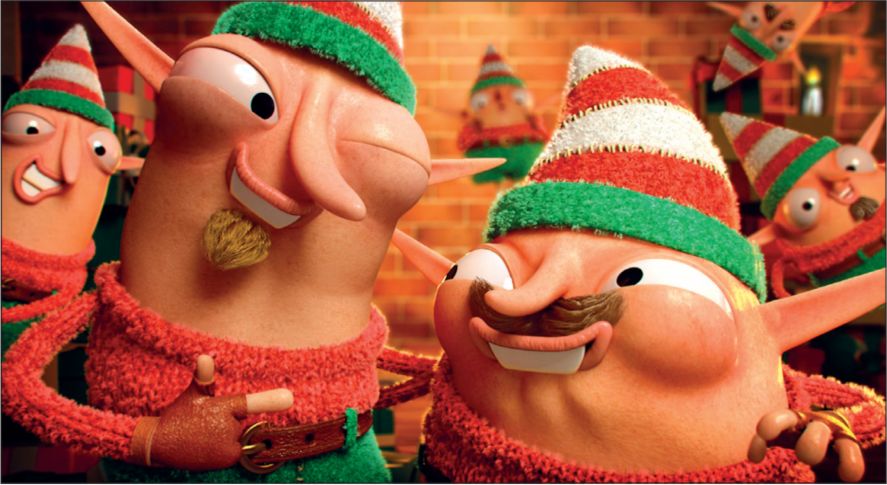
The design of the characters was crucial for the successful realisation of the film, as all other aspects of the film had to be developed on this basis.
There are already countless examples of singing elves in the world of animated films, but something special had to be created for “More Stuff”. Creating stereotypical elves with a high recognition value that are also unique was a major challenge. The team solved this problem by giving the elves huge eyes, which gave the animators many design options and gave the characters a fresh look. Three different elves were modelled in ZBrush for the entire film, which were then imported into Maya. The characters went through several iterations until the look was as close as possible to the 2D designs.
It has to be snappy
The animation style for the elves was inspired by two masters of animated comedy: Tex Avery (Bugs Bunny) and Genndy Tartakovsky (Dexter’s Laboratory, Hotel Transylvania). The team’s goal was to push the limits of CG rigs to achieve the fluid and snappy movements typical of traditional animation: To achieve this, the team utilised blurred frames, exaggerated deformations, squash & stretch and strong poses.
However, the high flexibility of the rigs was not enough for the animators, so they added lattices for greater deformation possibilities. During the animation process, the team often used the Maya plugin TweenMachine(justinsbarrett.com/tweenmachine).
Environments
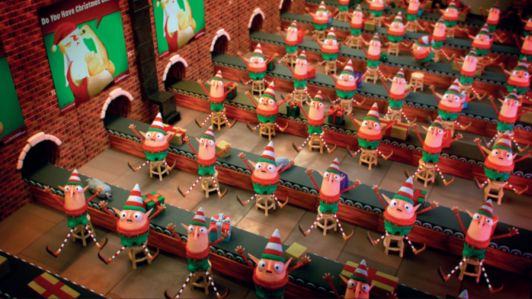
The film’s 3D environments were intended to convey a large scale – but as there was no time to build elaborate 3D assets, the artists projected environment paintings onto 3D geometry. The team reused many of the assets, in particular the gift piles and the tiled floor and wall textures.
GPU rendering
The look of the animations needed to convey a real, tangible feel, which traditionally can only be achieved through higher render times. However, the project schedule did not allow for this, so Blue Zoo utilised the Maya plug-in of the Redshift render engine to take advantage of GPU rendering to achieve the highest possible quality in the shortest possible render time. Compared to conventional CPU render engines, Redshift ran 5 to 10 times faster. As the renderings could be seen much more quickly, the artists were able to experiment more with the shaders and achieve a nice look in a short period of time. Apart from Redshift, the regular studio tools were used for look development, lighting and hair.
Scripts and bugs
Before the project started, the team wrote tools to speed up the animation and rendering pipeline. This allowed the animators to work with light rigs, after which the scripts automatically copied all attributes to the heavier render rigs and optimised them at the same time. This allowed the artists to work with lightweight files that could be rendered quickly but still contained a lot of detail. At the same time, this approach prevented many potential problems associated with different file referencing.
Halfway through production, the team encountered a tricky bug that caused renderings to crash and appeared to occur randomly. An upgrade of Redshift on the render farm fixed the problem, but other productions needed the older version to run smoothly. The Blue Zoo pipeline team managed to separate the projects so that each production could use the appropriate version of Redshift. In order to realise the project in a very short time, a solid but flexible pipeline was extremely important.
More Christmas stuff
Blue Zoo is currently working on the realisation of another festive short film that picks up at the end of the story of “More Stuff” but comes with a twist. Blue Zoo plans to release the new film in December (the film was not yet online at the time of going to press, just take a look at vimeo.com/bluezoo ).