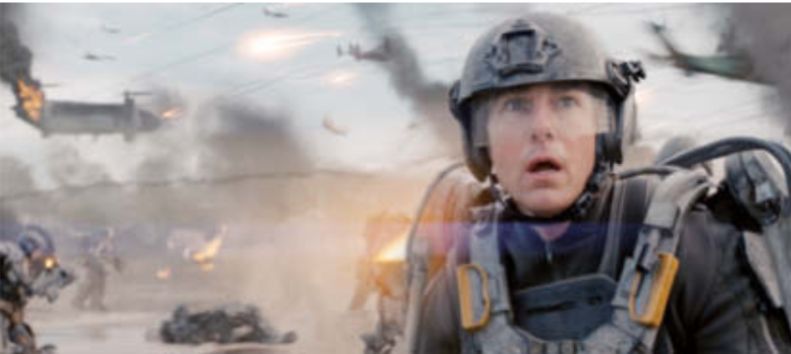
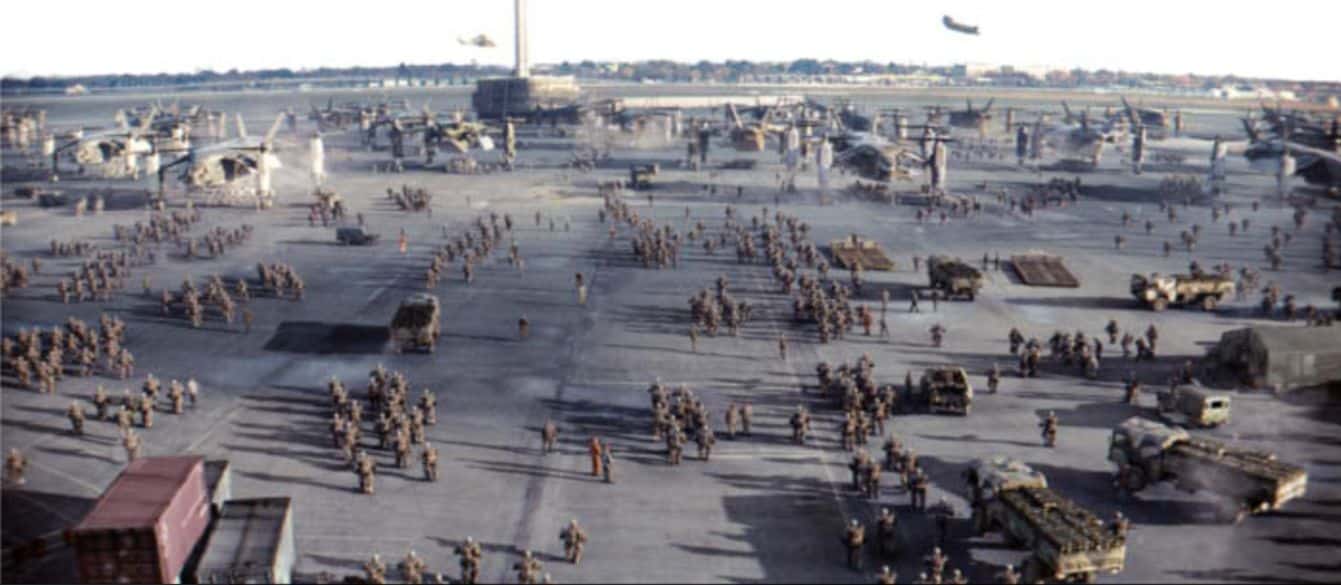
After looking at Framestore Canada in issue O2/14 , this time we take a look at London. This is where the effects for the alien time-travelling shooter “Edge of Tomorrow”, in which Tom Cruise often dies, were produced. We spoke to Isabell Mayrhofer, VFX Production Coordinator and SAE graduate, about her career, training and how she applies what she has learnt today.
Studio Framestore, founded in 1986, is located near the famous Oxford Street in London. To this day, there are few major films in which Framestore is not at least partially involved. From “Avatar” to “Harry Potter” and “James Bond” to “X-Men” – plus Oscars for “The Golden Compass” and most recently “Gravity” as well as nominations for “Dark Knight” and “Superman Returns”, BAFTAs and much more. The latest project in cinemas is “Edge of Tomorrow”, in which director Doug Liman – together with Framestore and Cinesite, SPI, Nvizible, PeanutFX and Prime Focus – has Europe annexed by aliens.
DP: Isabell, you were involved in “Edge of Tomorrow” for Framestore as VFX Production Coordinator. What were your tasks and what experiences do you take with you to “Paddington”?
Isabell Mayrhofer: I was mainly responsible for animation and FX on “Edge of Tomorrow”, but I also supervised rigging, CFX and, towards the end, stereo conversion. Compared to my previous projects, the main difference was probably the size of the team. You have to spread the work over several people to cover everything. As a coordinator, this means limiting yourself to just a few departments instead of paying attention to all of them, which was the case with “Wolfblood”, for example. This clear demarcation of tasks is in turn very helpful for “Paddington”, as I can concentrate on my area right from the start and therefore get involved in the daily tasks more quickly.
DP: Shots from Cinesite, SPI, Nvizible, PeanutFX and Prime Focus were also used in the film. How do you coordinate with the artists from the other studios and what is the best way to pass this on to your own team?
Isabell Mayrhofer: The coordination between all the different studios is the sole responsibility of the client. In the case of “Edge of Tomorrow”, this means Warner Bros. We are generally only responsible for our own shots and assets. Only in the case of direct collaboration with other studios do I have to make sure that everything goes according to plan. For example, there are certain assets, such as the aliens, that are designed and built by one studio and then made available to the other studios. But certain technical requirements also have to be met for the stereo conversion at the end to enable the subsequent conversion.
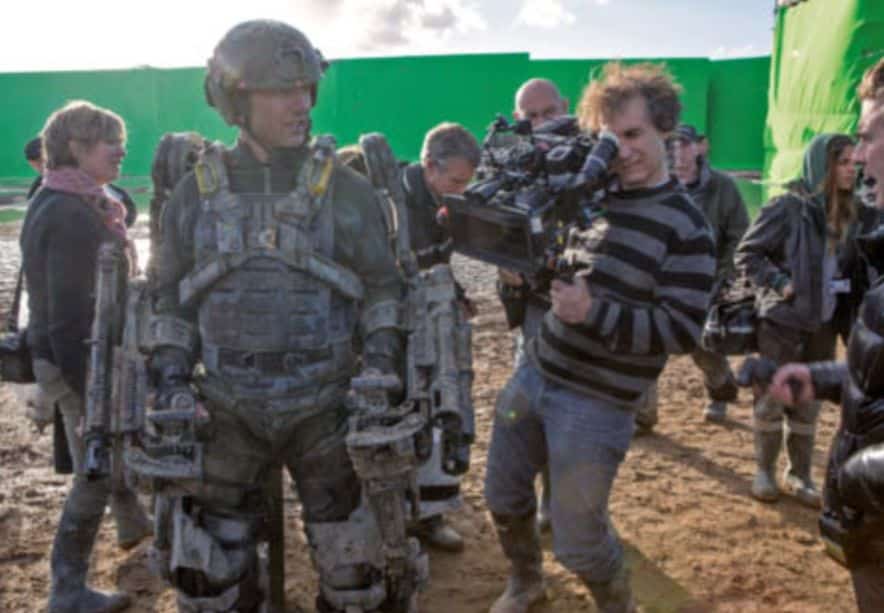
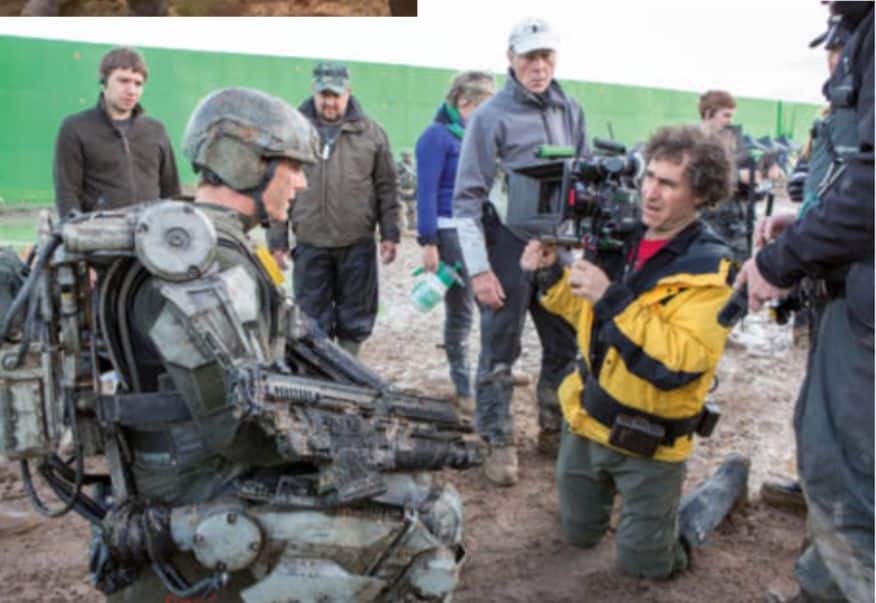
DP: What were your shots for “Edge of Tomorrow” and what were the challenges?
Isabell Mayrhofer: First of all, a little spoiler warning for anyone who hasn’t seen the film yet. Our sequences actually span the entire duration of the film. One of our biggest sequences in London was the so-called “dropship crash” scene, in which Tom Cruise and Emily Blunt drive (no, not fly) a kind of helicopter along the Champs-Élysées, chase it through the Arc de Triomphe and steer it straight into the Louvre. That was also one of the most extensive sequences, I would say. But as with any other project, the challenge lies more in getting everything up and running at the beginning. I’m thinking, for example, of Doug Liman, the director, who expressed the wish that the aliens should move in a way that had never been seen before in a creature. So, if you have any idea about animation, you will know that the main thing at the beginning is to collect templates and references. So we were a bit clueless at first. But with the help of Nick Davis, the VFX supervisor, we were finally able to impress with our animation.
DP: How big was your team and what was your workflow like?
Isabell Mayrhofer: This question is difficult to answer as the size of the team changed on an almost monthly basis, depending on the requirements at the time. Roughly speaking, I would say we had around 100 artists working on the project in London. At the same time, Framestore Montreal was also involved, and the team there was even bigger. The workflow of a standard 3D shot begins with sorting the plates (the film material) and entering all the shot-specific data into the database (camera information, cut length, etc.). From there it’s on to tracking, then layout and on to animation. Then come the CFX and FX team, who in turn pass on their work to lighting and rendering. Finally, compositing puts everything together and at the end we, the production team, send the whole thing to the customer. As a rule, many of these steps take place at the same time and production has its fingers in the pie right from the start in order to maintain a good overview of the project. Although we have usually done all of this before, it is always a challenge because new technical and artistic tasks arise each time and the customers increase their demands with each new collaboration.

DP: How many iterations did you have on average and which shot did you spend a particularly long time on?
Isabell Mayrhofer: We generally have a lot of iterations, as all departments build on each other and the versions are therefore constantly increasing. The “dropship crash” sequence described above was a particular challenge to ensure that everything finally meshed together perfectly.
DP: In your experience, how much does traditional project management and its structures need to be adapted to make it work for film projects?
Isabell Mayrhofer: Basically, I would say that the structure of film productions is very similar to traditional project management. You have a certain amount of work that has to be realised with the available resources in a given time. Of course, you need the specific expertise of film production to be able to plan the project realistically and get it off the ground, but the basis itself is the same.
DP: You work with Shotgun – what are your experiences with it?
Isabell Mayrhofer: Shotgun is great, but also challenging at times. It took me a while to get used to the structure. But I quickly realised the advantages of Shotgun and how much it can make everyday production easier. Best of all, although Framestore has an in-house Shotgun support team that is always available for questions and comments, Shotgun developers still come in person to offer further training on request, answer questions or generally give tips on day-to-day working methods. I also had a 1:1 session with one of the Shotgun employees and was able to make suggestions for improvements and discuss new ideas with him that he would like to incorporate into future updates.
DP: What other tools do you “always have with you” – and is there a tip that you think everyone should know?
Isabell Mayrhofer: We use a number of additional tools that are integrated directly into Shotgun by our developers. These are, for example, delivery tools that help us to send the finished shots to the customer. This means I don’t have to constantly switch between different programmes, but can control everything conveniently from Shotgun. In addition, programmes such as Filemaker Pro and RV (= Media Player from Tweak Software) are also part of our daily work. These can also be connected to Shotgun. For example, Filemaker files can be easily imported and Shotgun data can be exported in a Filemaker-specific way. The best tip I can give is probably this: Buy Directory Opus (= file manager). I love this thing! It makes life in production so much easier, especially if you have to deal with moving, copying or renaming files in any way. I even use it privately.

DP: What personal qualities should a coordinator have?
Isabell Mayrhofer : First of all,you should have a technical understanding of the programmes that the artists use. These are, for example, Maya, Nuke and others. You also need to understand the basic principles of film production, such as the workflow. As a Coordinator, you will work closely with the artists and the production team and should therefore have a social, open-minded but also reliable manner. A certain talent for organisation and flexibility are also needed to survive on a day-to-day basis. Ultimately, however, you need to enjoy your work, because in production in particular, you are usually the first to come into the office and the last to go home.
DP: You completed a degree at the SAE Institute – how well did that prepare you for your current tasks?
Isabell Mayrhofer: My studies at the SAE Institute helped me above all in terms of technical understanding. My knowledge of Maya, Nuke & Co. helped me progress quickly. It’s a great advantage if you know what the artists are talking about as a producer, especially when they are trying to get out of a rather awkward situation. Especially as a woman, it’s not always easy to assert yourself in the male-dominated film world. It can be an advantage to show an animator how to change the camera angle in Maya, for example. True Story. Not only is it helpful for the project in question if you can quickly help out with something without keeping other artists from their work. I’ve also won many a bet with it. Of course, you have to convey the whole thing with a certain charm so as not to scratch the ego of other – usually older – colleagues. What professional artist wants to be reprimanded by a production coordinator in their own programme? But some take it with humour and think it’s great if they can express themselves technically without immediately receiving questioning looks. Of course, my knowledge only goes up to a certain limit, but you learn something new every day and most artists are even enthusiastic when they can teach you something new.
DP: In hindsight, which courses could you have used?
Isabell Mayrhofer: A course on production itself would have been beneficial. It’s not just people like me who actually work in the field afterwards who could benefit from it. I explain far too often what the tasks of the various people in production actually are and where the differences lie. Many artists also lack an understanding of why exactly they have to carry out certain tasks within the given time frame, etcetera. Of course, it’s the same the other way round. In other words: there are far too many producers who don’t know what effort is behind all the tasks. A course could include topics such as: What is a schedule and how does it actually work? What does the daily routine in production look like? What are the tasks of a production assistant/coordinator/line producer/producer et cetera? Shortly before I went to London, I even gave such a presentation at the SAE Institute in Munich and received nothing but positive feedback. So if such an opportunity should arise again, I would definitely do it again or recommend it to others.
DP: What did you gain most from your studies and what would you recommend to prospective students who want to get the most out of their time?
Isabell Mayrhofer: Quite simply, you should try out as much as possible. There are so many different opportunities at the SAE Institute that you simply won’t get them again later in your career. It’s not easy to find exactly what you enjoy doing professionally. Especially when there are so many different career paths, as there are in the industry. Where else can you learn how to write a script, direct, hold the camera, position the lights, hold the sound bar, process the data correctly, design / model / texture / rig / animate / render a character, add effects, bring everything together in the comp, colour the picture and set the cut – only to realise at the end that the punchline is missing?
I wish I was joking, but unfortunately it’s part of our everyday lives and it happens from time to time that completely finished shots that have taken months of hard work simply don’t end up in the film.
So, where was I? Oh yes: having done everything once – that should be the attitude when you decide to study SAE. You never really go into the depths of the individual areas, but you get a good insight into everything and therefore have a better understanding of other departments, especially if they are connected as they are in the film. After all, without a story there is no filming, without filming there is no material for VFX, without rigging there is no animation et cetera. As soon as you have decided on something, the thematised knowledge comes naturally anyway. And after a short time, you’ll wish you had the variety of your studies back.