



 In nuce: In a study worth reading, the Animation Institute of the Filmakademie Baden-Württemberg reports on virtual production – and how it can be used to realise sustainable film projects. The title of the paper is “Green Screens, Green Pixels and Green Shooting”, outlining in four informative pages how modern film productions can focus on sustainability.
Research question of the study: Can VFXs be produced more sustainably thanks to new technologies? To answer this question, the authors of the study contrasted two comparable productions: A traditional offline post-production and a virtual production with an LED wall.
The initial situation: According to the study, several recent reports show how conventional film productions affect the environment. The average CO₂ requirement of current feature film productions is estimated at 2840 tonnes. However, according to the study, visual effects and their impact were not taken into account. The Animationsinstitut study is primarily based on the Screen New Deal.
Comparing two approaches: As knowledge about the sustainability of virtual productions is currently thin on the ground, the authors of the study decided to compare two different approaches to film production: A production with commercially available offline rendering and industry-standard post-production, contrasted with a production with LED walls and in-camera visual effects (ICVFX).
Object of the comparison: In order to investigate the environmental impact of a film production, two Filmakademie productions were compared with each other: the offline production “Sprout” (2019) and the virtual production “Awakening” (2021). “Awakening” was part of a set extension workshop for Film Academy students, in which students get to know the different film departments.
 Turning the focus – and the wheel of time? Will blue and green screen soon be a thing of the past in terms of production technology?
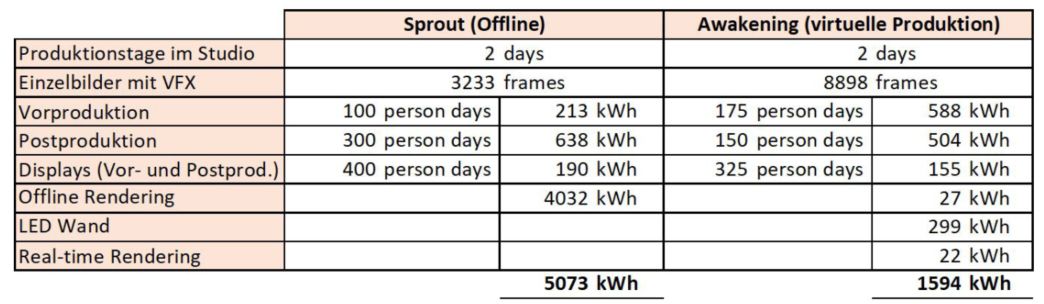
Production No. 1 – offline production “Sprout”: In this production, most of the energy consumption was used for offline rendering and post-production. Here, the traditional green screen was used in post-production. The study states: “The studio shots were realised in two days. The production comprised eight shots with a total of 3233 frames, including VFX.” It goes on to say: “The average render time was between 40 minutes and up to two hours.”
How much (wo)manpower was required for “Sprout”? The study says that the pre-production of “Sprout” took 100 man-days (eight hours per day), while the subsequent post-production was completed within 300 man-days. A person-day is made up of eight person-hours. The so-called person-hour measures the average performance of a person within one hour. A total of five students were involved in pre- and post-production.
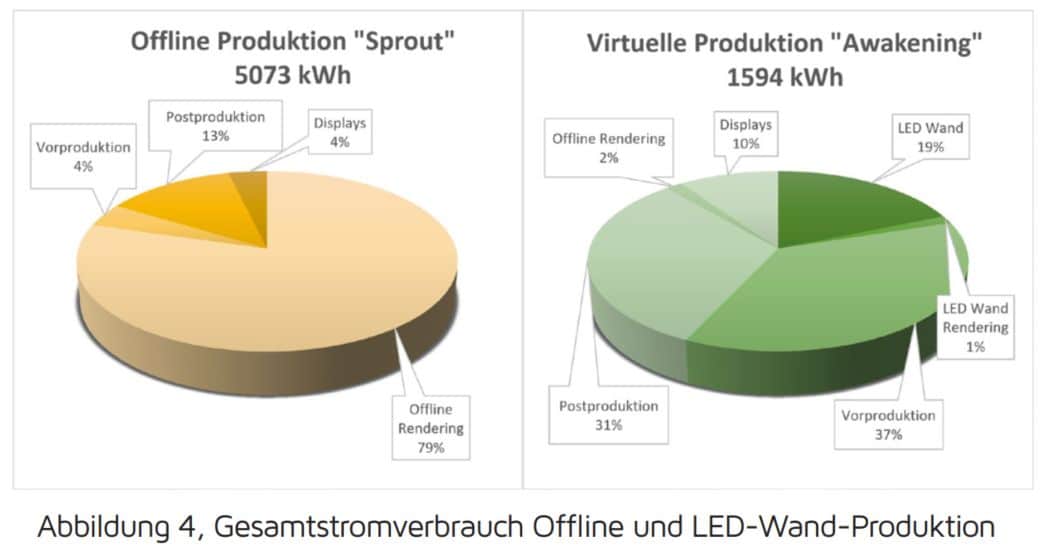
How much electricity was consumed during offline production? All in all, “Sprout” consumed a total of 5073 kilowatt hours of electricity, 4% of which came from pre-production, 13% from post-production, 79% from offline rendering and 4% from the electricity required for the displays.
Sprout (2020) | VFX Breakdown
Production No. 2 – LED wall production “Awakening”: Instead of the frequently encountered green screens, “Awakening” used curved LED walls as part of a virtual production. The authors of the study measured “Awakening” with eight shots, which totalled 8898 individual images. In terms of workload, seven students were involved in the pre-production for five weeks, and six students were responsible for the post-production for a period of five weeks.
How big was the (wo)manpower of “Awakening”? Six people were involved in post-production for five weeks, resulting in a consumption of 504 kWh. The authors point out that one might have expected a lower figure for ICVFX, as it is generally understood that in-camera visual effects are those that are recorded on set and do not subsequently require post-production.
How high was the power consumption of the LED wall production? The authors of the study estimate the total power consumption for the LED wall production at 1594 kilowatt hours, of which 37 % was used for pre-production, 31 % for post-production, 10 % for the displays, 19 % for the LED wall, 1 % for LED wall rendering and 2 % for offline rendering.
In their conclusion, the authors of the study came to the conclusion that a virtual production can consume around three times less energy than an offline rendered production. The authors therefore consider virtual production to be a sustainable and environmentally conscious production technique. However, the authors emphasise that they are not giving a clear vote in favour of virtual production, as it is “not a solution for all aspects of film production”. At the same time, however, it should be seen as a valuable option that presents environmentally friendly and sustainable solutions.
Click further: You can read the entire study in either German or English. Click on the links to find out more about the Film Academy, its animation institute and its research activities. Prospective students can find out everything they need to know about the Ludwigsburg university’s training programme in our article “Filmakademie: Auf zum Studenten-Oscar?”, printed in the print edition DP 03 : 2021.
