



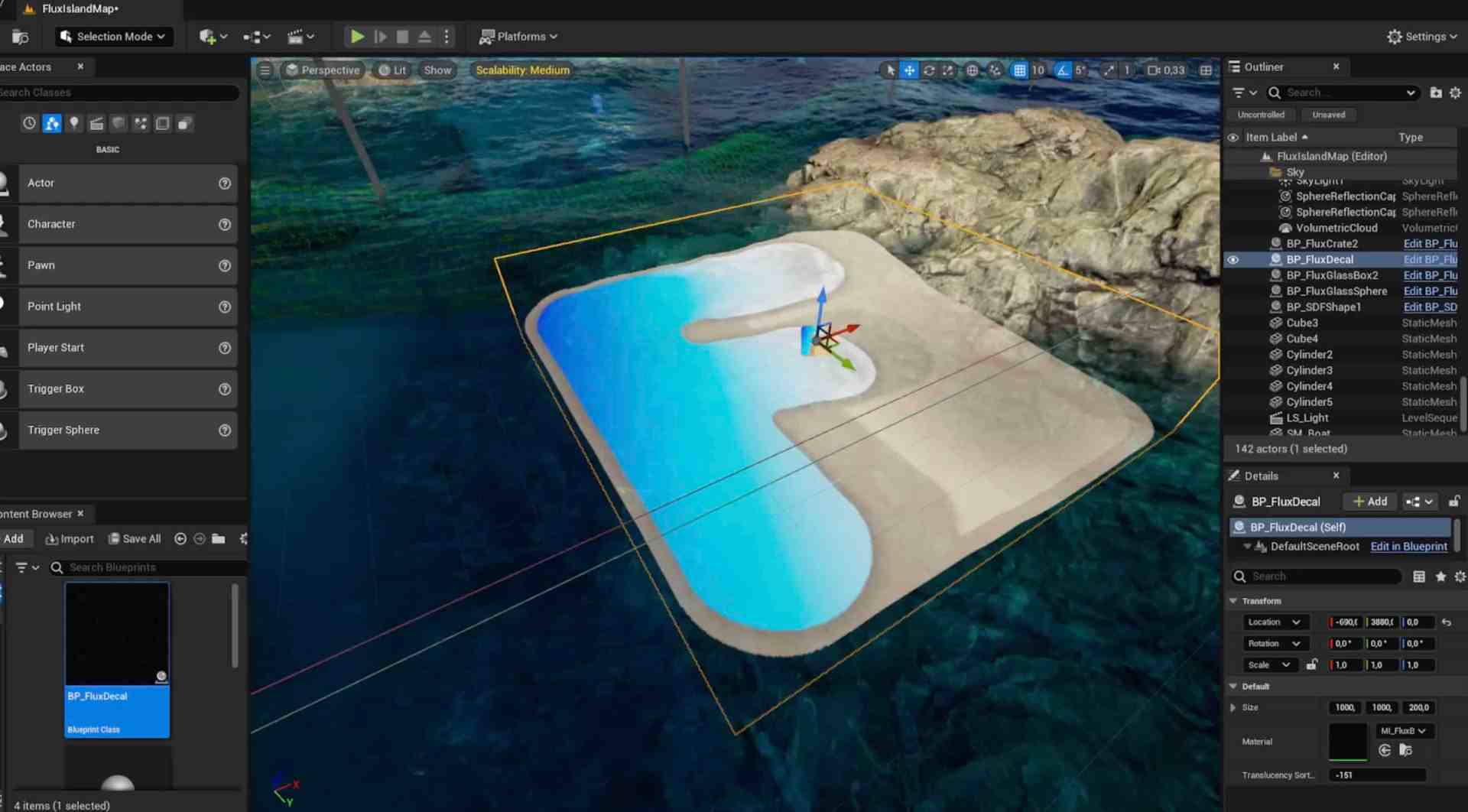
Real-time fluid dynamics for VFX artists just got an upgrade with Fluid Flux 3.0, a plugin for Unreal Engine. Designed for simulation-heavy workflows in game development, real-time rendering, and VFX production, this update brings features like glass system simulation, underwater lighting improvements, decals, rain, and more to simplify creative pipelines without sacrificing detail.
Glass Simulation and Lighting Updates
One of the standout additions in Fluid Flux 3.0 is the glass system, enabling realistic refractions and reflections. Whether designing shattered windows or curved lenses, artists can fine-tune how light interacts with transparent materials. Underwater lighting also sees significant enhancements, with support for caustics (light patterns refracted by water) and realistic attenuation effects, crucial for crafting immersive underwater scenes.

Expanding Dynamic Weather Effects
For those working on dynamic environments, the rain system delivers fluid interaction with surfaces in real-time. The droplets move naturally across uneven surfaces, adding depth to cinematic sequences or interactive gameplay. Paired with decals, users can dynamically apply and animate textures like water stains or liquid spills, further expanding the storytelling potential in virtual worlds.
Fluid Dynamics Enhancements
The fluid simulation engine remains at the core of the plugin. Fluid Flux continues to support GPU-accelerated simulations, ensuring high-performance rendering even with complex scenes. The physics system has been refined to accommodate the demands of larger-scale simulations, improving integration with Unreal Engine’s other real-time tools.

Integration and Practical Use
Fluid Flux 3.0 also introduces a range of additional features aimed at streamlining workflows and expanding creative options for Unreal Engine users. The static mesh generator has been completely rewritten as a separate editor actor tool, now leveraging the Geometry Scripts Plugin introduced in Unreal Engine 5, offering a more modular approach to mesh creation. A buoyancy editor provides a dedicated interface to preview pontoons and fine-tune buoyancy settings directly in the editor view, with real-time runtime previews to visualize adjustments instantly. Improvements to how velocity data from simulations are interpreted within Niagara particles and the surface shader offer more precise control over fluid interactions, enhancing realism in particle-based effects. A new motorboat asset expands the possibilities for interactive and dynamic scenes, while an innovative Niagara particle effect simulates raindrops interacting with water surfaces, adding depth to weather simulations. Additionally, the update introduces a curve-based waterline configuration, a completely reimagined system for defining the visual properties of waterlines, such as light refraction, transmittance, shadows, and blur effects, granting unprecedented control over fine details. Together, these tools broaden the capabilities of the plugin, making it an even more versatile solution for game developers and VFX professionals looking to push the boundaries of real-time fluid simulations.
The plugin is available now, priced at $349.99, with additional details and purchasing options on Fab.
And read the full release notes here.
