



Lighting artists, rejoice: A new online library titled Open HDRI has launched, offering 25 high-quality HDRI environments for download, all under a CC0 license. That means: free for commercial use, no attribution demands, no licensing emails, no awkward conversations with Legal.
The emerging library comes from Grzegorz Wronkowski, a photographer with more than a decade of professional HDRI experience. His work has supported visualization and VFX pipelines since 2010 through platforms such as HDRMAPS, Viz-People and HDRI-Skies, with assets also licensed to tools like KeyShot, 3DCoat, Maxwell Render and Adobe Substance. He has produced sequential, location-based environment captures for CD Projekt Red during the early production phase of The Witcher 4 and more recently signed an agreement to supply new HDRIs for Poly Haven. Open HDRI is his independent project: a growing, free library designed for 3D artists, game developers and CG generalists, free from tracking cookies and analytics, recording only anonymous download counts.
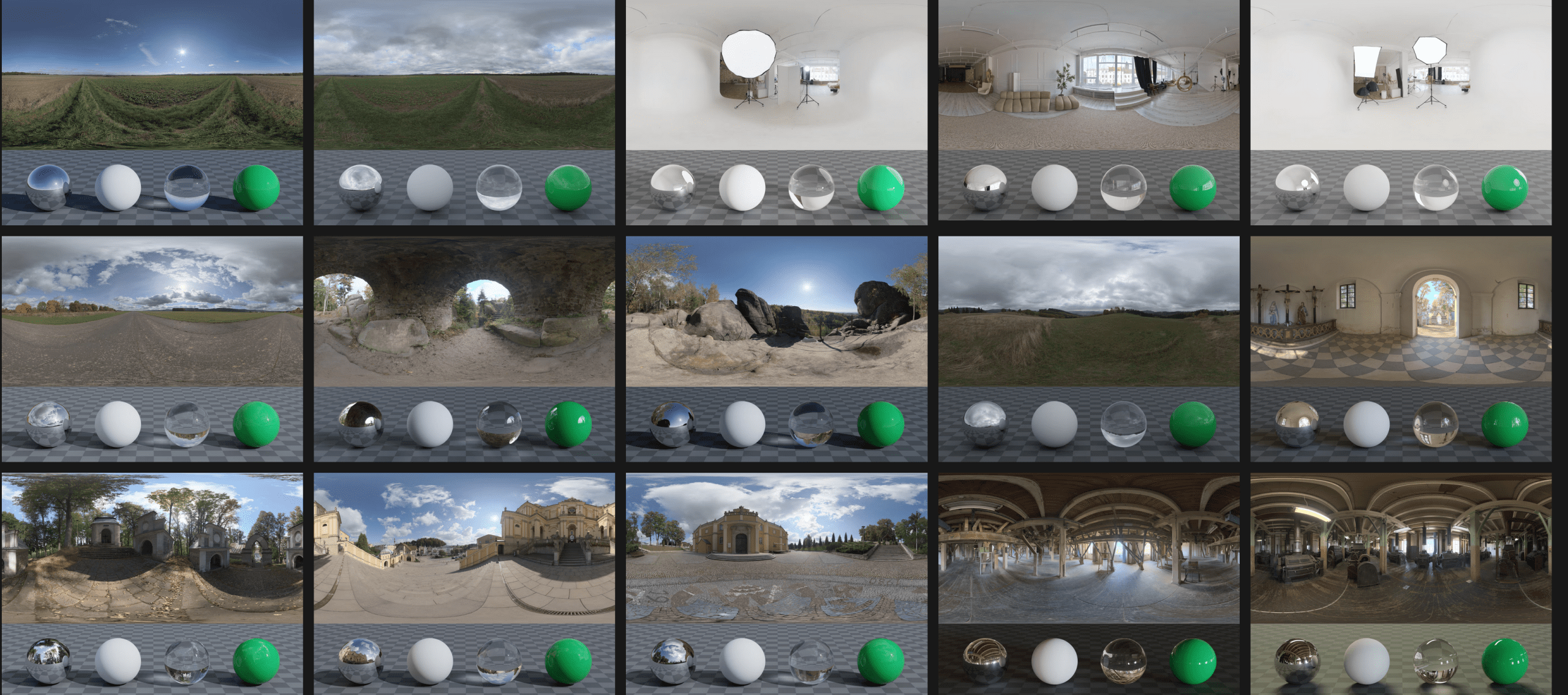
Ultra-High Resolution and High EV Range
Lower-resolution variants such as 1K, 4K or 8K are available for viewport use, but the headline feature is ultra-high resolution: select HDRIs are provided at 29,696 × 14,848 pixels, with dynamic ranges between 12 and 27 EVs. Exterior captures generally fall toward the top of that range, delivering enough latitude for realistic relighting and accurate specular behavior even in physically-based workflows. The current set covers domestic, industrial and historic interiors as well as natural and urban exteriors under varied lighting conditions.
Why This Library Belongs in Production Pipelines
The CC0 licensing makes these assets frictionless in large pipelines: they can be used in commercial productions without attribution or rights management. The availability of 29K source material enables lighting for demanding output formats such as 8K deliveries, large projection environments or virtual production LED walls. The EXR format ensures physically meaningful light information, while the diversity of capture environments gives look-dev artists a useful spread of lighting scenarios for both grounded realism and stylized work. Since the library is designed with VFX, arch-viz and real-time engines in mind, Open HDRI fits cleanly into standard pipelines including Unreal Engine and Unity.
Most productions will gladly use the lower-resolution variants for previewing and general lighting due to reduced memory load and faster interaction. However, when final pixels matter, having 29K originals ready in the library allows teams to render high-resolution reflection and lighting passes without scrambling for replacements. Storage administrators may still groan, but at least they will groan in high dynamic range.
Building a Standardized Lighting Library
Studios looking to integrate Open HDRI should approach these assets with the same rigor as any purchased library. HDRIs benefit from tagging by resolution tier, with master files archived alongside lower-resolution proxies for rendering and real-time work. EV range and environment type should be recorded for search and retrieval during look development. Teams targeting real-time engines can generate mip-maps or bake lighting probes from the HDRIs to accelerate performance. Finally, maintaining context metadata like time of day, weather condition, interior versus exterior ensures matches for continuity and scene mood. Clear organization is often what separates useful lighting assets from those that become forgotten experiments on a server share.
More to Come
The current 25 HDRIs mark only the opening phase of the project. Wronkowski intends to release 10–25 new captures each month depending on community support, with donations helping to secure travel, bandwidth and equipment costs. Free does not mean costless, especially when delivering tens of thousands of pixels across a 32-bit dynamic range.
Download
Open HDRI library: https://openhdri.org
Scroll, download, light a scene, no account required.
