



Table of Contents Show
Pixar’s RenderMan 27.0 is not a mere update: For the first time since the RIS introduction in 2014, RenderMan’s rendering core has been fundamentally rebuilt. The headline act: XPU, Pixar’s hybrid CPU+GPU architecture, now capable of producing final-frame renders. With multi-GPU support, full compositing pipelines, and feature parity with RIS in most production cases, XPU has stepped from experimental preview to the new backbone of RenderMan’s future.
According to Pixar, version 27 marks the most significant performance and interactivity leap in over a decade. The new architecture combines compute scalability with physically based consistency, while also supporting new aesthetic flexibility through a fully integrated Stylized Looks framework.

XPU: From Preview to Production
RenderMan’s XPU engine now operates as a complete production renderer, supporting both CPU and GPU resources simultaneously. This dual utilisation allows artists to push hardware to its maximum throughput, whether on workstations or render farms. The new final-frame rendering mode eliminates the former division between lookdev and production rendering, streamlining pipelines previously dependent on RIS for the last mile. XPU now supports multi-GPU rendering, with the caveat that all GPUs in use must be identical and contain full scene memory. The engine’s minimum requirement has been raised to CUDA 12.8.1, reflecting its deeper reliance on modern GPU driver capabilities. Pixar confirms that this configuration is the foundation for all future RenderMan development.
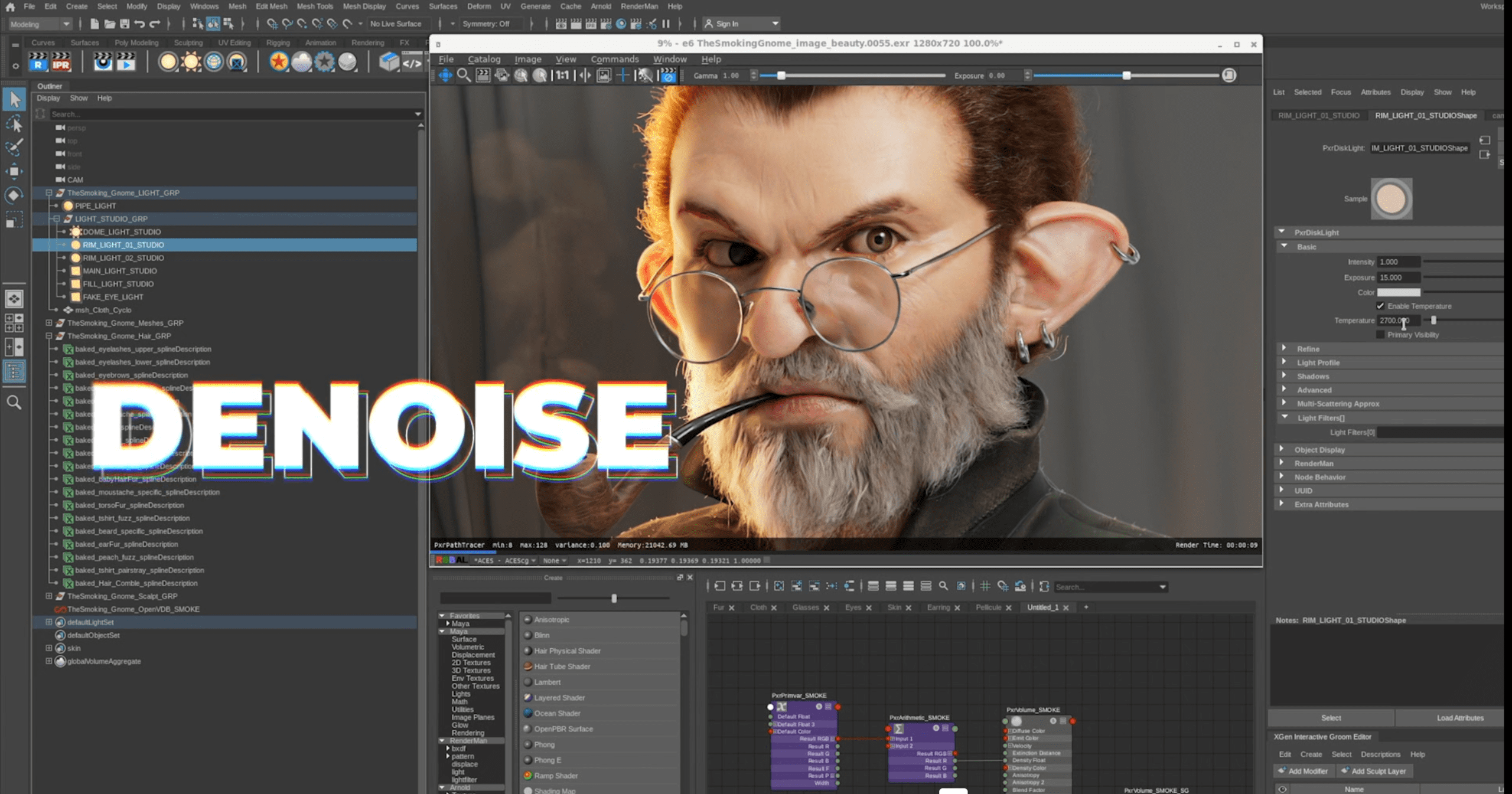
Adaptive, Smarter, Faster
Under the hood, Pixar’s engineers have reworked adaptive sampling, aligning it with internal techniques used in Pixar Animation Studios’ own productions. Adaptive metrics such as “relativepixelvariance” and “mse” AOV-based control now run per object, delivering more accurate sampling without inflating render times. Checkpointing, a feature long requested by production supervisors, has been fully implemented. Artists can now save partial renders at defined intervals, resuming from checkpoints without rerendering full frames. This system, combined with interactive denoising, significantly tightens iteration loops in look development. The denoiser itself now outputs timing data, integrates directly with live renders, and can be toggled interactively. Pipeline engineers can expect improved configurability for modern, distributed render farms.
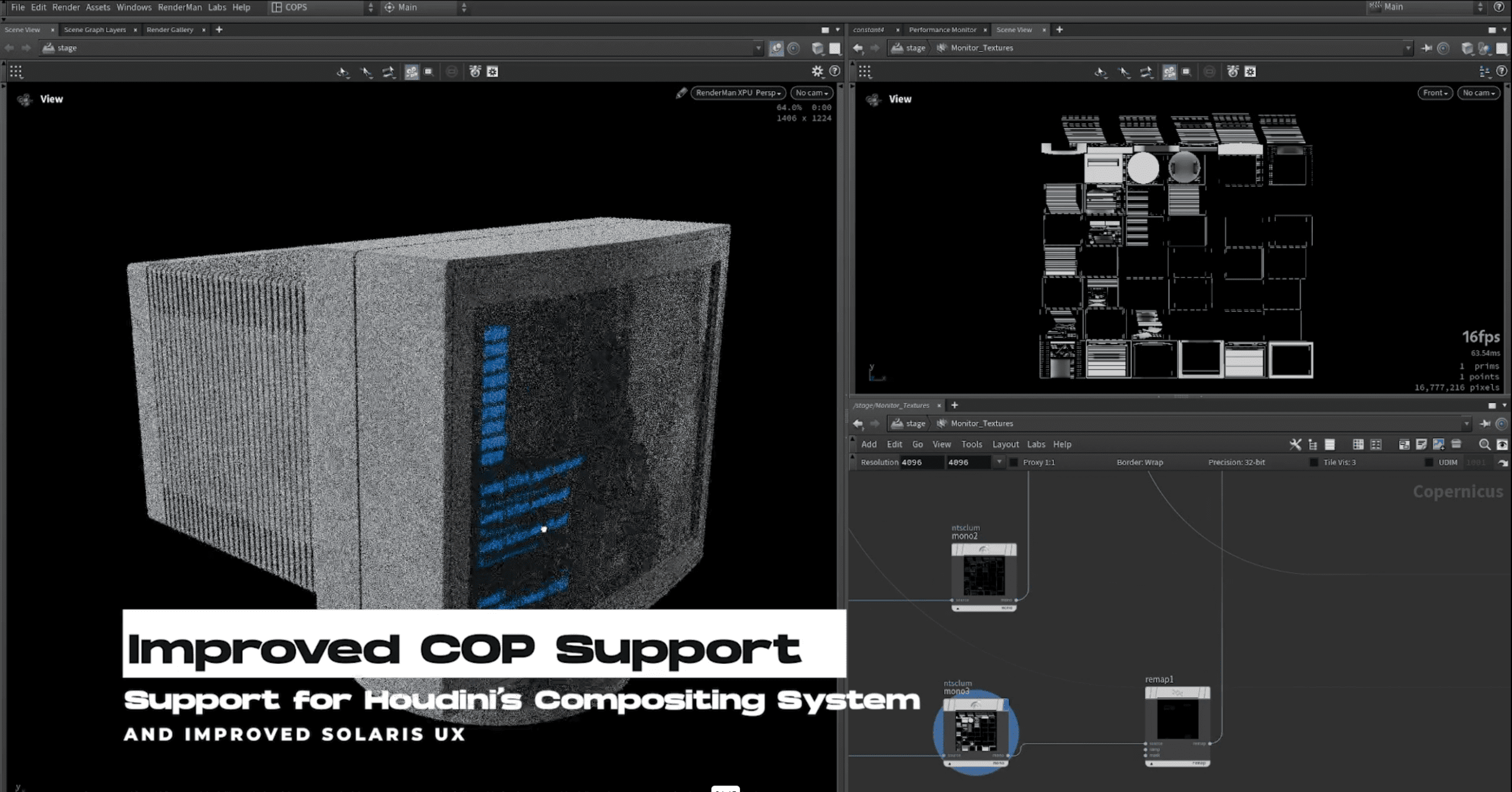
Deep Compositing and AOV Control
Version 27 brings complete deep data workflows to XPU. OpenEXR 3.0 Deep IDs are fully supported, allowing compressed ID manifests to be automatically generated for compositing. Artists can extract object-level data directly from deep renders using Pixar’s new deepidextract utility. Compositing teams gain matte and holdout workflows, expanded AOV handling, and support for the shadows and invshadows LPE prefixes. OpenEXR metadata is now written natively, ensuring compatibility with Nuke and other deep compositing tools. Cryptomatte, while not yet part of the initial 27.0 release, is scheduled to arrive in a dot update, according to Pixar’s release notes.
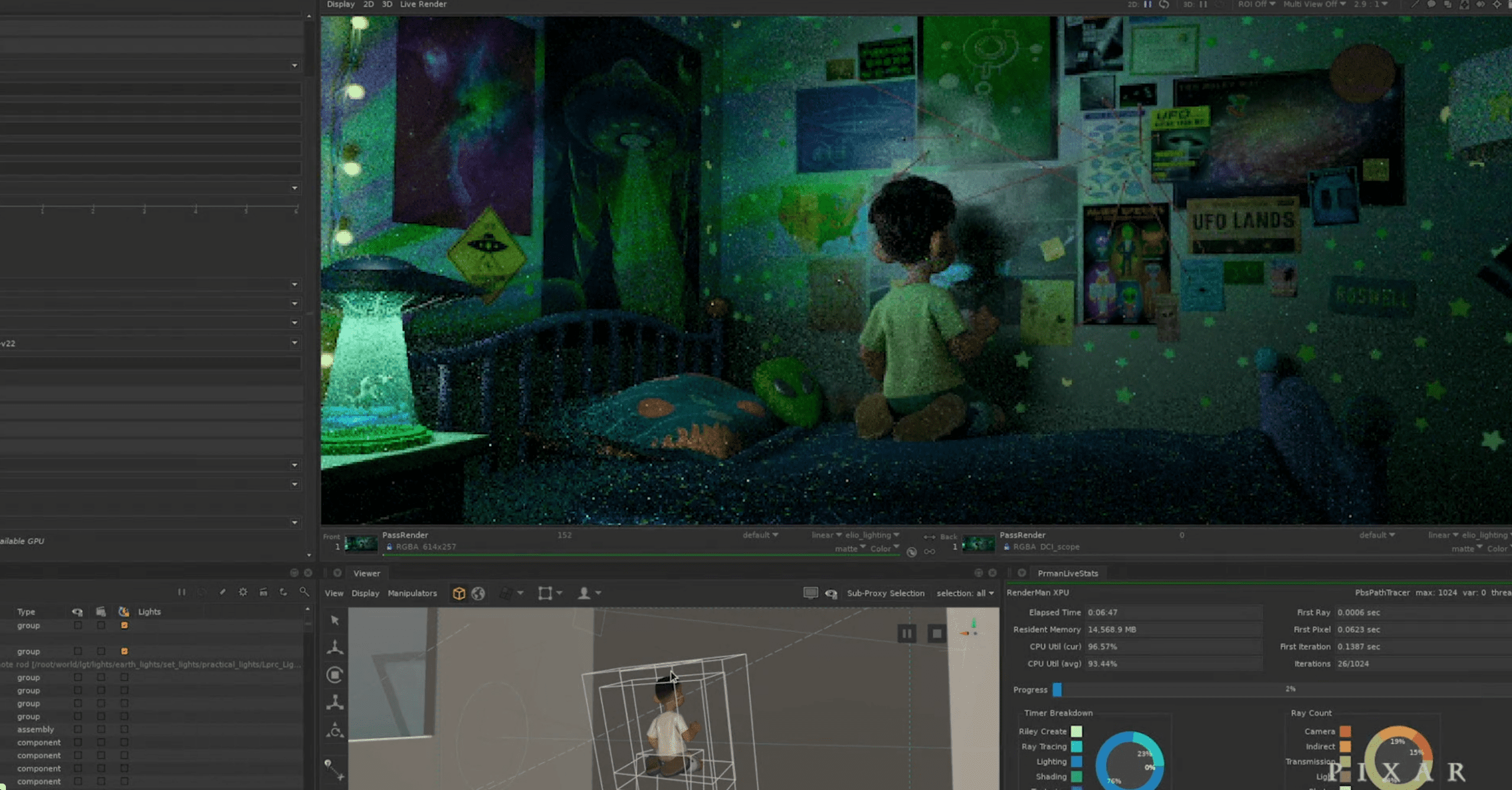
Geometry, Lighting, and Volume Precision
Geometry handling in XPU 27 has been heavily rewritten to achieve parity with RIS. Nested instancing, long a sticking point, now supports material inheritance and attribute propagation without breaking shading hierarchies. Displacement, motion blur, and volume interactions have been stabilised, with notable improvements in the handling of semi-sharp subdivision creases.

Lighting gains precision as well. Mesh lights are now fully supported, and light filters have been corrected for spline and falloff anomalies. The PxrPathTracer integrator adds new clamping controls (clampDepth and clampLuminance), aligning noise handling across both rendering architectures. Volumetric fidelity benefits from the new interior volume aggregates, enabling complex materials such as murky liquids or translucent crystals. Artists can now fine-tune deep shadow error parameters for exact compositing control.
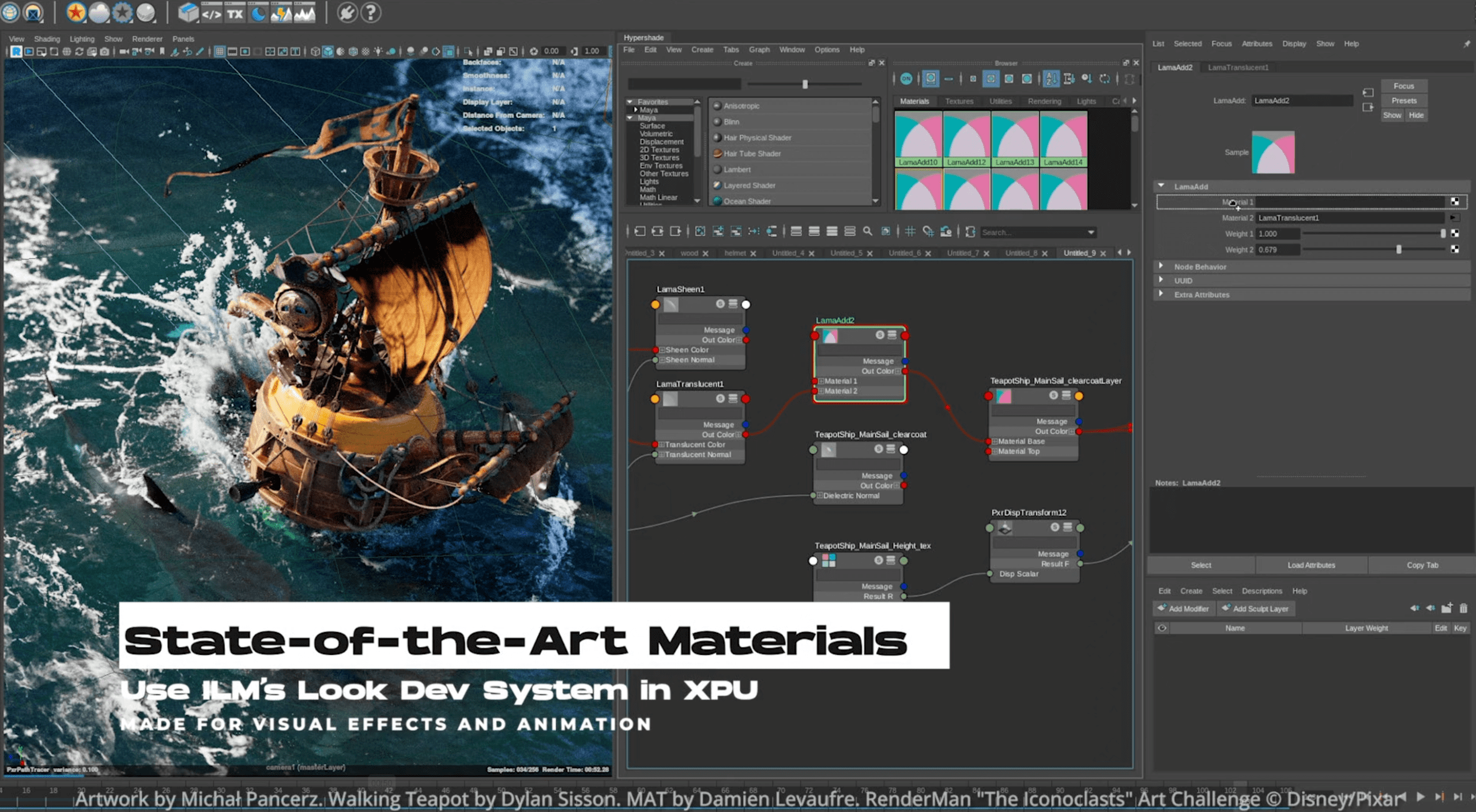
MaterialX Lama: Early Access, Serious Potential
RenderMan 27 introduces MaterialX Lama, Industrial Light & Magic’s modular shading system, as Early Access inside XPU. The system allows layered material construction using physically accurate combiners. Pixar’s current implementation supports LamaDielectric, LamaConductor, and GeneralizedSchlick nodes with anisotropy, single scattering, and extinction behaviour now properly matching or exceeding RIS accuracy. Full support is scheduled during the 27.x release cycle. Pixar notes that look differences compared to RIS are expected in this early phase and requests feedback from studios integrating Lama in production.
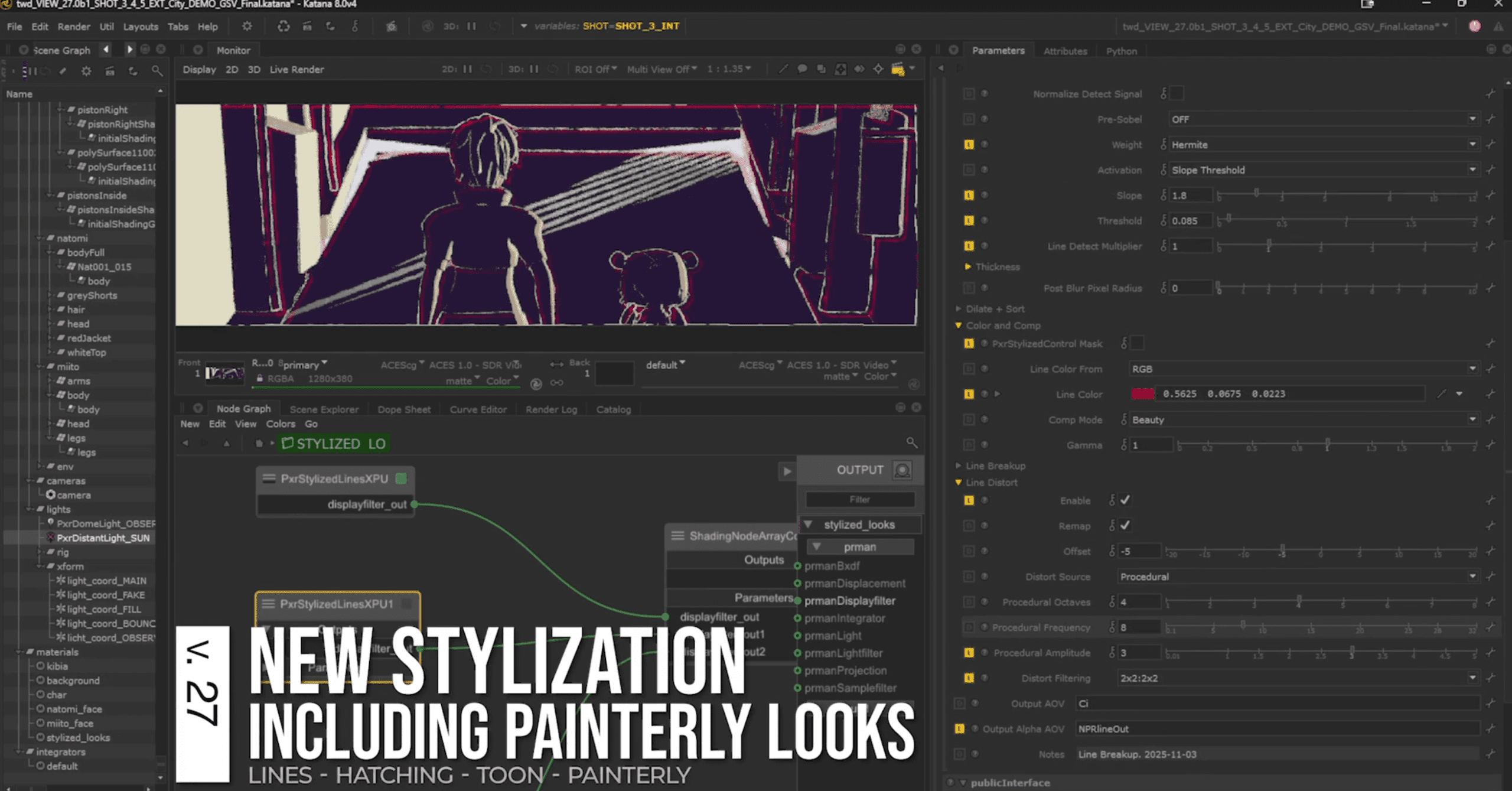
Stylised Looks: Non-Photorealism, Physically Based
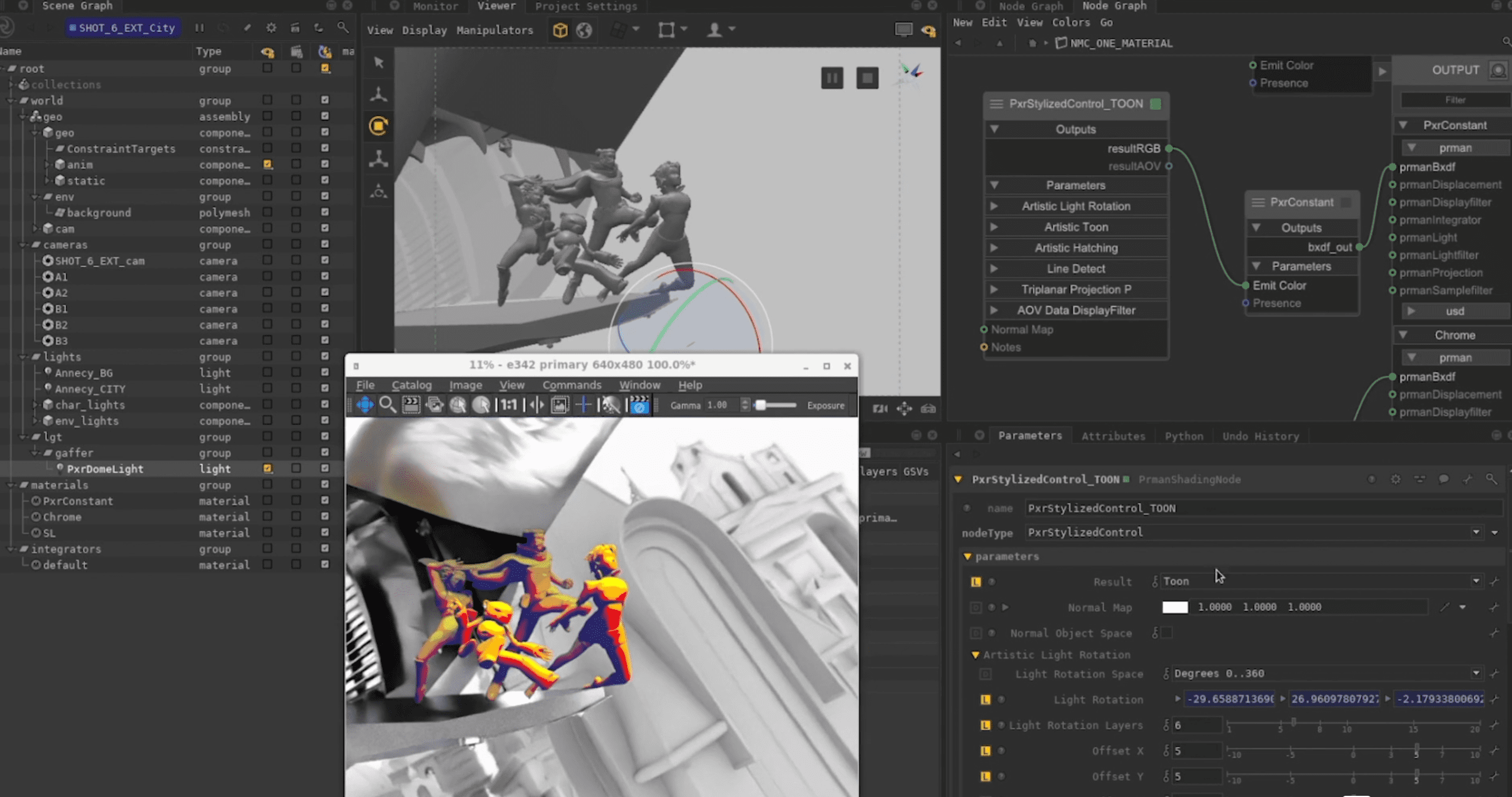
The Stylized Looks suite has matured from experiment to production toolset. It now ships as a unified subsystem under XPU, comprising PxrStylizedControl, PainterlyBrush, Lines, Hatching, Canvas, and Toon filters. Each operates as a display or sample filter, allowing NPR (non-photorealistic rendering) effects such as painterly brush strokes, toon shading, curvature-based outlines, and cross-hatching, all integrated directly with RenderMan’s physically based lighting.
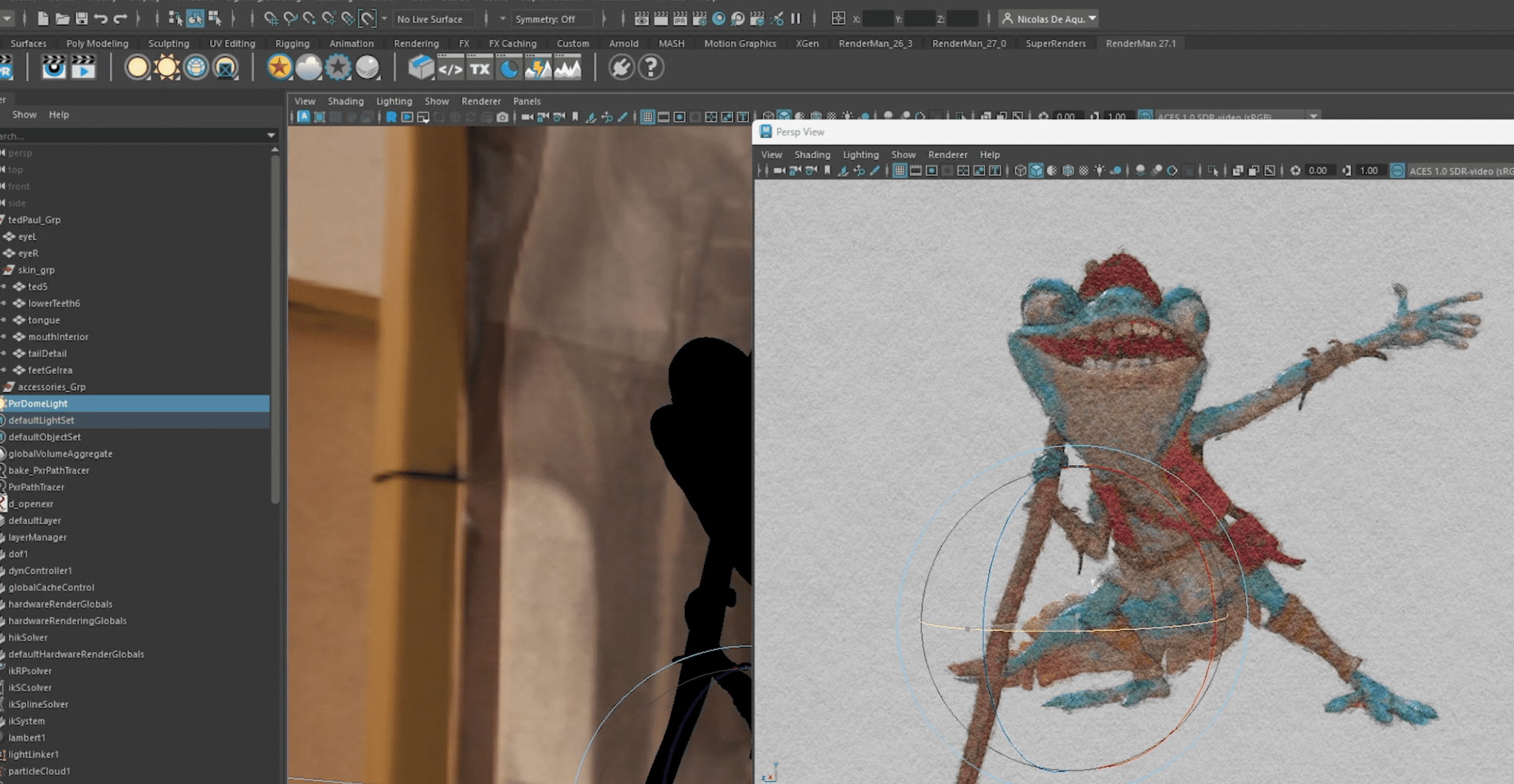
The system supports AOV outputs, interactive denoising, and compositing passes. The new PainterlyBrushXPU filter enables procedural brush strokes with depth and lighting awareness. StylizedCanvasXPU and StylizedLinesXPU introduce compositing and in-filter distortion options with up to 96 preset line textures. Pixar’s stated goal: to let stylised rendering coexist with physically plausible shading without breaking pipeline compatibility.
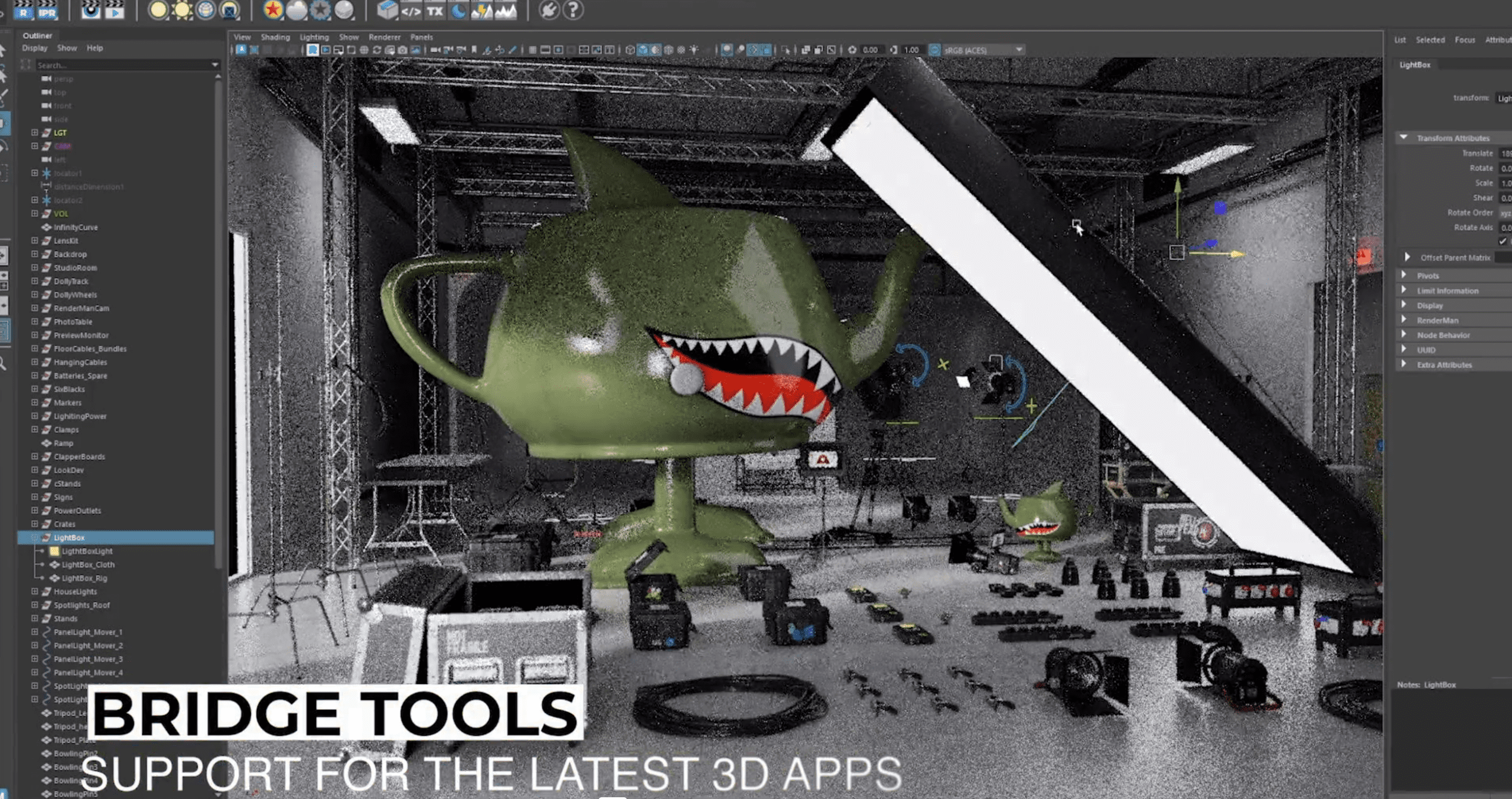
Integration and Pipeline Alignment
RenderMan 27 strengthens its integration with major DCC applications and pipeline frameworks. Solaris, SideFX’s USD-based environment in Houdini, now features deeper RenderMan embedding, including improved UI, native support for OpenSubdiv 3.6.1, and GPU progress tracking in hdPrman. RenderMan LOP nodes have been refactored, and “RenderMan Render Vars” replace the older “Standard Render Vars” for more robust USD conformity.

RenderMan for Blender reintroduces Qt-based UIs via PySide6, restoring the texture manager and preset browser on Blender 4.x. Artists now benefit from native light linking, velocity blur control, and on-the-fly texture conversion.
In Maya, RenderMan’s Texture Manager has been modernised, adopting OpenImageIO for mipmapped texture conversion. Pixar’s proprietary texture format has been replaced by OpenEXR, aligning with the VFX Reference Platform 2024 standards. The legacy txmake utility remains available for backward compatibility but is now officially deprecated.
The Texture Manager now supports ACES-compliant defaults, HiDPI UIs, and multi-selection editing. Pixar warns that lowercase <udim> tokens will no longer be recognised; pipelines must adopt the uppercase <UDIM> convention for USD compliance.
Complying with the VFX Reference Platform 2024
RenderMan 27 aligns fully with VFX Reference Platform 2024, standardising on current builds of Python, OpenEXR, OpenImageIO, and USD. For production pipelines, this ensures compatibility with other industry-standard applications and reduces dependency conflicts across render nodes. The change affects texture formats, shader APIs, and compositing metadata. Pixar’s move to OpenEXR for both image outputs and texture caching is particularly significant, replacing proprietary workflows with interoperable standards.
Performance and Statistics
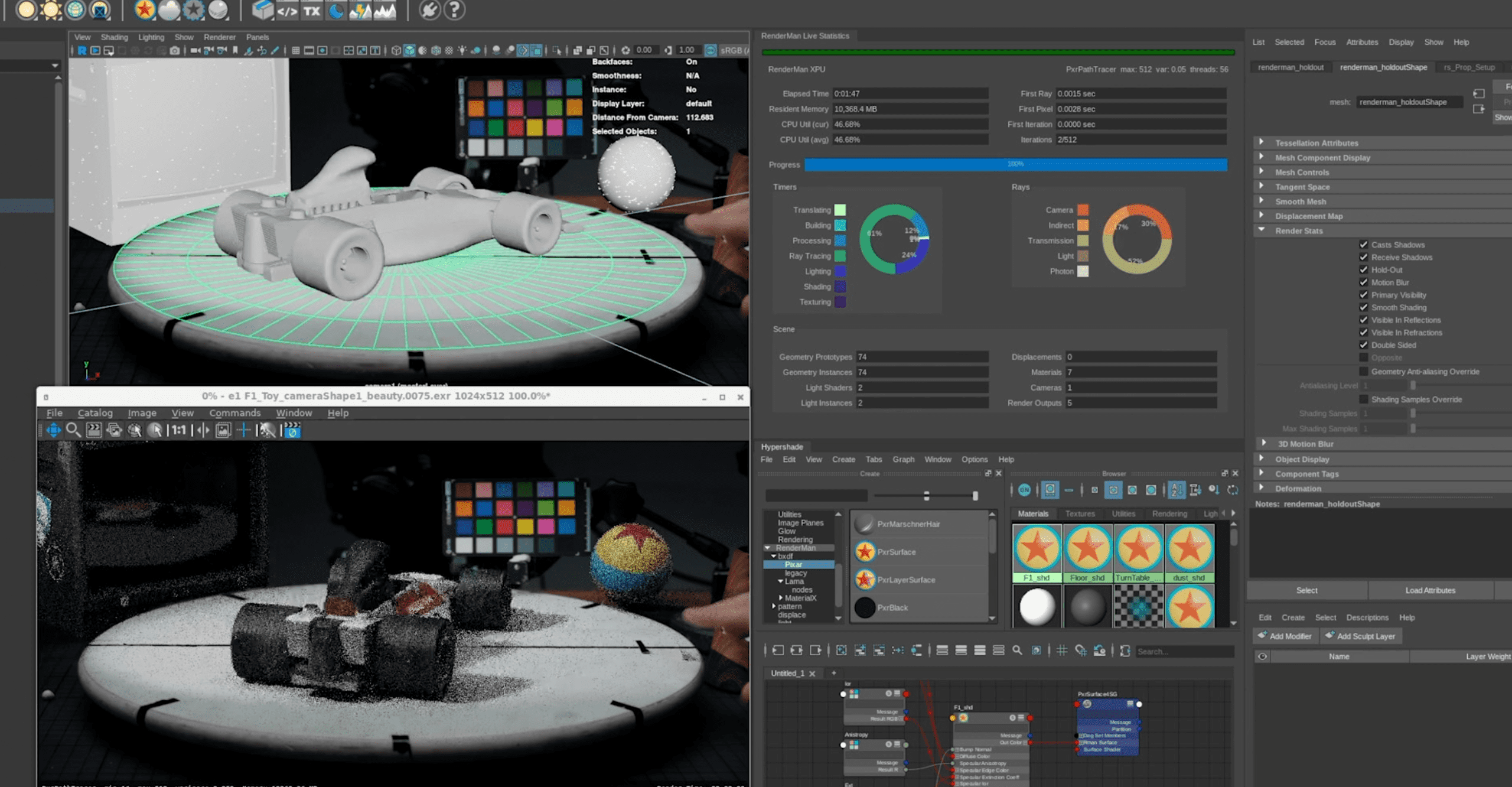
Performance instrumentation across XPU has been expanded, with scene ingestion, GPU allocation, and adaptive ray counters now visible in live statistics panels across DCCs. The stportal interface presents real-time timers, counters, and memory metrics, enabling TDs to diagnose bottlenecks without external profiling tools. RenderMan’s JSON reporting system has been refined for both RIS and XPU, offering standard and detailed modes for automated render diagnostics. Memory tracking now includes deduplication efficiency, critical for large USD scenes.
Future of RIS
While RIS remains functional in version 27, Pixar has confirmed its future deprecation. The renderer continues to support legacy pipelines, but new features including deep compositing, MaterialX Lama, and multi-GPU acceleration, are exclusive to XPU. Pixar recommends transitioning new projects to XPU immediately to ensure feature parity and forward compatibility. The company has maintained RIS only for existing productions requiring deterministic CPU-only rendering or legacy shader behaviour.

Non-Commercial Version – still free.
The free Non-Commercial RenderMan 27 is Pixar’s way of saying, “Go ahead, break it, just don’t charge for it.” The edition now includes full XPU support, right down to final-frame rendering, meaning anyone can experiment with the same hybrid CPU–GPU tech used on Pixar features. It’s designed for personal projects, research, and plugin tinkering, with no watermarks, only a polite request to credit RenderMan if your test project accidentally becomes an internet hit.
Naturally, there’s a catch or two. The licence is strictly non-commercial, locked to two machines, and politely expires every 120 days, because nothing keeps a pipeline sharp like forced renewals. The Stylized Looks suite, Pixar’s NPR playground of painterly brushes and toon shaders, is absent here, reminding users that true artistry still costs a studio licence. Still, for anyone wanting to explore the XPU ecosystem without opening the budget spreadsheet, it’s a generous, production-grade sandbox.
Compatibility, Stability, and What Comes Next
RenderMan 27’s release is a clear signal: Pixar’s renderer is now fully committed to hybrid GPU computing and open pipeline standards. With XPU stabilised for final-frame rendering, Solaris deeply embedded, and MaterialX Lama laying the foundation for unified shading, the software’s architecture is more extensible than at any point in its history. The move to industry formats and the inclusion of non-photorealistic rendering tools reflect Pixar’s recognition that creative flexibility and pipeline efficiency must coexist.

RenderMan 27.0 should be thoroughly tested before deployment in production, especially when adopting early access features such as MaterialX Lama. Pixar’s documentation explicitly requests user feedback to refine those systems during the 27.x cycle.
