



The 2025.2 update of Marvelous Designer, developed by CLO Virtual Fashion, focuses on five new features that enhance realism, efficiency, and creative control across digital garment workflows. The release expands the program’s animation and simulation toolkit while tightening interoperability with external systems such as Epic Games’ MetaHuman Creator.

Keyframe Animation Gains Real Cloth Control
The most substantial technical update lies in the expanded key-framable properties. Fabric behaviour can now be animated directly through properties such as shrinkage, pressure, solidify, tack, and trim weight. Artists can animate shrinkage weft and warp to tighten or loosen cloth dynamically, or use pressure values to create inflation and deflation effects. The solidify control adjusts fabric stiffness over time, useful for animating transitions from soft to rigid materials in one shot. Tack properties can be keyed to attach or release trims, and trim weight itself can be animated — for example, making a prop lighter or heavier in response to motion. This deeper control allows complex, physically-based animations such as self-inflating garments, reactive drapery, or controlled cloth deformation without leaving Marvelous Designer’s simulation environment.
Patterns Become Trims and Accessories
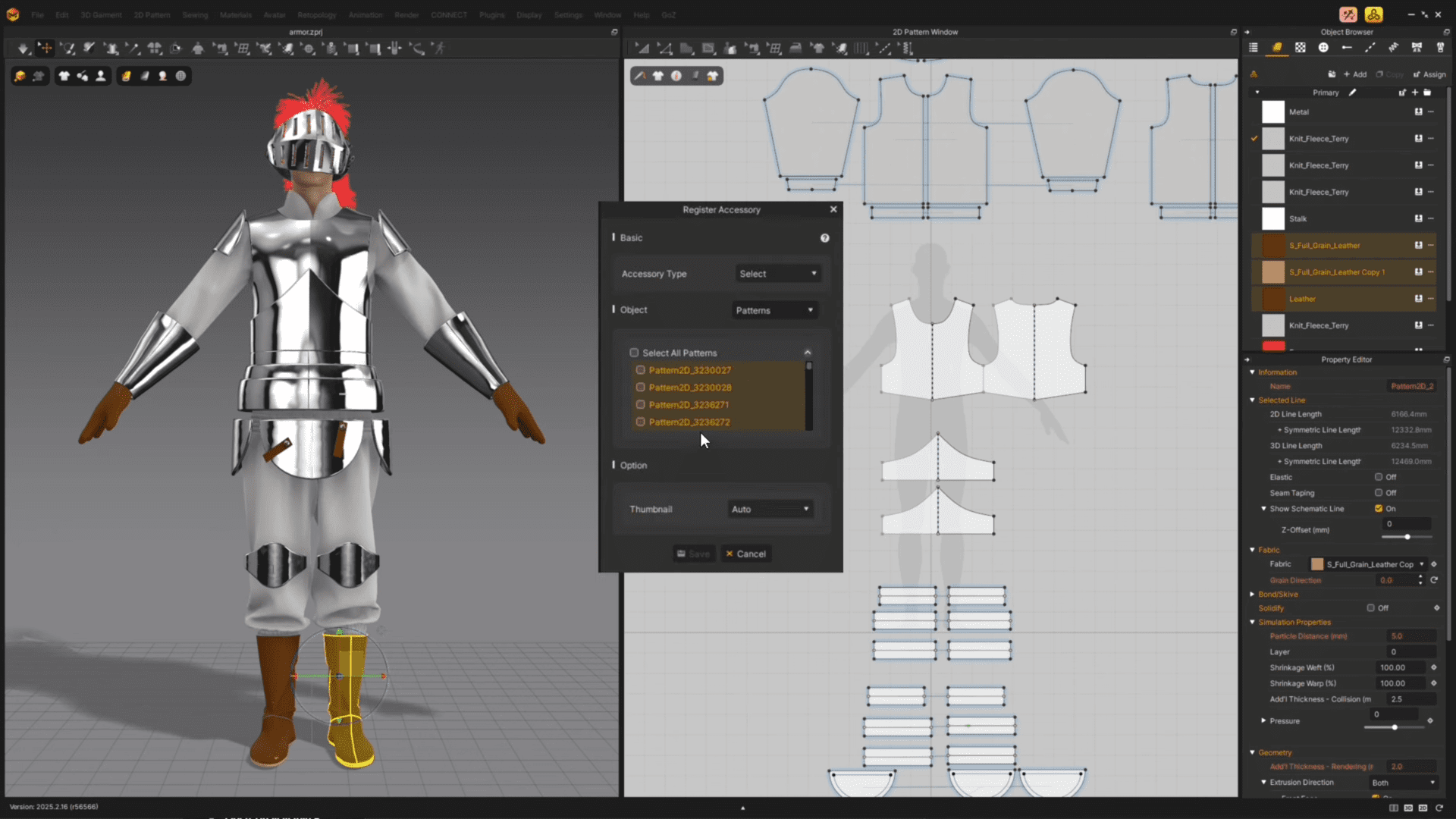
Patterns can now be converted directly into trims or avatar accessories through a context-menu operation. Once converted, these assets are stored as Trim Styles or registered as accessories, allowing them to be reused across projects. The change provides clear advantages in asset management and simulation efficiency. Trims are treated as rigid geometry rather than simulated cloth, which reduces processing overhead. This workflow supports the creation of non-deformable surfaces such as metal, wood, or plastic, enabling hard-surface detailing directly inside Marvelous Designer. In practice, it is now possible to design a fully armoured character by converting fabric plates into rigid trims or to repurpose footwear and props as reusable accessories.
Local FBX Export Without CONNECT
EveryWear, Marvelous Designer’s asset-exporter, now supports direct FBX export to local storage. Earlier versions required users to upload garments to the CONNECT platform before download. The 2025.2 revision replaces that dependency with a local-only workflow. Artists can optimise garments, rig avatars, pack UVs, bake textures, and export the final FBX directly to disk. This update eliminates one of the most common production bottlenecks, streamlining integration with DCC tools and game engines that rely on FBX.
MetaHuman DNA Import
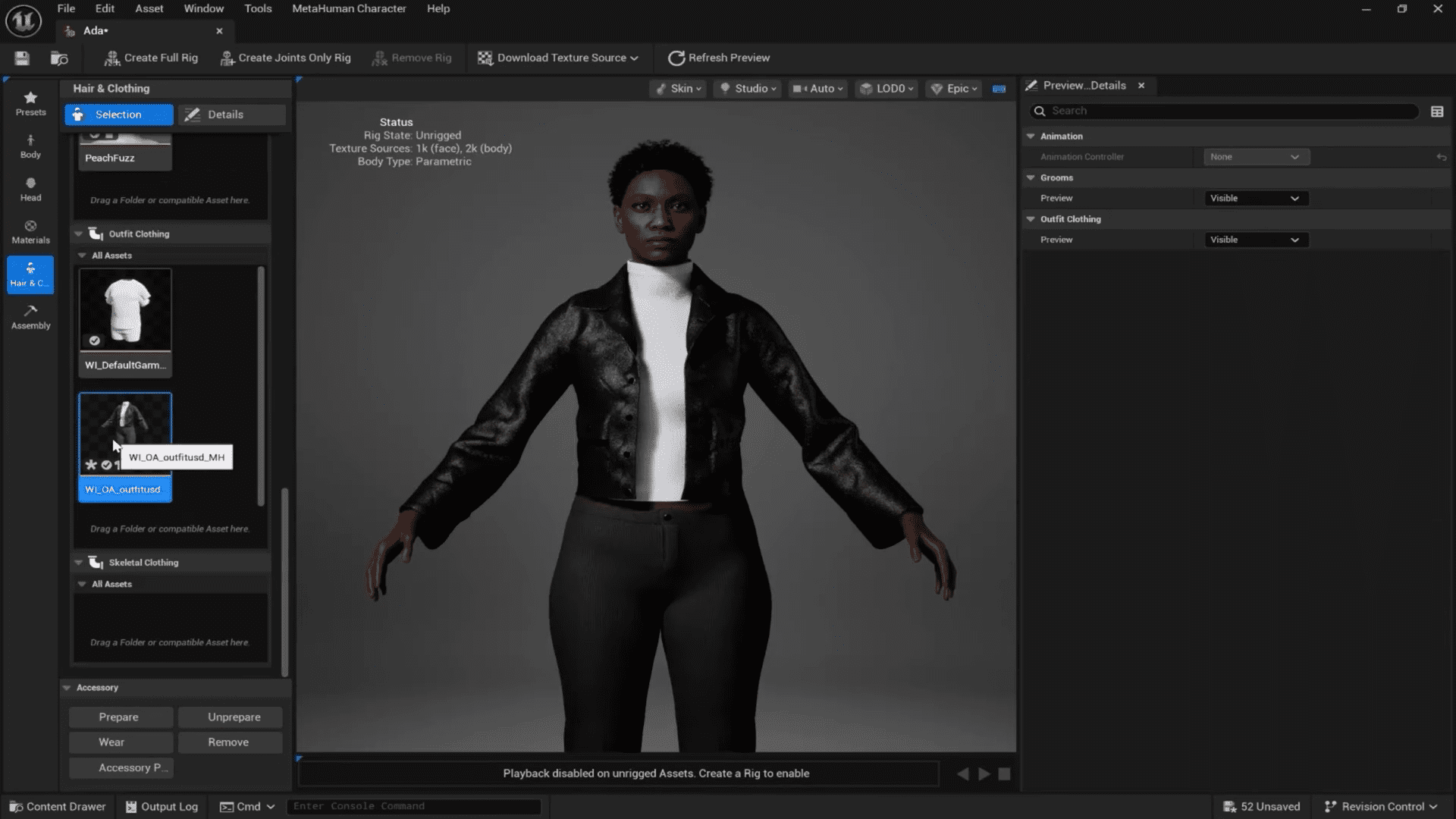
Epic Games’ MetaHuman Creator avatars can now be imported directly into Marvelous Designer in their native DNA format. This import process is non-destructive, preserving the avatar’s proportions, mesh fidelity and rigging data. Designers can fit garments directly on MetaHuman bodies, export them back to Unreal Engine, and have the clothing automatically adapt to any subsequent body adjustments made in MetaHuman Creator. The result is a tighter pipeline between digital-human design and cloth simulation, significantly reducing retargeting and scaling errors.

Pleats Made Simple
Creating pleats manually has long been a slow, calculation-heavy task. The new Pleats Tool simplifies the process with an interactive interface for generating knife, box or accordion pleats. Designers can adjust number, depth, interval and fold angle parameters directly in the tool’s window, previewing results in real time. The system allows non-destructive editing: pleats can be undone and modified without redrawing patterns. This not only saves time but also makes pleated garments—such as skirts, dresses and uniforms—more iterative and design-friendly.
Pricing
Marvelous Designer 2025.2 is available now for both Windows 10 and later, and macOS 12 and above. The software continues to be offered exclusively through subscription. Individual licences are priced at around US $39 per month, or US $280 per year, equating to roughly US $23 per month when billed annually. Enterprise pricing remains higher, with node-locked licences typically around US $199 per month or US $1,900 per year, and floating licences in the region of US $2,000 per year.
As always, professionals should test the new version within controlled environments before integrating it into production pipelines. Although the update appears stable in demonstrations, verifying simulation performance, export fidelity, and MetaHuman interoperability is essential before deployment.
