



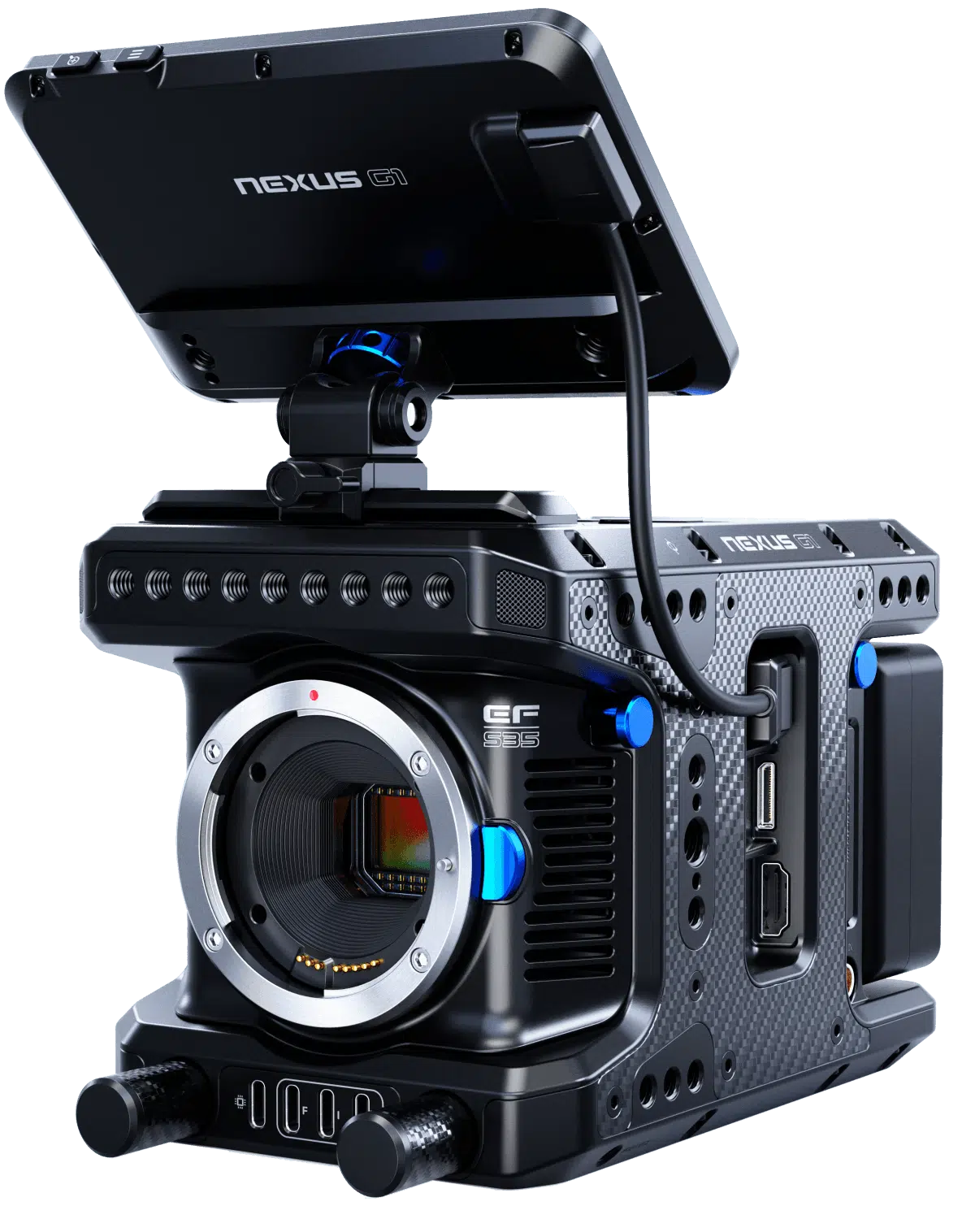
The Australian-based team at Nexus Cameras has announced that their modular box-style cinema camera, the Nexus G1, is now fully operational. The company published first test footage shot in an Australian rainforest. According to Nexus, the imaging system, cooling, “MaxDrive” storage and optical subsystems are complete and field-tested.
Built on a familiar sensor
The Nexus G1 incorporates the imaging core of the highly capable Blackmagic Pocket Cinema Camera 6K, retaining its Super-35 sensor, BRAW codec, and ProRes recording. The body, however, is entirely new: a magnesium-alloy and carbon-fibre enclosure with modular design, extensive rigging points, and additional connectivity, as well as a new Screen. Nexus reports refinements to the optical stack (sensor glass, IR-filter) and verified thermal stability in stress tests at 57 °C during rainforest trials. (Not that any of us here is having the heat problem, yet.)
Confirmed specifications
As disclosed, the camera records up to 6K at 50 fps and 2.8K at 120 fps, includes an internal 2-to-7-stop electronic ND filter, and supports interchangeable lens mounts (EF standard, optional PL and Micro 4/3).
It offers built-in FIZ (Focus-Iris-Zoom) control and an internal 15 mm rod system with 64 mounting points. The body includes dual full-size XLR inputs and uses Nexus’ proprietary 1 TB “MaxDrive” media. During the field trial, Nexus claims continuous recording for 90 minutes without thermal shutdown. These figures have not been independently verified so far.
Pricing and availability
The G1 is scheduled for release in Q1 2026, delayed from the previous Q3 2025 target. Retail price is US $3,300, with early pre-orders at US $2,980 under the “Founders Edition” label featuring special side-panels and engraving.
The camera nobody asked for, but everyone is watching
What makes the Nexus G1 interesting is its concept: a professional “aftermarket upgrade” for a camera that is already very capable. The Blackmagic Pocket 6K remains a strong tool in its price class, yet Nexus has effectively re-engineered it into a modular, production-grade chassis. That alone is a novelty. We have not seen a third-party vendor attempt a full mechanical and electronic rebuild of an existing cinema camera at this level before.
Still, this is early-stage territory. The G1 exists as a working prototype with test footage. No independent reviewer has yet handled it, powered it, or verified its endurance in production conditions. Cooling performance, firmware stability and component tolerances remain unproven, and before it goes through the trial-by-camera-assitant-whio-is-the-execs-nephew, we cant say anything about durability.
So for now, the Nexus could turn out to be either a Maybach or a Sport Edition Trabant, and yes, apologies for the car comparison, since the Nexus looks far sleeker, tasteful and better engineered than a gaudy Maybach. Until independent testers confirm otherwise, it remains a promising but unverified concept.
Editorial note for production users
The Nexus G1 is an ambitious small-vendor project, not a mass-market camera ecosystem. Potential buyers should examine service, warranty and workflow compatibility before committing. Test units in-house before deployment on client work, especially where reliability or continuity of supply matter. But the Nexus G1 brings an intriguing idea: pairing a proven imaging pipeline with a high-grade, modular body design. If it performs as claimed, it may bridge a gap between DIY rigging and factory-built cinema systems. For now, however, it remains a prototype worth watching, cautiously.
