



Mocha Pro 2026 is out, and Boris FX’s Emmy and Academy Award-winning planar tracker returns with an update that focuses on refinement rather than reinvention. The 2026 release adds new AI-driven roto and matte tools, smarter 3D-solve cleanup, and a rebuilt Curve Editor, all tuned to make shot-fixing and cleanup faster and more predictable for working compositors.
The update also aligns with VFX Reference Platform 2025, adding support for Qt 6.5.4 with PySide 6, Python 3.11, OpenEXR 3.4.5, Alembic 1.8.8, and FBX 2020.3.7. This ensures fewer pipeline compatibility issues in studio environments.
Matte Refine ML: AI for tricky edges
The new Matte Refine ML system expands Mocha Pro’s machine-learning masking family, which already includes Object Brush ML, Matte Assist ML, and Face ML. It analyses existing masks and automatically refines soft or semi-transparent edges which is useful for hair, fur, motion blur, and defocus.
Two refinement modes are available: one optimised for soft motion or blur, the other for sharper edges. Additional post-processing sliders (Black Clip, White Clip, Edge Grow, Shrink/Grow, and Blur) let artists fine-tune how transparency and detail are blended along the edge.
For multi-layer composites, the new Group Layer Mattes option merges multiple layers into a single matte clip, improving render and playback performance. Combined with Matte Assist ML, this creates an efficient path from object masking to refined alpha without intermediate renders.
Refine Solve: faster, cleaner 3D tracking
The Refine Solve tool targets 3D camera solves that have drifted or accumulated bad data. Using the Clean Up Features dialog, users can delete unstable or short-lived tracking points, then recalibrate the existing solve without starting over.
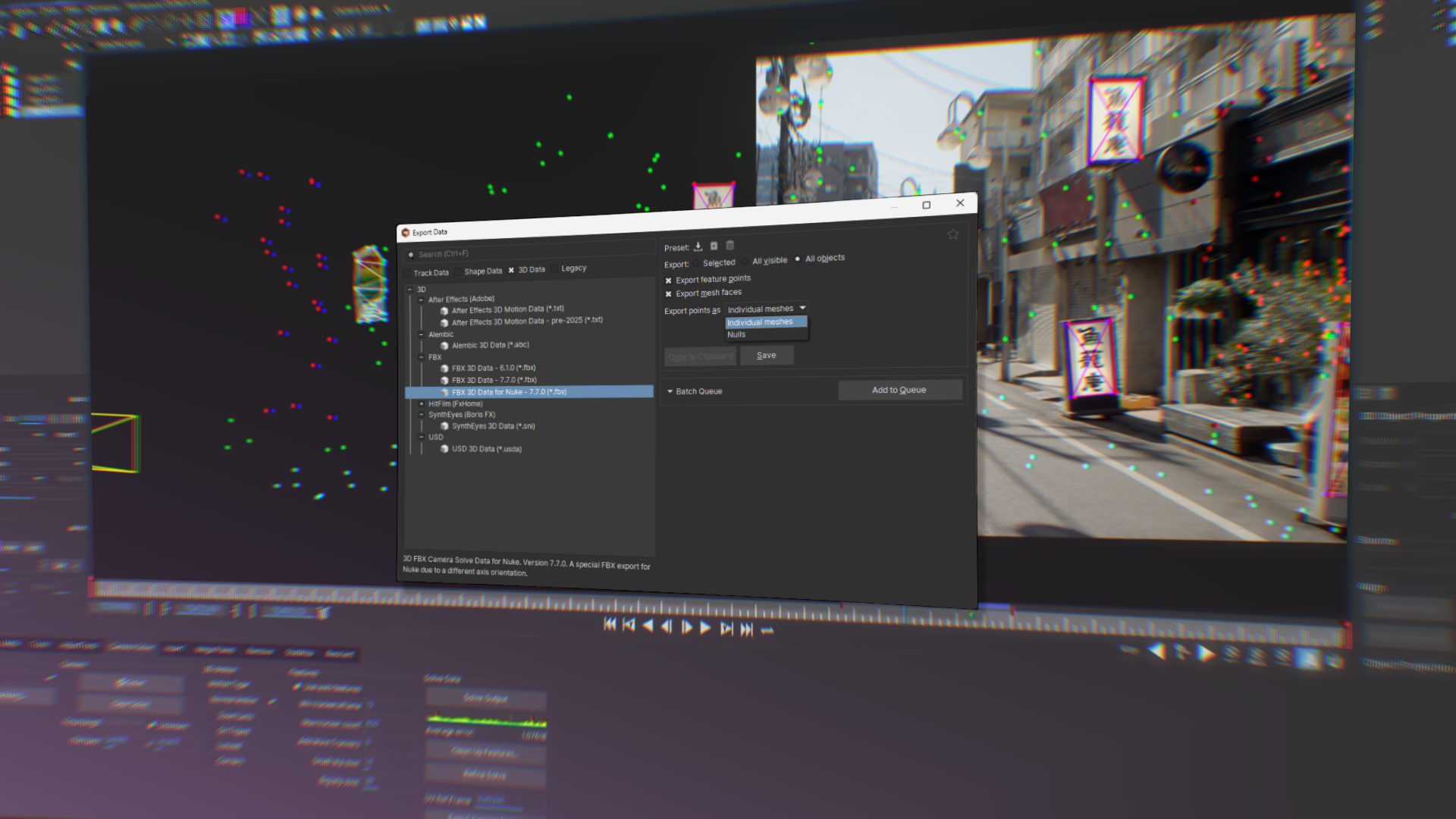
Because Refine Solve builds on the original solve data, it preserves previous adjustments such as ground-plane alignment or scene scaling. For extended tracking and finishing, the refined data can be exported directly into SynthEyes for further cleanup. The result: faster iterations and fewer re-solves for 3D match-move tasks in complex shots.
Blips and 3D
Technically, Mocha’s camera solver identifies trackable “blips” in the image and converts them into 2D trackers, which are then triangulated into static 3D feature points. The software measures the average deviation between the 2D trackers and 3D points as HPix (horizontal pixel error). A low HPix value signals a stable camera solve, while spikes in the error curve expose moments where the 3D reconstruction drifts. These spikes often correspond to unstable track data caused by motion blur, occlusion, or minor parallax inconsistencies.
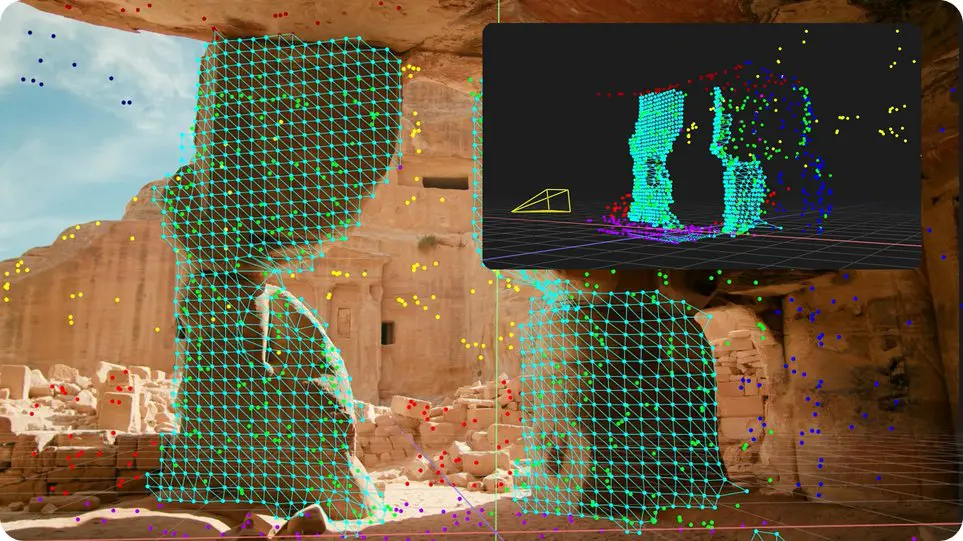
The Clean Up Features system provides targeted filters to address these issues. It can automatically disable feature points during high-error frames, discard very short or inconsistent trackers, and remove features that contribute excessive deviation. Once unwanted data is removed, Refine recalibrates the existing camera without re-solving from scratch, updating only the relevant calculations while maintaining previously established orientation and coordinate systems. This allows technical directors to preserve scene alignment and object placement while improving solve precision.
Refinement should be applied only when the base camera movement is physically plausible. If the initial camera path is incorrect or erratic, a full re-solve remains necessary. However, for typical production shots where the solve is broadly correct but slightly unstable, this incremental workflow offers a reliable way to tighten accuracy, lower HPix variance, and maintain alignment integrity across multiple refinement passes.
Curve Editor rebuilt for modern pipelines
After a long hiatus, Mocha Pro’s Curve Editor makes a full return. The interface has been rewritten from the ground up, with tighter integration between the Dope Sheet and Graphs panel. Artists can now visualise tracking, roto, and camera-solve data as curves, then smooth, zoom, or isolate problem areas directly. A new offset-curve overlay in the Adjust Track module displays how refinements affect the original track in real time. Filtering options allow users to display only keyframed parameters or selected spline points, helping to pinpoint problematic data without clutter.
Smaller but useful refinements
Beyond the headline features, Boris FX lists numerous “quality-of-life” updates under the hood. Playback of refined mattes no longer requires separate rendering, and composite mattes can now be applied directly in other Mocha render modules, such as Insert or Remove.
Mocha Pro 2026: Pricing and availability
Mocha Pro 2026 is available as a standalone application and as plugins for Adobe After Effects, Premiere Pro, Avid Media Composer, Foundry Nuke, Blackmagic Fusion, Autodesk Flame, and VEGAS Pro. Subscription pricing starts at €42 per month or €290 per year. Perpetual licences (from €675), upgrades, and support plans are also offered. Customers with active Mocha Pro or Boris FX Suite subscriptions receive the 2026 update at no additional cost.
Reality check
While the AI-driven refinements and rebuilt Curve Editor mark significant usability improvements, studios should validate performance and matte accuracy in controlled conditions before integrating Mocha Pro 2026 into production pipelines.
