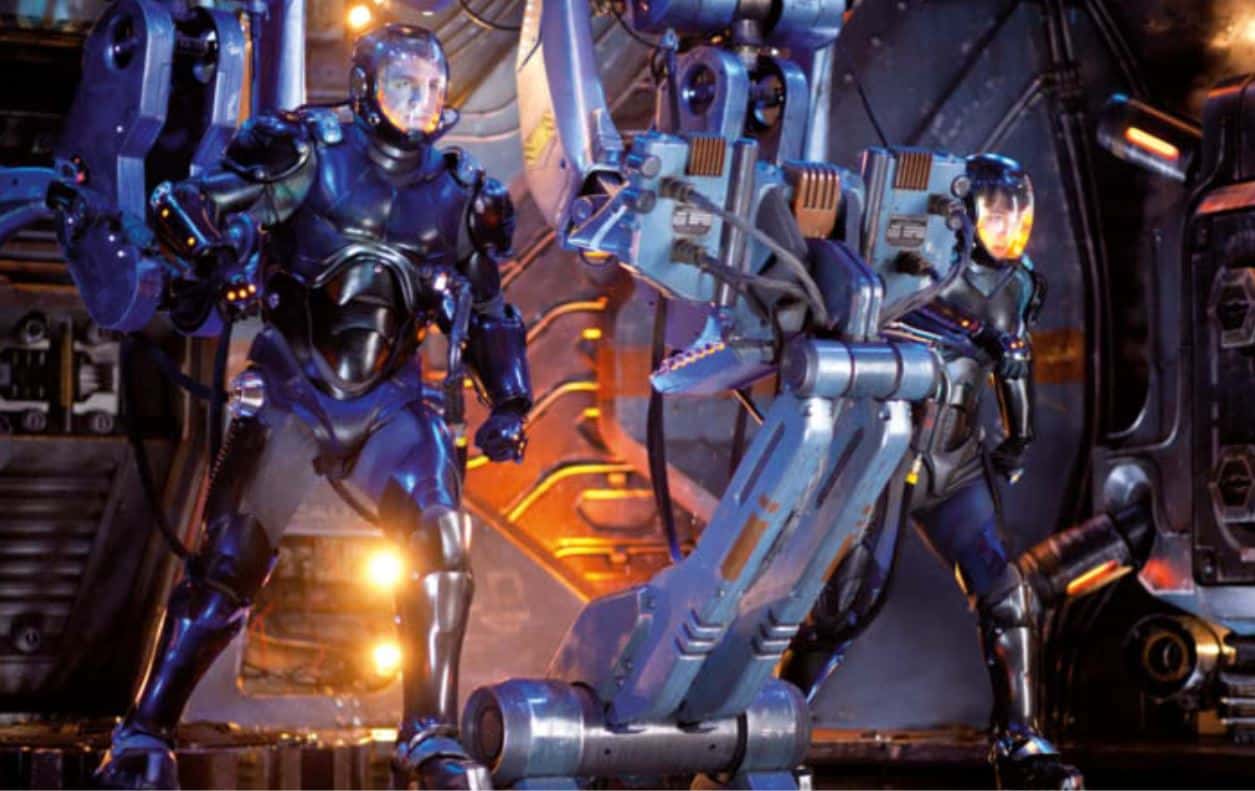
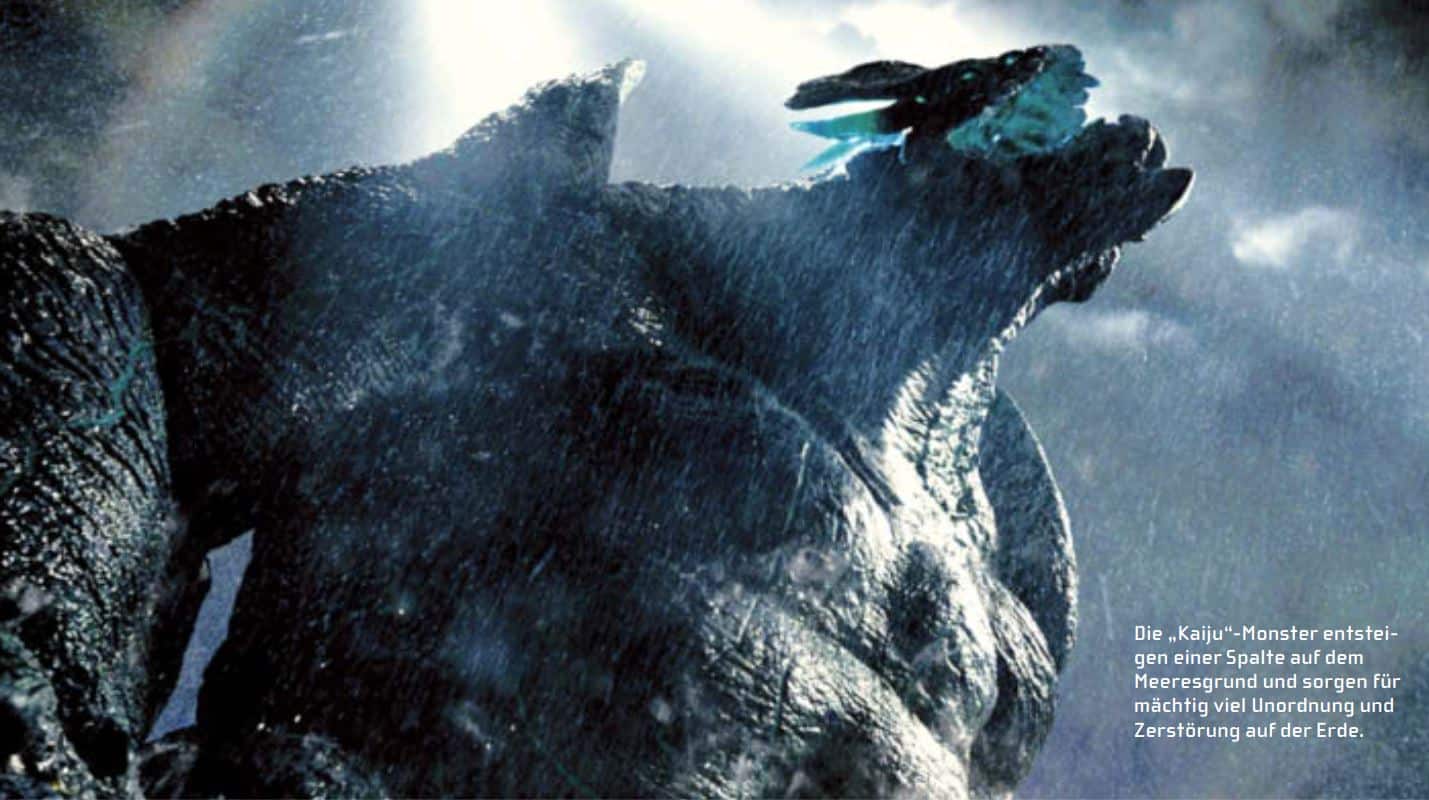
When giant, vicious alien monsters emerge from a crevice at the bottom of the sea, humanity is faced with the question: resistance or extinction? They decide to fight the “Kaiju” (Japanese for giant monsters) with robots called “Jaegers”, which are brain-controlled by two pilots. This works quite well for a few years until ever larger monsters emerge from the sea and only four combat robots from America, Australia, China and Russia are left. In order to avert the apocalyptic inferno after all, the four nations enter the final battle for the world.
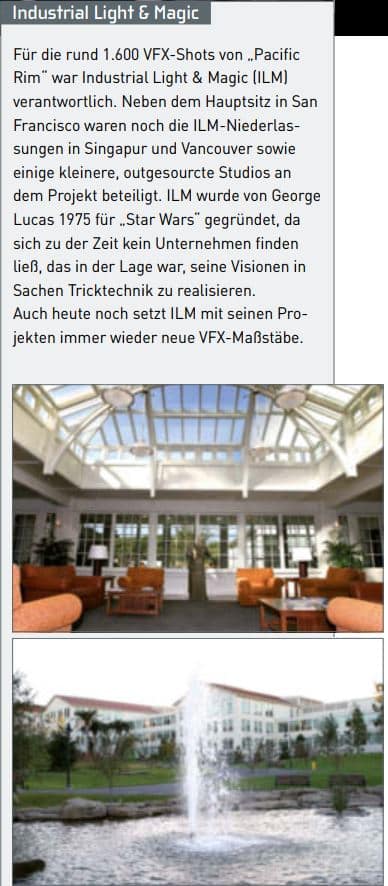
Industrial Light & Magic (ILM) was responsible for around 1,600 VFX shots, including “Jaeger” robots and “Kaiju” monsters. It was also the studio’s first collaboration with Mexican director Guillermo del Toro. Filming took place at Pinewood Studios in Toronto, where the film team occupied all the halls with the real film sets – the set of the main cockpit of a robot, the so-called “Conn-Pod”, was also located there (you can also find out more about the design and set construction of the Conn-Pod in this issue of DP in the interview with set designer William Cheng).
The cockpit set weighed around 20 tonnes and could be moved and even shaken by a gigantic hydraulic tilting device, the “Mighty Mo”. The actors wore heavy boots that were permanently installed on the platform. For the actors, the shoot was like a rollercoaster ride, during which they were sprayed with around 5,000 litres of water per take.
The actors’ ordeal was a great reference aid for the VFX artists, as the ILM team was able to transfer the actions of the actors in the robot’s head to the movement of the 3D robot models. The team deliberately decided against motion capture for the animation, as the “Jaegers” were not supposed to move too humanly or organically, but rather robotically. The main protagonist of the robot squad, which is explicitly described as female in the film, is the 80-metre-tall “Gipsy Danger”. Around 20 model versions of her alone had to be created for the different degrees of destruction. The secret stars of the film are the monster creatures with bright blue maws, the concept of which involved some of the best monster designers in the world. Both ILM and compositing artist Michael Ralla describe “Pacific Rim” as the most challenging and exciting project of their careers to date. We spoke to Michael Ralla about the reasons for this statement and the extensive pipeline and workflow changes ILM made for the project.
DP: How many VFX artists were employed by ILM and how many studios in total?
Michael Ralla: The work was split between the headquarters in San Francisco and ILM’s offices in Singapore and Vancouver as well as some smaller outsource vendors like BaseFX in Beijing, Ghost in Denmark and RodeoFX as well as Hybride in Montreal. In total, the team involved was around 650 people strong, and they worked on a total of 1,566 shots.
DP: How did ILM organise the workflow for the project internally?
Michael Ralla: Efficiency was extremely important. The overarching principle was: “Every dollar goes straight to the screen.” In San Francisco, ILM processed 432 shots, which was sometimes the most complicated part of the work.
As with previous projects, the teams were organised into departments. But this time they worked much more closely together – direct communication was actively encouraged and required. Whenever a certain combination of different artists seemed to work well together, the production tried to keep this constellation together: For example, as compositor I worked together with VFX-TD Florian Witzel and LightingTD Michael Rich on a whole series of similar shots.
The supervisor for the entire project was John Knoll, with co-supervisors Lindy DeQuattro and Eddie Pasquarello working together on the supplied work – but all three were based in San Francisco. The lynchpins of each day were dailies and nightlies, with the Vancouver department seamlessly involved via video conferencing. Basically, ILM in San Francisco shared a pipeline with Vancouver, which is mirrored in Singapore. From a compositing perspective, it was interesting that ILM had leads for each discipline and character. This was incredibly helpful as the “Jaeger” robot and “Kaiju” monster looks were really complex. Especially in terms of specific glows, materials and lights, which of course had to look consistent throughout.
DP: Which scenes were you responsible for?
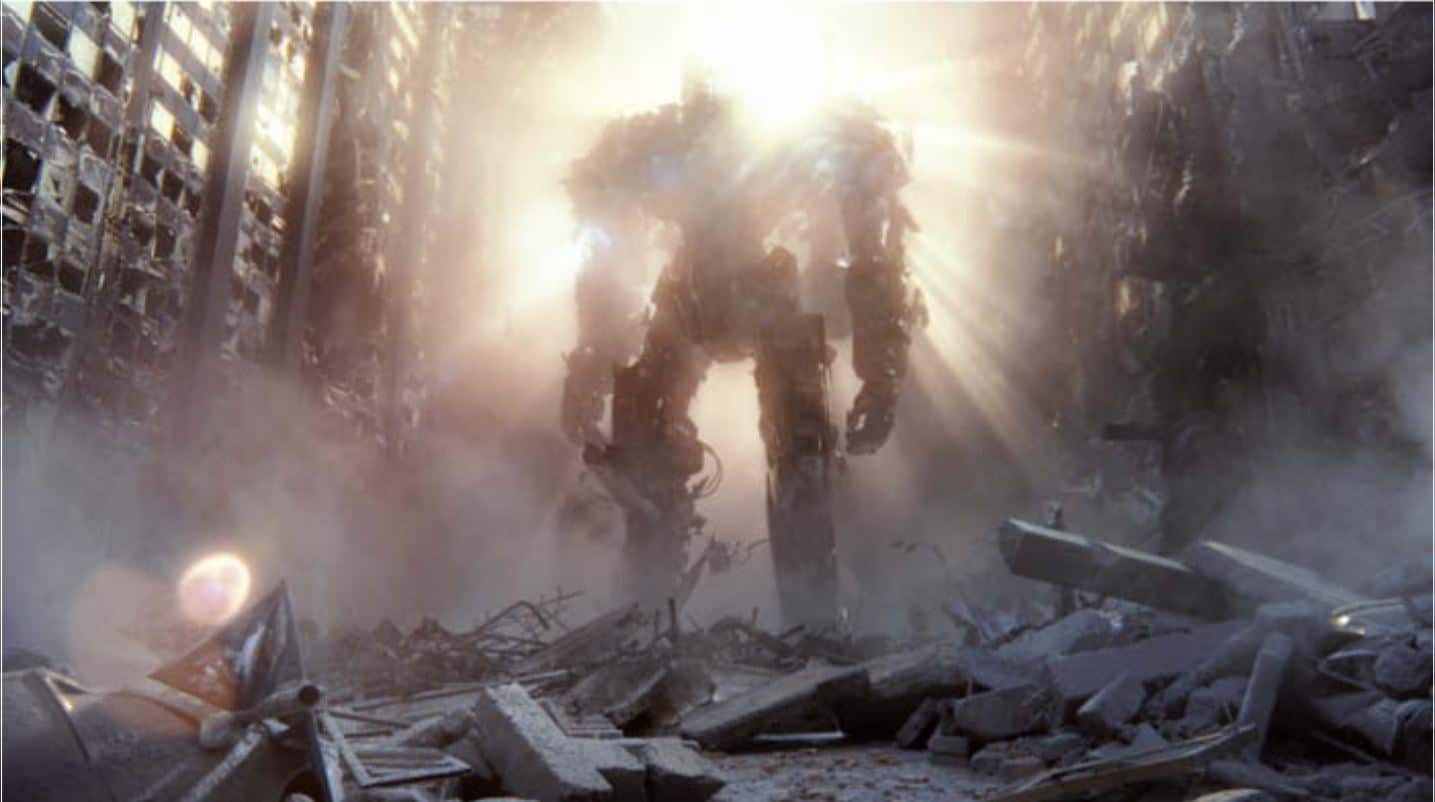
Michael Ralla: I worked mostly on two specific sequences: the dramatic “Dockfight” between “Leatherback” and “Gipsy” and the exciting final fight between “Otachi” and “Gipsy” in the streets of Hong Kong – both incredibly rewarding tasks with shots that were a lot of fun to shoot.

DP: How was deep compositing used for this project and what are the benefits?
Michael Ralla: Deep compositing was used extensively, but selectively on a per-shot basis and only for things where it really made sense. As already mentioned, efficiency was very important because the storage space requirements and the computing power needed for a deep workflow are enormous.
With all the atmospheric effects such as water running on the objects, ocean and wave interactions as well as the consistent rain in almost every shot, deep compositing helped to avoid time-consuming re-renders due to holdouts that no longer fit, for example in the event of an animation change.
We also used the entire standard deep toolkit in Nuke, for example, to see where the renders were located in 3D space and punch them out correctly: In almost every shot, tons of Practical Elements like sparks, dust, smoke, explosions and of course rain were integrated, which helps tremendously with realism. In order to place these efficiently and correctly, it helps a lot to see exactly where the 3D deep elements are located in 3D space.
DP: What tools did you work with on “Pacific Rim”?
Michael Ralla: All the compositing was done exclusively in Nuke with the addition of a number of regular commercially available plug-ins and, as always, some proprietary ILM tools. There was no need as a compositor to write any pipeline scripts. All I did in that framework were small helper scripts that automated or facilitated repetitive things in my own Nuke scripts.
DP: How was Katana used in this project?
Michael Ralla: Katana was used almost exclusively by the lighting TDs, who also did quick slap comps of their passes in Nuke for testing purposes.
DP: Why did ILM primarily switch to the Arnold renderer for “Pacific Rim”? For which elements did you have to supplement the pipeline with other renderers?
Michael Ralla: I’m not a lighting TD, nor did I have anything to do with the pipeline planning. So unfortunately I can’t say much about this, except that the primary renderer for all characters was Arnold. V-Ray was used for the vast majority of environments, while RenderMan was used for water and simulation work.
DP: The final fight in the film between “Gipsy” and “Otachi” is a complicated scene: how did you manage the incredible number of render layers, especially all the reflections of the neon lights including the rain?
Michael Ralla: There’s a pretty simple answer to that: you just try to get the most talented people in the VFX industry to work on it (laughs). Absolutely right, there was an incredible amount of elements that mostly all interacted with each other in some way and were only put together later in compositing. The layering process was relatively complex, but all the people on the team did their best to facilitate this – and it worked pretty well.
DP: You’ve worked on many Hollywood projects. Why was “Pacific Rim” the most challenging and exciting project of your career to date?
Michael Ralla: The exciting thing about this project from a compositor’s point of view was the complexity of the shots and all the technical challenges involved, as well as some new approaches and ideas. Particularly in the compositing department, we used a whole range of new workflows, all of which were extensive but also highly efficient. It was really exciting to be at the forefront of this crew. At least in San Francisco, there wasn’t a single “easy” shot. As already mentioned, there were an enormous number of render passes, and dealing with the daily updates alone required good self-management skills.
DP: What was particularly challenging for you?
Michael Ralla: For example, I worked on the development for the final battle in Hong Kong: “Otachi” swims into a part of the harbour, causes a massive wave in the ocean, knocks over entire ships and finally smashes a car park full of exploding cars with the first steps ashore. So 15 seconds packed with dynamic action in a full CG environment where everything reacts with everything else – this shot kept me on my toes for quite a while.
But as I mentioned before, we tackled the challenge with a proven team of artists, and again it was Florian Witzel who took care of the fluid dynamics. There are simply synergy effects from this way of working, which makes things easier. The combination of two people in a team usually results in more than just the pure addition of the two talents.
DP: “Pacific Rim” is often compared to Michael Bay’s “Transformers”. What were the main differences between the two projects for you as an artist?
Michael Ralla: There are fundamental differences between the two projects, at least from a compositor’s point of view – not to mention the completely different mindset of the two directors, although they also have certain things in common, which I will come back to later. The most obvious similarity between the two films is the robots – but that’s about it. And even those were already largely different: 80 metre tall manned machines versus 15 metre tall intelligent robots. The overall style is completely different, it’s all about highly polished sports cars versus worn-out steam-punk machines and perfectly timed “golden hour” lighting versus constant rain and thunderstorms at night.
DP: And the compositing in particular?
Michael Ralla: “Transformers 3” had a much higher proportion of live action with shot material, because Michael Bay tries to do as much as possible in-camera, such as explosions and smoke. Realistically integrating the robots into the plate in this scenario is a challenging task, whereas in “Pacific Rim” the majority of the VFX shots were completely computer-generated.
The task there therefore centred on creating an overall image that looked photorealistic and plausible while still fulfilling all of the director’s artistic, stylistic and, above all, story-related requirements.
An extremely important task in “Pacific Rim”, for example, was to get the scale across in almost every shot. “Kaijus” and “Jaegers” are gigantic in size, but this is not always necessarily obvious to the viewer, which is why an attempt was always made to put them in relation to something of a known size. This is a little easier with the “Transformers”, which are derived from cars of a known size.
DP: What was it like working with VFX supervisor John Knoll? Michael Ralla: Working for and with John Knoll was an incredibly rewarding experience. John runs a pretty tight ship and knows exactly what he wants – which harmonised well with what Guillermo wanted. Knoll had a palpable feel for del Toro’s vision. At the same time, as an artist you still had quite a lot of room for artistic freedom. John trusts his artists and if an idea or suggestion makes a shot better and is realisable, John almost always agreed.
As overall supervisor of the whole project, he kept the crew happy by simply fully respecting and trusting each person. And despite the size of the team, he usually knew each person by name and was always approachable.
DP: Was del Toro actively involved in the post-production process?
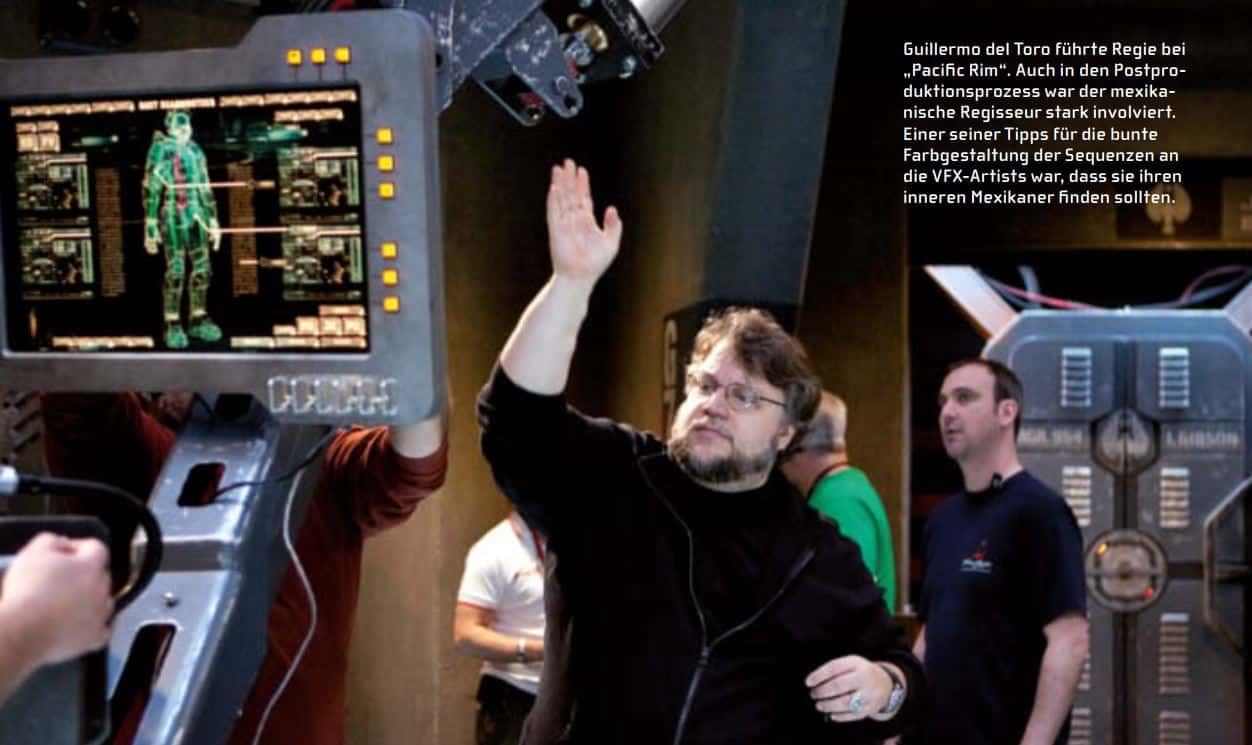
Michael Ralla: Guillermo del Toro was definitely very involved and active in the post-production phase. He’s relatively similar to Michael Bay in that respect – they both direct the effects work as well as every other step of the film and there was no client supervisor in between on either “Pacific Rim” or “Transformers”.
Each week, Guillermo was shown both final and work-in-progress shots from John Knoll for approval – usually the artists would get direct and immediate feedback from him via video conference. It was definitely fun to work on his project and for him. He is inspiring and open to new ideas, but can still formulate precisely and decisively what he wants.
DP: How much freedom of choice did the VFX team have in designing the look of the digital elements?
Michael Ralla: Basically, working on “Pacific Rim” was more like working with the director than for the director: from the perspective of an artist doing shot work, we were definitely all in the same boat. Guillermo was an integral part of the team, visiting the crew often and talking to them directly and personally – he just wanted to get people excited about his film, his passion was infectious and definitely a big factor in the positive experience as a whole.
Del Toro has a colourful personality and the colour palettes for his sequences were just as colourful. “Find your inner Mexican” was a phrase he mentioned often – something I personally had to get used to. Especially as a German who, at least from an American perspective, stereotypically likes perfect right angles and a controlled colour spectrum …
DP: What else do you like about working at ILM that keeps you coming back for projects?
Michael Ralla: ILM, one of the global leaders in VFX, is definitely the most Oscar-winning company with probably the longest history in this field. Just getting a job interview there was a huge thing for me and then to be able to work there multiple times is still incredible. ILM values and respects its employees enormously, but the demands and requirements are high. For us Europeans, there are also relatively restrictive immigration conditions – but once you’re there, you’re rewarded with a great atmosphere, a collaborative and inspiring working environment, cool projects and incredibly nice colleagues.
DP: What are your next projects?
Michael Ralla: I’m currently finalising the “Ender’s Game” project at Digital Domain in Los Angeles, unfortunately I can’t talk about follow-up projects yet. However, looking at the current state of the feature VFX industry, I’m seriously considering – at least for a while – trying out the world of commercials.