



Depeche Mode are back and going on tour. If you can’t be there live, you can perhaps enjoy the TV broadcast later in your living room at home, or you can watch a concert DVD. Cologne-based post-production house the editors cgn is responsible for the high-quality post-production of major concert events. In an interview with DP, Head Editor and Managing Director Tobias Berbuer explains what it takes to make the artists look as good as possible in terms of editing and colour correction.
The Cologne-based company the editors cgn specialises in the post-production of concerts. In collaboration with partner companies 2Bild TV Events & Media and neoxfilm Filmproduktion, they can offer a project from order acceptance to filming and finalisation from a single source – worldwide. The core business is the post-production of multi-camera recordings. This includes concerts, operas, galas, TV shows, Blu-ray and DVD productions. Thematically, the spectrum ranges from rock/pop to the Bayreuth Festival or a cookery programme for WDR.
Post-production for music sponsorship
The Editors’ partner company, 2Bild, specialises in corporate events – and this is how the Depeche Mode order came about, as Deutsche Telekom is accompanying the European tour and exclusively presenting 16 concerts in nine countries and the English band’s album launch concert in Vienna. “The ways in which concerts are viewed have changed. Fewer and fewer people still go to the shop and buy a DVD. Concerts are now mainly broadcast via traditional TV or streamed live,” says Berbuer. However, there is still a demand for high-quality content.
Berbuer’s small, powerful Editors team works with freelance colourists, editors and sound engineers who have been with the company for many years. The teams are put together according to skills but also interests, because “hard guitar riffs don’t necessarily go well with Wagner. But an affinity for music and enthusiasm are crucial for a good result,” says Berbuer.
The studio is equipped with four editing suites and has a DaVinci grading room with the latest software and class 1 monitoring, daylight lighting and appropriate backgrounds. Furthermore, films can be dubbed in a Pro Tools-based voice booth, either with the R128 or a stereo mix. The equipment is completed by a workstation for retouching and graphics work.

DP: Hello Mr Berbuer, how did you prepare for the Depeche Mode concert?
Tobias Berbuer: As best we could – it’s difficult with these big bands. For example, we only received the set list, i.e. the songs to be played, two hours before the concert. But Depeche Mode have a lot of material that you can use to prepare very well and get into the right mood. The dominant colours here are blue and red. The light show is very reduced, rather sedate, but this suits Depeche Mode’s music well. They also often use a huge projection screen with elaborately produced videos.
DP: Preparation is probably not a problem with the lighting set-up?
Tobias Berbuer: Thanks to the Production Rider, we know exactly which lights and stage set-up will be used. Bright and cost-effective LEDs have become more popular recently – which was not the case at the Depeche Mode concert. Sometimes this light is difficult to capture with cameras. It can happen that the recorded signal in the camera does not “burn out” white with very bright light sources, but fades to black. LED lamps also distort the colour value of the light. Basically, you always have to hang additional light in the hall, otherwise the stage is bright but the audience is pitch black. But there also needs to be more white light on stage so that the skin colours of the musicians can be recorded.
DP: How did the shoot go?
Tobias Berbuer: Director Marc Schütrumpf developed a visual concept in advance and agreed the camera positions with the band and management. Based on this, we worked with our partner, the OB van service provider TV-Skyline, to realise this production entirely with three manned and three unmanned remote cameras. In addition to three LDK 6000 system cameras, we also used three Sportscam 4 cameras – a camera developed by Skyline itself – which were positioned in the pit and hung above the stage with a view of the band’s drummer. As Depeche Mode’s songs are big and elegiac, long shots make the music seem particularly intense. So you don’t need a lot of movement in the cameras. Sometimes static images create more grandeur than wild panning shots or lots of close-ups.
DP: Which band would this wilder style make sense for?
Tobias Berbuer: A concert by Tokio Hotel would have an edit by a factor of three to four. Kids can find their way around a storm of cuts more easily. You show details such as Bill Kaulitz’s ring finger and belt buckle to create a greater dynamic. In this case, you would also work with ten or twelve cameras. Then you can pick up every use on the guitar or drums.


DP: Which cameras do you shoot with?
Tobias Berbuer: We have more or less tested all manufacturers and systems and can use this experience to address any budget. We have also worked with the Red. As a camera that is intended for scenic work, it is not so flexible for concert use. For smaller productions, we like to work with the C300, which also allows high-quality and flexible work with a mobile control room, or with the 5D Mark II. For the latter, there is the Technicolor CineStyle Profile, which delivers a flat image, which in turn allows a high degree of creative freedom in colour grading.


DP: What was special about the colour design of Depeche Mode?
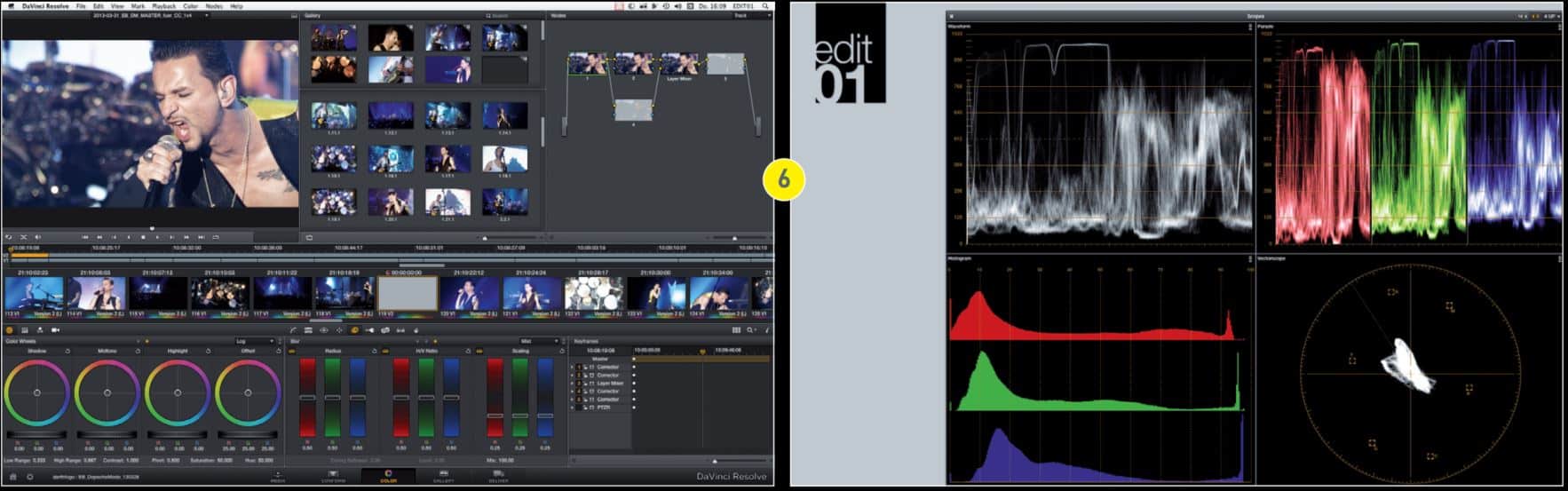
Tobias Berbuer: Together with our colourist Ingo Schulten, we came up with a special colour concept for the Depeche Mode concert. The focus was on finding the right tonal value for singer Dave Gahan. All other colour decisions are positioned around this central point. We orientated ourselves on the lighting concept of the show. For the skin tones, we therefore opted for a bronze tone with a slight “gritty look”. It emphasises the contours of the face and the muscles and therefore goes well with the music. Next, we focussed on a rich, pure black. It gives the image punch and depth. On a concert shoot, it is always important to find the right balance between the desired pure black and the desired skin tone. The third point is to emphasise the light. The haze that is artificially created in a hall is both a blessing and a curse for us. On the one hand, it reduces the contrast of the more distant cameras enormously, which is sometimes difficult to compensate for. On the other hand, it forms a kind of canvas in the room on which the cones of light from the spotlights are reflected. Our aim was to further emphasise this effect and thus make the lighting concept of the show more vivid.

DP: Are improvements actually paid for without any problems?
Tobias Berbuer: Of course, we try to do everything possible within the budgetary constraints. We are not artists who create an intangible work, but craftsmen who produce films at a high technical level. I believe that an hour of craftsmanship should cost money. Take the following example: A customer orders a table from a carpenter. After completion, however, he wants it two metres longer and drawers added. Then it simply costs more. You have to point out possible costs at an early stage.


DP: How much can you absorb in advance?
Tobias Berbuer: Quite a lot. We provide advice long before production and also on site so that surprises like this don’t happen. For a watertight offer, the items must be precisely defined, then you can also argue in case of change requests. Our job is to make the artist look as good as possible on stage without making it look unnatural. We simply put things in the right light. I have to take into account the wishes of the band, management, client, director and, of course, the viewing habits of the target group.
DP: How do you organise your workflow?
Tobias Berbuer: It varies from production to production. Nevertheless, there are of course steps that are always the same, such as how an ingest is organised. To optimise the workflow, we convert all data into ProResFiles before the start of post-production, as we always have mixed camera systems. Although this makes more work in advance, it avoids potential sources of error afterwards.
DP: Do you have any other tips?
Tobias Berbuer: We have a permanent employee who supervises a project from A to Z, i.e. from digitisation to playout, so they know exactly what’s going on. We have also built in quality control at every stage of the process. This avoids errors relating to synchronisation or timecode breaks. Of course, basic rules such as a clearly defined folder structure and file names are essential for production reliability.

DP: Why do you work with Resolve?
Tobias Berbuer: The workflow is very flexible and raw material can be accessed directly. The three-layer correction is also essential for speedy work: I can define a global look and edit the images again on each camera or locally, cut by cut. With DaVinci, I can apply a grade that I set to camera 6, for example, to all camera 6 cuts in a concert at the touch of a button. With 120 minutes, we have between 1,500 and 4,000 cuts. You can imagine what it would mean to start from scratch with every cut. I personally think that Blackmagic provides a powerful and cost-effective tool with which you can make high-quality corrections and designs. The support team is also quick to respond to problems.

DP: What else should be added in the future?
Tobias Berbuer: The next version of DaVinci Resolve has just been unveiled at NAB. Many of our wishes have already been incorporated into it. Resolve is continuing to develop into a finishing tool. Thanks to new editing tools and improved audio processing, it is now possible to export the finished master directly from the programme. A fundamental improvement is the ability to use OFX plug-ins. It won’t be long before someone has written a legaliser plug-in. Such a function was previously missing in Resolve, so that a final step in an editing application was still necessary to eliminate any gamut problems during quality control. In addition, many small changes simplify and speed up the work: new power windows for creating vignettes, colour correction options directly in the grid view, the transfer of tracking data via copy and paste or the display of several variants of a grade next to each other. If we need four or six mouse clicks less for a work step with this version, we reach our goal faster and can use our time more effectively.
DP: Which programme do you use for editing?
Tobias Berbuer: We have been working with Final Cut Pro for many years, as it emerged as the best system for multi-camera recordings at the time.
DP: What about FCP X?
Tobias Berbuer: I have a working toolbox. As long as nothing new comes onto the market that significantly improves our workflow and results, there is no reason to change. There is a lot of uncertainty in the industry. Many colleagues are asking themselves whether they need to switch to Avid or Premiere now. I don’t buy into the hype of having to try out every new thing.
DP: You were the first German post-production company to switch to Huawei storage, the Ocean Store S5000T. How did that come about?
Tobias Berbuer: In the course of founding Editors, we added two more editing suites. This pushed us to our limits in terms of data volume and throughput. It was important to me that the administrative workload remained as low as possible. I want to concentrate on the actual work and not on how to get the technology to work. Accordingly, we work on an Xsan infrastructure as a metadata server and handle data exchange via Fibre Channel – every computer can access the raw material with an 8 GB Fibre Channel line. In December, we had many large projects in parallel, with a total of 160 man-days of work – the successful acid test for the system.
DP: What else was decisive in winning the contract?
Tobias Berbuer: The intelligent design of the system is also very useful in an emergency. If necessary, you can change any component during operation. I only have to turn a small tick and 10 seconds later I have replaced a power supply unit. This works really well on the fly. Another point was the relatively favourable support contract.
DP: Finally: What is your favourite band?
Tobias Berbuer: Oh, that’s difficult. I’ve been working with music since I trained as an image and sound media designer, I’ve been involved in music video productions and have been editing concerts almost exclusively for nine years. Let’s put it this way: live music interests me the most. Basically, I like bands where you can tell that they have mastered their craft, make music for the love of music and develop their very own, unmistakable sound.
