



In nuce: Nvidia presented its latest generation of graphics cards at the Nvidia GPU Technology Conference (GTC) – more precisely: the graphics cards of the GeForce RTX 40 series (see the video of the GTC keynote below). The luxury product is the RTX 4090, flanked by the RTX 4080 – which will be released in a 12 and 16 GB version. The RTX 4090 has 16,384 CUDA cores, while the RTX 4080 12 GB variant only has 7,680 CUDA cores and the RTX 4080 16 GB variant has 9,728 CUDA cores. The difference between the RTX 4090 and the two RTX 4080s is therefore correspondingly large. In addition, a new version of the RTX 6000 graphics card is to be released, which is aimed at the needs of creative professionals (see video below). In other words, a total of four new graphics cards have been announced.
In toto: According to Nvidia, the new generation of graphics cards will bring ray tracing to the mass market. Nvidia CEO Jensen Huang said at the GeForce Beyond: Special Broadcast at the GTC that Nvidia wants to take RTX ray tracing and neural rendering to the next level with the Ada-Lovelace architecture. The Nvidia CEO also said that the Ada-Lovelace series would deliver four times the performance of the previous generation of Nvidia graphics cards. Incidentally, the competition is not sleeping. AMD plans to launch its new Radeon series on 3rd November.

RTX 4090: The RTX 4090 graphics card flagship will be available from 12 October for around 1,600 US dollars. In Germany, the top model will be priced at 1,949 euros. Jensen described the RTX 490 as the “heavyweight champion” at the GTC. The RTX 4090 with 16,384 CUDA cores has a theoretical computing power of 83 teraflops and 24 GByte GDDR6X. The built-in Ada Lovelace technology, named after the world-famous mathematician, works via Deep Learning Super Sampling (DLSS) 3. The highlight: the AI behind DLSS 3 is designed to create frames – instead of just individual pixels, as was previously the case. DLSS is designed to overcome the performance limitations of the CPU. Other important key data: RTX 4090 is based on the 4 nm AD102 chip with 608 mm² and 76.3 billion transistors.

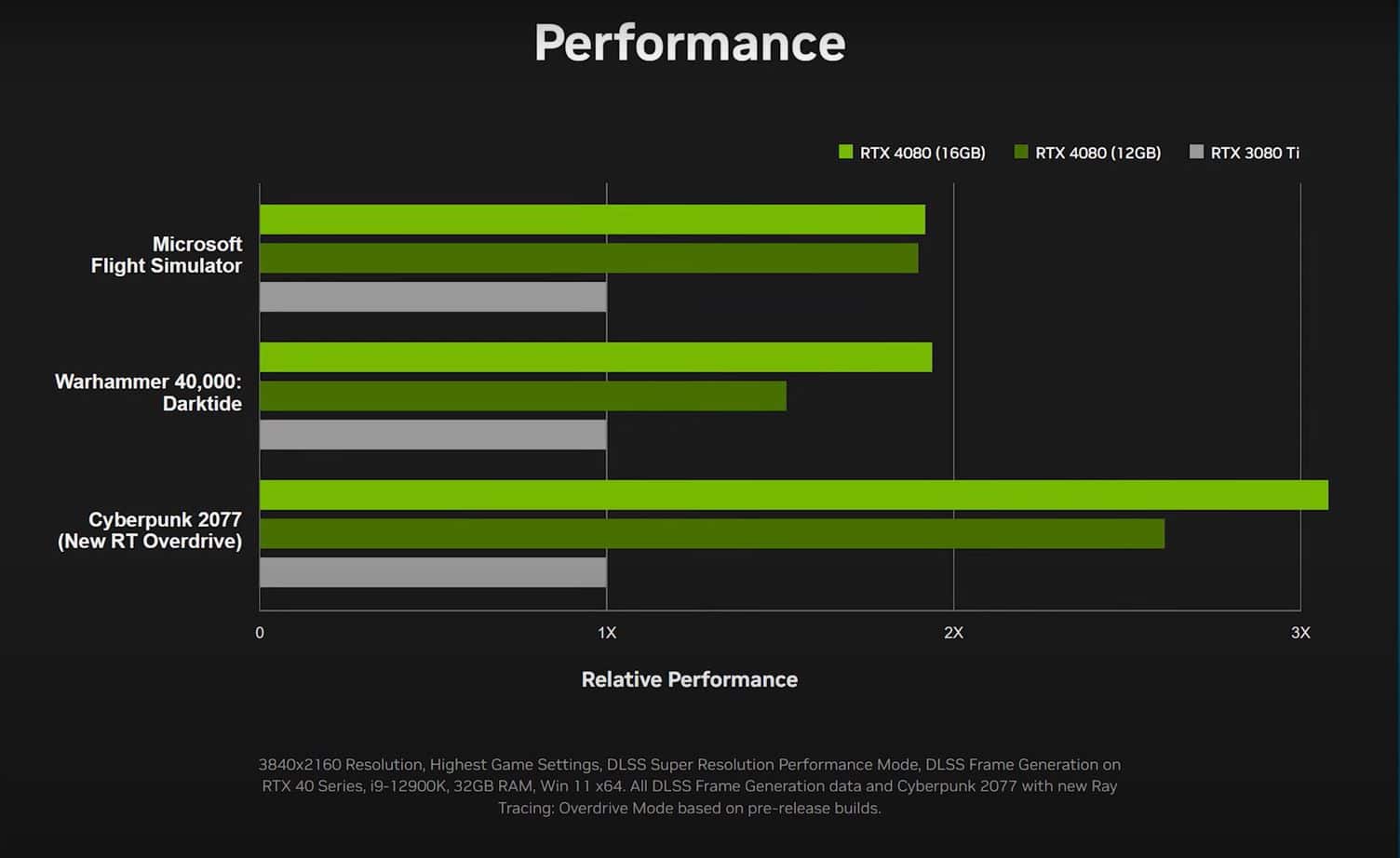
RTX 4080: The RTX 4080, which has also been announced, is to be released in two variants – one with 16 GB GDDR6X memory, 2.51 GHz and 9,728 CUDA cores, then with 12 GB GDDR6X memory, 2.61 GHZ and 7,680 CUDA cores. Both RTX 4080 variants will be available to buyers in November of this year for USD 1,199 (EUR 1,469) and USD 899 (EUR 1,099) respectively. In a performance comparison, Nvidia pits the 16 GB variant against the 12 GB variant – the differences in terms of performance are only marginal (see image below). The computer games Microsoft Flight Simulator, Warhammer 40,000: Darktide and Cyperbunk 2077 were used for the comparison. Graphics card experts are currently discussing Nvidia’s naming online – the two RTX 4080 variants are labelled under the same name, but have very different technical specifications.
Widespread ray tracing: As mentioned above, ray tracing is to be brought forward with the new GPUs. Thanks to Shader Execution Reordering (SER), several processes are to be calculated simultaneously during ray tracing – resulting in an FPS increase of around 25 per cent. Opacity Micro-Map is intended to fundamentally increase the frame rate for ray tracing. According to Nvidia, Opacity Micro-Map helps to map complicated geometries more efficiently onto triangles and micro-meshes. Opacity Micro-Map encodes the opacity of micro-triangles – and generally makes ray tracing more performant (for example in scenes with many environmental details, such as complex vegetation). In addition, a micro-mesh engine spontaneously generates micro-meshes and uses them to create additional geometries, which should also speed up ray tracing.
Sources: derstandard.de, golem.de, heise.de, notebookcheck.net, YouTube channel Linus Tech Tips, developer.nvidia.com
GTC Sept 2022 Keynote with NVIDIA CEO Jensen Huang
RTX 6000 Ada Generation Accelerates Engineering Simulations for Faster Product Development Workflows
