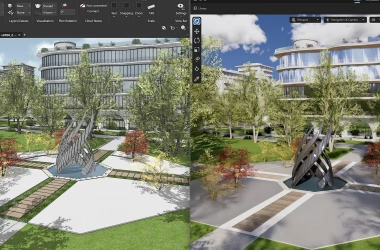
DLSS Ray Reconstruction lands in Blender 5.3 Cycles this fall, adding a new denoiser option built on the existing OptiX path. Expect faster lookdev, then test hard.
Maxon has released Redshift 2026.4. The update introduces Redshift Live as a new real-time render mode, drops Redshift RT, adds support for Vectorworks 2026 Update 4, and brings a set of rendering and workflow updates across the wider Redshift ecosystem.
World Creator 2025.3 brings ORBX export for OctaneRender, Godot integration and cave-mask terrain tools, adding flexibility for terrain export and engine pipelines.
Houdini 21 polishes the chaos: production-ready MPM, neural surfacing, smarter Pyro, and Vulkan viewport upgrades: all taste-tested for real-world use. (Part 1 of ???)
Theory Accelerated has dropped Axiom 4, the GPU-driven Houdini solver for smoke and fire that promises fewer artifacts, more speed, and a UI that doesn’t feel like it was designed during a caffeine shortage.
Arnold 7.4.3 introduces a machine-learning Inference imager, faster GPU volume rendering, improved Global Light Sampling, and enhanced OpenPBR and USD workflows.
Autodesk's Arnold 7.4.1 introduces GPU-accelerated toon shading, enhanced procedural instancing performance, and a new interactive HTML-based render statistics viewer.
Project DIGITS pairs NVIDIA's Grace Blackwell Superchip with compact design, offering potential for VFX rendering, denoising, and AI workflows. Testing will tell.
Marmoset has released the beta version of Toolbag 5, which supports real-time rendering as well as texturing and lighting. The update offers numerous new features aimed in particular at VFX artists and game designers. Users of version 4 can test the beta version free of charge.
There are some things that get more complicated, the more
you look at them - simulation of physical phenomena is one of them. And as we saw at this year's Siggraph Conference,
there are people who are looking very closely!
Version 3.5 of the 3D graphics software Blender is in the starting blocks - together with Metal Support, Renderer Eevee and bug fixes. A message from the alpha phase.
The top model RTX 4090 has ray tracing superpower - and RTX-4080 comes in 12 and 16 GB variants. The new RTX-6000 is tailored to the needs of creative professionals.
New machine-learning features, Physical Defocus effect, finishing updates and more: Flame 2021 from Autodesk comes with several practical new features.
Thunderbolt fuelled hopes early on that it could be used to boost the graphics performance of a computer. For a long time, however, it only supported the use of fast storage solutions, but not external graphics cards - now known as eGPU or eGFX. Read more....
Biased vs unbiased rendering, new features in Redshift 3.0 and a look into the future of rendering: This and more in our conversation with the developers!
Alongside the Cinema 4D R19 integration, AMD now provides further macOS plug-ins: beta versions for Maya and Blender are already available to download.
With your own render farm, you can render your projects flexibly in your own premises. But what differences are there and how do I select the right render servers?
Redshift has released the second version of its GPU renderer: new features include OpenVDB support, improved subsurface scattering and a new PBR-based Redshift material.
Natron, the blossoming open-source compositing tool, is currently at version 2.0.5 and has now gained an interesting feature: Shadertoy, a unified GPU shader language.
Do you have a maintenance licence for Nuke? Then don't take anything for granted on 15 January - because Nuke 10 enters the beta phase on the 14th. And what will we have to test and try out? Keyer on the timeline, more Opencolor IO, Smartpainter and a new render engine!
Konstantin Gaytandzhiev of Chaos Group provides an insight into the V-Ray realtime rendering engine on a 5-GPU 3DBOXX 8950 workstation, including integration into the Maya viewport. With a brief (!) outlook on V-Ray 3.0.
The newly available update for Adobe After Effects, Version 11.0.1, includes support for GPU acceleration using GeForce GTX 680 Kepler technology for the 3D Windows ray-tracing renderer.
At this year's GPU Technology Conference, Nvidia presents another innovative development. Cloud computing receives acceleration through the Kepler architecture.
In two days, the time is supposed to come. NVidia intends to present the new generation of graphics chips with the designation GK104, and the rumour mill is already bubbling vigorously. The question is which of the rumours about the new Kepler GPU actually come into consideration.