DLSS Ray Reconstruction lands in Blender 5.3 Cycles this fall, adding a new denoiser option built on the existing OptiX path. Expect faster lookdev, then test hard.
As the AI revolution redefines the creative landscape, Reallusion is proud to unveil its latest technology roadmap, positioning the company at the forefront of the next era of hybrid media creation.
Chaos’ Chris Nichols explains how Chaos Arena and Chaos Vantage cut out the engine middleman with full ray tracing, open formats, and one asset for all.
Virtual production wouldn’t be possible without high-performance workstations. These systems deliver the computing power required for rendering, simulations, and complex visual effects directly within the studio environment.
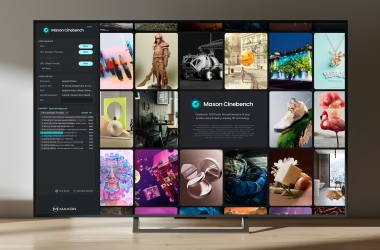
Graphics benchmark Specviewperf 15 adds test suites for Blender and Unreal Engine 5 – plus support for RTX 6000 Ada, Radeon Pro W7900 and Intel Arc GPUs.
ComfyUI now supports NVIDIA Cosmos, transforming AI video generation into a serious tool for VFX pros. Text-to-video meets production pipelines—but test first!
Project DIGITS pairs NVIDIA's Grace Blackwell Superchip with compact design, offering potential for VFX rendering, denoising, and AI workflows. Testing will tell.
The Blender release cycle consists of three new versions of the software per year. The first release is usually characterised by new features. The reason for this is that the third and final release is a Long Term Support (LTS) version, which is supplied with bug fixes for another two years.
Okay, we admit it: AI is slowly becoming interesting - even for everyday production. And as we see more and more tools that are relevant for artists, and not just for "tech bros", the more our workstation is glowing. So it's time for us to find out what it takes to work normally and what adjustments we can make to reconcile budget and computing power.
USD seems to be catching on - Pixar, Adobe, Apple, Autodesk and Nvidia have launched the "Alliance for Open USD" together with a branch of the Linux Foundation
„The fastest codec in the world“ is how the Munich-based broadcasting and production software developer Cinegy advertises its video codec Daniel2; it uses the computing power of the graphics processor to speed up image processing specifically and workflows in general. The codec promises: real-time film editing with Adobe Premiere CC, at a resolution of
of 8K - without any drop in frame rate. A conversation with Cinegy boss Jan Weigner about Content Creation with Power Codecs.
Omniverse in its various components can serve as a "meeting point" for the various DCC packages and their output - and now everyone is wondering
and now everyone who wants to work with it is wondering how well it works. So let's just ask Simon Haegler from the CityEngine team how well you can develop with the Nvidia environment.
At the Consumer Electronics Show, graphics card manufacturer Nvidia presented innovations for its Omniverse collab platform. AI tools, Blender extension and more.
DeepSearch is being modernised, new connectors are to ensure better collaboration - and Omniverse is to become more performant and user-friendly in general.
The top model RTX 4090 has ray tracing superpower - and RTX-4080 comes in 12 and 16 GB variants. The new RTX-6000 is tailored to the needs of creative professionals.
Perhaps the most impressive new feature is called Neural VDB - it is currently still in beta, but should result in significant data savings for 3D assets.
Presented by notebooksbilliger.de: Users looking for a desktop computer à la price-performance queen should go for a Windows or Linux computer with a powerful GPU, right? With one caveat: the availability and price of high-performance GPUs are currently problematic. So where can digital nomads and laptop enthusiasts find what they're looking for?
Brought to you by notebooksbilliger.de: In this in-depth interview with Senior Technical Product Manager Rick Napier we talked about Nvidia Studio. What is it and how does it work?
VFX triad at the GTC: "Adobe Substance 3D enters into marriage with Nvidia's Omniverse", "Artist collaborations worldwide with Omniverse Cloud" and "Improved rendering on Nvidia's online platforms".
The realtime project for V-Ray is now ready to test as a beta for users with a V-Ray Next Render licence: Project Lavina is available as standalone version 0.10.
The Razer Blade is the second gaming notebook in the test that we analysed for its suitability as a potential workstation. Of all the workstations in the test field, the Razer Blade has the CPU with the lowest performance reserves, but can compensate for this with other qualities.
The company Weltenbauer from Wiesbaden has been a specialised dealer for 2D and 3D software for over 15 years and, in addition to Hewlett Packard computers, also offers workstations and render servers from its own production. We had the entry-level model RK50 sent to us for testing and took a closer look at it.
The new Titan RTX, nicknamed T-Rex, comes with 11 Gigaray ray-tracing performance, 130 teraflops of “deep learning performance” and 24GB DDR6 RAM. Shall we start editing 16K material?