



Rahul Parihar has released Clay 4.Doh, the latest update to his procedural clay shader and toolkit for Blender. Announced on 22 August 2025, the update is free to existing users and continues the promise of one‑time purchase pricing with perpetual updates. The toolkit, originally designed to mimic the look and behaviour of real clay, now expands into new territory with additional tools, modifiers, and shader refinements.

Clay 4.Doh retains its foundation on Blender’s Principled BSDF shader, which ensures physically accurate rendering without requiring UV unwrapping or manual texturing. A single master node drives all clay variants, streamlining material creation for artists working across Cycles and Eevee. This design makes the shader predictable and consistent, an important consideration for production environments where stability outweighs novelty.
New Tools and Modifiers
The update introduces several new creative tools including a Pottery tool, Clay Text, and Eyes. These extend the procedural approach, allowing users to generate complex clay‑like effects without leaving Blender. Clay Text supports all fonts and languages, broadening its use in motion graphics as well as character work. The Eyes tool integrates directly into the clay system, enabling stylised character creation with consistent shading.
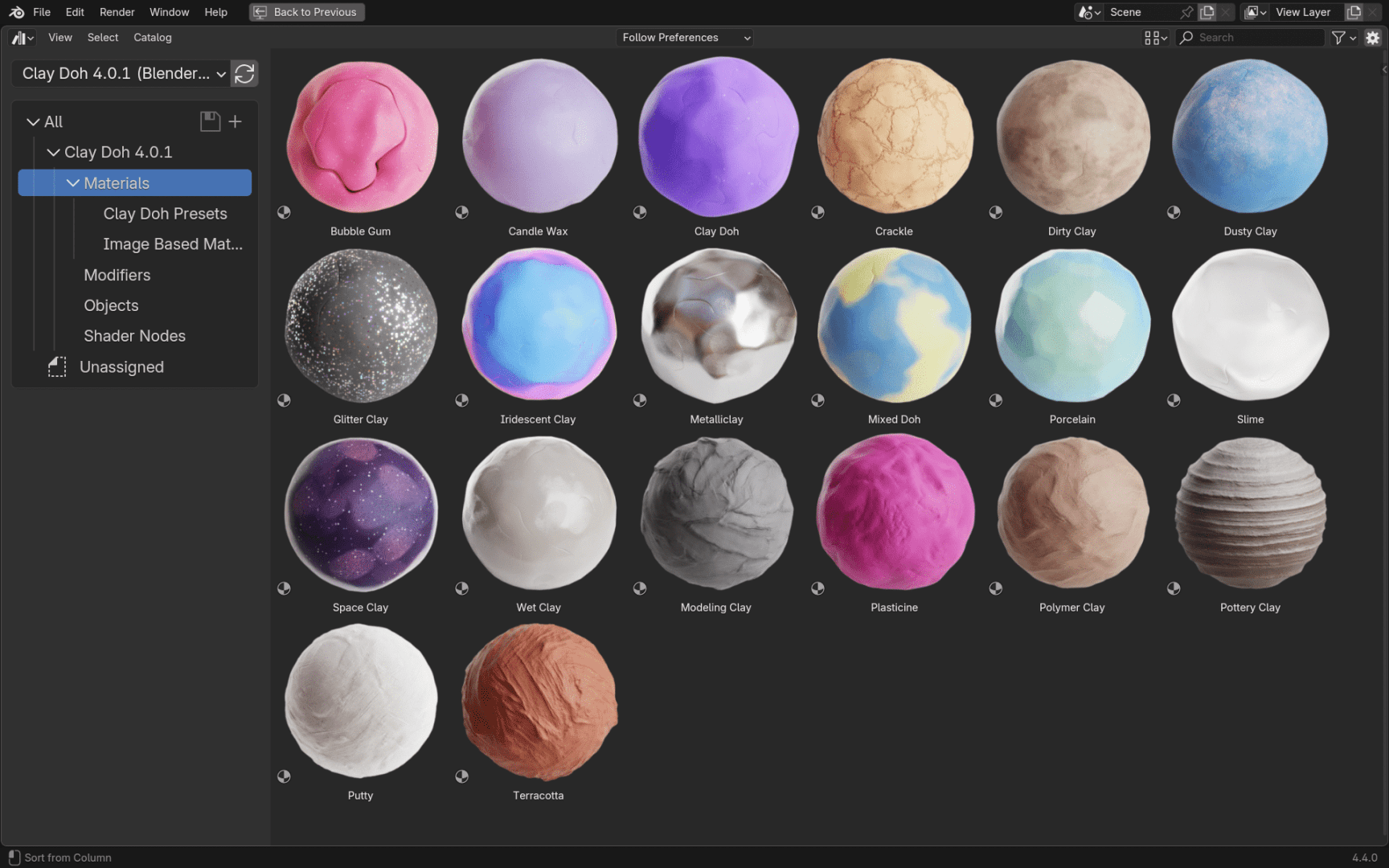
Clay 4.Doh also brings modifiers for Mesh, Curve, Grease Pencil, and VDB objects. This widens compatibility across Blender’s different object types, allowing artists to maintain the clay aesthetic whether working with geometry, strokes, or volumetrics. Fingerprints and finger dents have been upgraded, producing finer, more realistic surface variation. These refinements address one of the key demands in claymation‑style projects: believable tactile detail.
Animation, Surface Effects, and Rendering
Support for sticky textures ensures materials move correctly with animated meshes, preventing sliding artefacts. Clay 4.Doh continues to include stop‑motion capabilities, enabling animators to simulate the frame‑by‑frame look of traditional clay animation directly inside Blender. Additional surface overlays have been added, including glitter, dust, and crackle effects. These run alongside existing shader controls such as subsurface scattering, ambient occlusion, and transmission, giving artists flexibility in shading without adding complexity to the node setup.
The toolkit is positioned as a production‑ready material system. By remaining tightly bound to Blender’s existing rendering engines and keeping everything node‑based, the workflow avoids external dependencies. This ensures projects can be archived or shared without versioning headaches.
Pricing and Availability
Clay 4.Doh is sold exclusively through Superhive Market. Pricing is tiered: Clay Doh Solo at 35 US dollars for individual users, Clay Doh Team at 140 US dollars for up to five users, and Clay Doh Studio at 299 US dollars for up to fifteen users. All licences are non‑subscription and include future updates at no extra cost. For a limited time, buyers can apply the discount code “claydoh25” for 25 percent off. The package includes tutorials and documentation, with further training available on Rahul Parihar’s YouTube channel.
