



Browsing Tag
macOS
83 posts

LUT Tuner Makes LUTs Tunable in Resolve
Excerpt: Cutpoint Labs turns edited .cube LUTs into adjustable Resolve DCTLs, complete with fit metrics, range controls and an inverse workflow.


Cadrage Directors Viewfinder NO AI
Cadrage Studio sits in creative pre-production for directors and DPs, between script breakdown, previs and location prep. It…

EditingTools.io Resolve Collect copies media
Resolve Collect scans Resolve and Premiere projects, finds used sources, and copies them into one place with options like trimming and symbolic links.

DriveCompare brings ASC MHL offload checks to macOS
DriveCompare does the boring part of film data right: compare, sync, verify, ASC MHL, Netflix-style checksums. No subscription tantrums required.

Sketchbook Pro 9.4 adds Lasso Fill and Draw Outline
Two new selection-driven tools land in Sketchbook Pro 9.4, while mobile gets the same tricks via Premium Bundle. Fast blocking, cleaner edges.
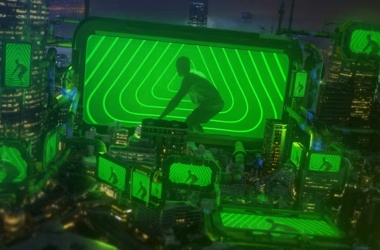
Maxon Autograph 2026 is here
Maxon Autograph went free for individuals, learned USD, and picked up OpenFX. Nice.

Neat Video 6.1.2 adds Vegas 2026 and Nuke 17
Neat Video 6.1.2 shows up with M5 Pro and M5 Max support and fresh host app compatibility, so your denoise keeps pace.

LUTs, Tags, or ICC: Getting Colours Right in Resolve on a Mac
For years, proper monitoring in DaVinci Resolve meant a Blackmagic I/O box and a calibrated display. On recent Macs, Resolve has become more predictable without dedicated hardware, but that does not make calibration optional. Here is where the situation has improved, where it still falls apart, and why Rec.709 scene remains the least bad common denominator.


VINZI Atlux λ arrives on Fab
Atlux λ is now on Fab, bringing a virtual photo studio and one click renders to Unreal Engine, plus Mac support.

OctaneRender 2027.1 alpha goes neural
OctaneRender 2027.1 alpha chases cleaner viewports, smarter lights, and more USD. Test it like it is spicy, because it is.


Dither Boy 6.0 brings animation and video polish
Dither Boy 6 rewrites the app, adds animation timelines and temporal variation, plus faster iteration and better video playback.
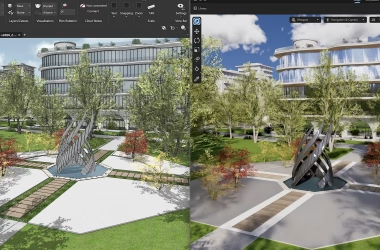
Maxon ships Redshift for Archviz
Redshift Archviz moves BIM scenes from waiting to tweaking, with real-time previews, assets, and a one-click hop to Cinema 4D for the fancy shots.

The GIMP Team boosts GIMP 3.2
GIMP 3.2 arrives with linked layers, vector layers, smarter non-destructive filters, and new export options. Less redo, more done.

Adobe releases Substance 3D Painter 12 with decal warp
Substance 3D Painter 12 adds Warp to Geometry for decals, expands viewport post effects, and introduces flatten-in-stack exports plus new pricing details.

Redshift 2026.3 fixes displacement headaches
Redshift 2026.3 is a stability release focused on texture displacement, Hydra USD updates and host bug fixes.

DJV 3.3.3 fixes flipped export and adds Escape
DJV 3 brings sequence-aware browsing, expanded shortcuts, OCIO UI updates and flipped export fixes through 3.3.3.

Neat Video 6.1 updates OFX and host support
Neat Video 6.1 adds Baselight 7 support, new default profile controls and OFX updates across Windows, macOS and Linux.

PFTrack update tidies Maya and LiDAR workflows
PFTrack update refines Maya export, LiDAR error handling and Survey Solver node logic for Studio and Enterprise users.

Baselight v7 refines the colourist’s toolkit
FilmLight’s Baselight v7 adds smarter mattes, new depth tools and workflow upgrades for complex grading and VFX-heavy productions.

3DEqualizer 8.1 Adds Piggyback Camera Solves
3DEqualizer 8.1 introduces piggyback rig solving, a rewritten Blender export script and new import and export options.

Rays Behaving Badly No More: MoonRay 2.34.0.1 Fixes the Path
MoonRay 2.34.0.1 lands with a light path visualiser, better macOS and Linux builds, smarter lightsets, and fewer crashes for your next render night.

Chaos Adds macOS & AI to V-Ray for Blender
Chaos ships V-Ray for Blender Update 2: macOS support, AI tools, faster distributed rendering, and a long list of bug fixes and GPU tweaks.

Off-Grid, On-Tape: EditingTools.io Launches Local Timecode Notes Server
EditingTools.io brings offline collaboration to live productions with its new Live Timecode Notes Server for macOS.

ProRes RAW News – Fresh from the Freezer
Resolve 20.2.1 + Sequoia = real ProRes RAW. Sonoma users: no dice. iPhone 17 footage shows the difference...

RV 2025: Onion Skin, Live Review, ARM Macs
RV 2025 arrives with Live Review (Beta), ARM64 macOS support, and onion skin annotations.

LuxCoreRender 2.10: Back on Track with Cross-Platform Support and Python Integration
LuxCoreRender 2.10 reintroduces support for Linux, Windows, MacOS Intel, and now MacOS ARM, with updated dependencies and Python bindings for seamless integration.


Mac mini or iPad Pro M4 for Post?
The iPad Pro, with its M4 processor, shows potential for video editing, particularly with applications like DaVinci Resolve. However, limitations arise, notably in memory capacity (16 GB max), affecting stability with high-resolution projects.

Baselight Goes Mac: FilmLight Introduces Baselight S and M
Baselight S and Baselight M bring FilmLight’s high-end grading tools to macOS with subscription-based access for freelancers and facilities.

Color Monitoring for Cheapskates?Part 1
Colour Monitoring is cheap, easy, and fast. As usual, you can pick two of those adjectives — and in this series, we are going for cheap and will make it easy for you!

Hardware for CineMon (et. al.)
After looking at the software side of CineMon, it's time to take a look at the hardware - whats good and what's not?

CineMon 1.0 (Beta) for iPad and Mac
The times of expensive hardware-based scopes are gone. Modern software scopes are versatile, flexible, and can be adapted to new technologies. Until now, Nobe OmniScope by Time in Pixels was the leading solution, both under Windows and MacOS. But there’s a new kid on the block for MacOS and iOS now, called CineMon (with a charming agnomination to a popular spice).

Assimilate Live FX 9.8 Pre-release
Live FX 9.8 introduces major enhancements, supporting USD 3D workflows on macOS, projection mapping updates, and improved OpenColorIO v2.3. Perfect for virtual production on the Mac.
Redmatica and Wavemachine Labs present new products at Musikmesse
The Italian software forge Redmatica presents its entire
range of EXS24 sample management software:

Equinux Hosts Munich CocoaDevHouse
Equinux will bring German Mac OS X developers together for the third CocoaDevHouse in Munich on 8 March 2008.
MediaCentral expands its online entertainment offering
equinux expands its media-centre software to more than 400 IPTV channels, video streams and international web-radio stations
Apple Introduces Xsan 2
Apple has introduced Xsan 2, a major upgrade to its storage-area-network file system for Mac OS X, adding MultiSAN and third-party RAID support.
“confoki”: parental controls for the internet
Website labelling system for all operating systems.
New Pinnacle TV and video solutions also for Mac users
Pinnacle Systems, the consumer division of Avid Technology, presents an update to its Mac solutions for particularly simple TV and video applications. These include Pinnacle Video Transfer, the simple video-transfer solution for iPod users, Pinnacle Video Capture for Mac, an affordable solution for analogue video-capture capabilities on the Mac, and the popular Pinnacle TV for Mac Sticks, the simple way to watch digital television on a Mac.
3Dconnexion SpaceNavigator Supports Leopard
3Dconnexion has added Mac OS X 10.5 Leopard support to its SpaceNavigator 3D mouse.
MW: Elgato Presents EyeTV 3
At Macworld Expo, Elgato presented the new version of EyeTV 3. The interface has been completely revised and adapted to Leopard.
MW: Quark Interactive Designer Now Runs on Leopard
Quark Inc. announced the availability of Quark Interactive Designer 1.02. The latest free update for Quark Interactive Designer is compatible with Mac OS X 10.5 Leopard. Quark Interactive Designer lets users create Flash projects (SWF files) directly in QuarkXPress 7 without programming knowledge.
Autodesk previews Toxik on Mac
Autodesk plans to show a technology preview of Toxik running on Mac at Macworld in San Francisco.
KORE 2 Demo Available for Windows and Mac
Native Instruments has released a demo of KORE 2, the second generation of its multifunctional host system.
desktop4education – Video Training from video2brain as Teaching Material at Austrian Schools
video2brain received an order for a nationwide campaign: The “OpenOffice.org” video training were licensed by the Federal Ministry of Education and Culture for use at Austrian schools.
KONTAKT 3 Demo Available
Native Instruments has released a KONTAKT 3 demo for Windows and Mac OS X with a tailored selection from the full sampler library.
FileMaker Satisfied with Bento Test Phase. More Than 100,000 Downloads in Less Than 30 Days
Database software manufacturer FileMaker is extremely satisfied with the preview phase of Bento, its new personal database for Mac OS X v10.5 (Leopard). Since the start of the public test phase on November 13, the company reports more than 100,000 downloads.
Bryce 6.1 Adds Native Intel Mac Support
Bryce 6.1 now runs natively on Intel-based Macs and requires Mac OS X 10.4.
Primera Supports Apple’s Premium Reseller Programme
On demand" burn and print optical media directly in the branch / Launch takes place on 8.12. at "Abbeys" in Munich.
M.I.R. 1.3 retouches film with Click & Fix
HS-ART’s M.I.R. 1.3 provides manual dust busting and wire removal for Windows and Mac film-restoration workflows.
New Flash Player Available
Adobe Is Making the New Flash Player Version 9.0.115.0 Available for Download.
MacLive Expo 2007: Nearly 90 partners and exhibitors
MacLive Expo 2007, which takes place in Cologne from November 15 to 18, is Europe’s only trade fair at which the Apple products iPhone and Mac OS X 10.5 (“Leopard”) as well as numerous other innovations are presented immediately after their market launch.
AJA Plans Mac OS X Leopard Support
AJA plans Leopard support for Io HD and the Kona 3, Kona LHe and Kona LSe professional video interfaces.
Apple’s Leopard jumps far
Apple sells two million Mac OS X Leopard copies in the first weekend
Leopard is in stores
On Friday, Apple brought the new edition of the Mac OS X operating system for Macintosh PCs to market. The new version «Mac OS X 10.5» had been eagerly awaited under the code name «Leopard».
It starts today: Launch events for the Leopard launch.
Apple is bringing the new version of its operating system Mac OS X to stores today at 6:00 p.m. The product launch is accompanied by a large number of so-called launch events. The Apple website provides information about exactly where they are taking place.
Apple Details Mac OS X Leopard Server
Leopard Server adds automated podcast production, CalDAV scheduling and 64-bit services while retaining native 32-bit compatibility.
Apple Sets Mac OS X Leopard Release
Mac OS X 10.5 Leopard adds Spaces, Quick Look, Time Machine, Boot Camp and updated Finder workflows, shipping on 26 October 2007.
SpaceNavigator Adds Acrobat Support on Mac
3Dconnexion adds SpaceNavigator control for Acrobat Professional and Reader 8 on Mac OS X 10.4.6 or later.
Microsoft: Silverlight 1.0 Available
Microsoft has released the first Final version of its Flash competitor Silverlight for Windows and MacOS X and at the same time announced a Linux version announced. In addition, Expression Encoder 1.0 is available for download.
The Pixel Farm: PF Hoe and PF Hoe Pro 2.0
The tracking specialist has updated the standard and Pro versions of its automatic matchmoving solution
Lacie Ships External Blu-Ray Burner
Drive compatible with BD-R and BD-RE media and with DVDs/CDs
Matrox DualHead2Go Now with Digital Outputs
External multi-display upgrade expands desktop area
Adobe Plans Cross-Platform Production Studio
Adobe's next Production Studio will run on Mac and Windows, adding Mac versions of Premiere Pro, Encore DVD and Soundbooth.
New Maxwell Render Plug-ins
Next Limit has presented updated plug-ins for Maya as well as 3ds Max and Cinema 4D
V-Tour for Mac
Realviz brings its tool for interactive 3D environments, after the Windows version, now also in a Mac version
Real Flow 4 Now Also for Mac
Next Limit's fluid-simulation software is now also available in version 4 for Mac - except in Japan
Cheaper Editing: FastCut 2.5 RT
New version of the realtime editing software for Mac OS brings better support for HD / engine revised
Automatic Duck Supports Intel Macs
The American manufacturer releases its timeline-integration software as a Universal version for Intel and PowerPC Macs
Digital Anarchy Microcosm 1.2 Encodes on All Macs
The lossless 16-bit video codec for Quicktime is now available in a Universal version for Intel and PowerPC Macs
Maxwell Render Also for Intel Macs
Next Limit now offers its software in version 1.1 as a “Universal Binary” for Intel and PowerPCs / some new features
Media 100 Launches Producer and Producer Suite
Software-only solutions for mobile editing available immediately
New Intuos3 Tablet for Widescreen Notebooks
Wacom responds to the widescreen-display trend with a compact professional pen tablet.
Realviz Stitcher 5.1 Available
Panorama software functionally expanded / Now also handles movie export and batch processing
Cinema 4D Available for Intel-Based Macs
Maxon today releases Universal Binary for new iMac with Intel Core Duo processor
Apple: Launch of the Intel Macs
With the presentation of the first Intel-based Macs, Apple started the new year. Professional users, however, must pay attention to several points when switching
Final Cut Pro 5: Apple Makes New Update Available for Download
Is Supposed to "Improve Reliability"
Avid Releases Media Composer Adrenaline and Xpress Pro for Mac OS X Tiger
The editing systems include new effects and functions optimized for Mac OS X Tiger
SIGGRAPH 2003: MicroScribe SDK for Mac
Immersion’s MicroScribe series can now also serve applications running on Mac systems.
Siggraph 2003: Poser 5 for OS X and Bodystudio 2.0 for Windows
From the end of August, Version 5.0 of the well-known Poser program is expected to be available for the Mac operating system OS X.
iStopMotion 1.0 Ships for Mac OS X
Boinx iStopMotion 1.0 combined stop-motion and time-lapse capture with uncompressed frames and external image editing.