



The short film was created as a final project in the Communication Arts/Narrative Environments master’s programme at the Institute for Media Research at HBK Braunschweig and was completed in 2012. Cinema 4D R12 was used for the 3D animation.
The big challenge with the small Meep was that knowledge of a 3D animation programme was initially only rudimentary. The HBK does not see itself as a traditional film school, but rather trains artists, designers and scientists on an interdisciplinary basis at many levels such as motion graphics, post-production, animation, compositing and in classic graphics disciplines. Computer animation at the institute is intended more for integration into the real image than as a unique selling point in a project.

However, to the extent that independent work is demanded and encouraged at the university, travellers are not held back and the ambitious project received every conceivable moral and technical support. Among other things, every effort was made to integrate pretty much every available computer on campus into the render farm set up especially for the project via a network, and a workspace and a Mac Pro were made available just for the project.
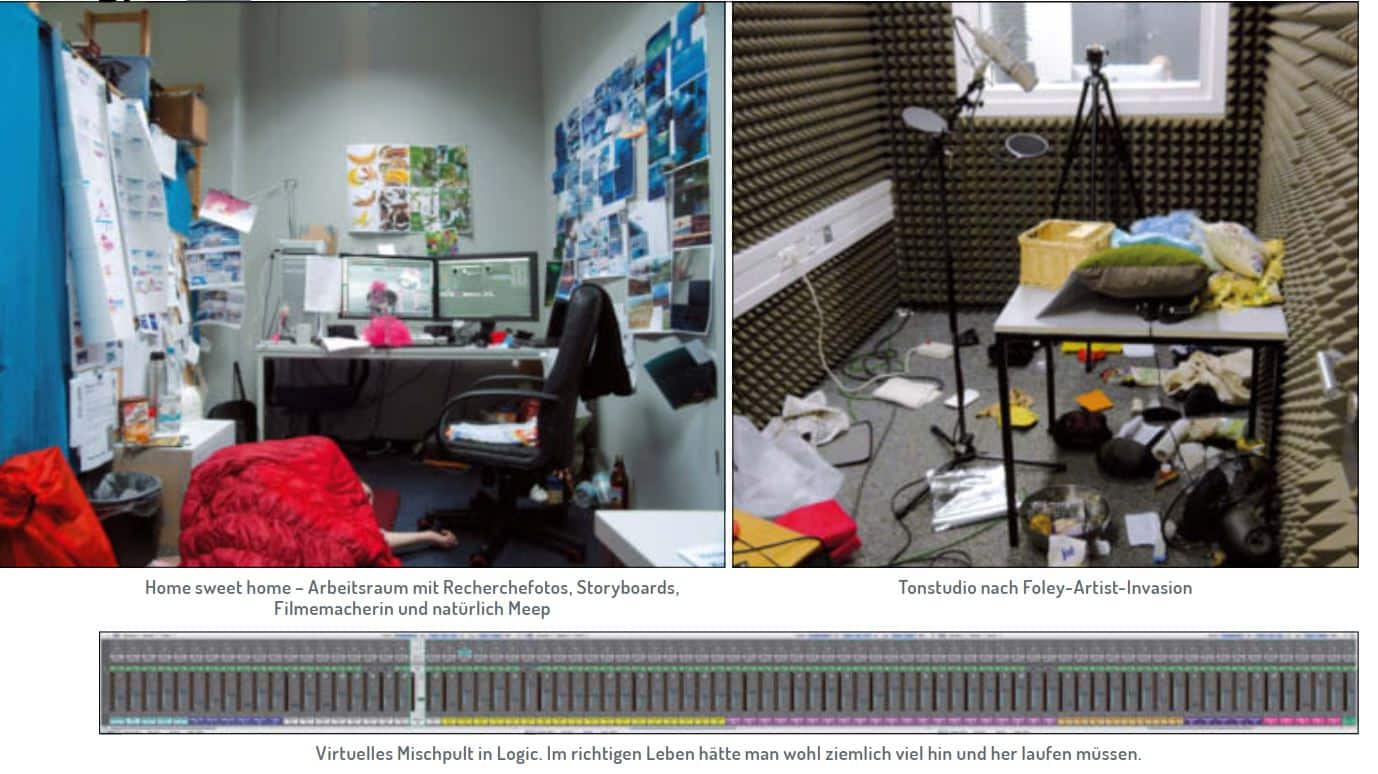
This was extremely helpful: a reliable machine was available at all times and the coffee cup, biscuits, pizza and research work did not have to be packed away every evening. The room soon mutated into a kind of second home.
The motivation to produce the film completely computer-animated arose from the fact that the hair module proved to be the ideal tool for the absolutely fluffy look of the main character. There had also been a desire for some time to finally work with computer animation. With Cinema 4D, achieving this goal seemed realistic, as the programme is relatively quick to learn. In any case, even at a relatively early stage, results can be achieved that are capable of motivating a beginner.
Story
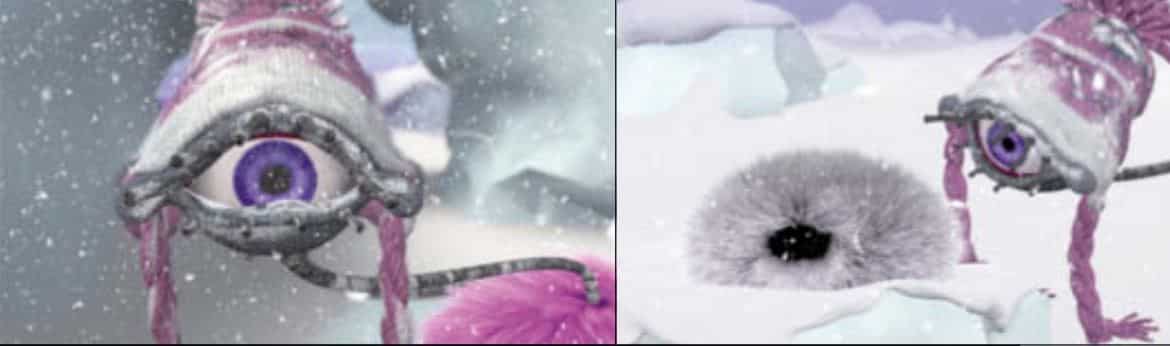
Meep is cute as sugar, fluffy, a compulsive wearer of a woolly hat and pink. He is terribly lonely in the snowy beauty of the Arctic and is bullied by a collective of dodgy furballs. He eventually falls madly in love with a banana and finds his very own path in life beyond the collective. The love affair ends tragically, but does not remain without consequences for Meep.



Idea and pre-production
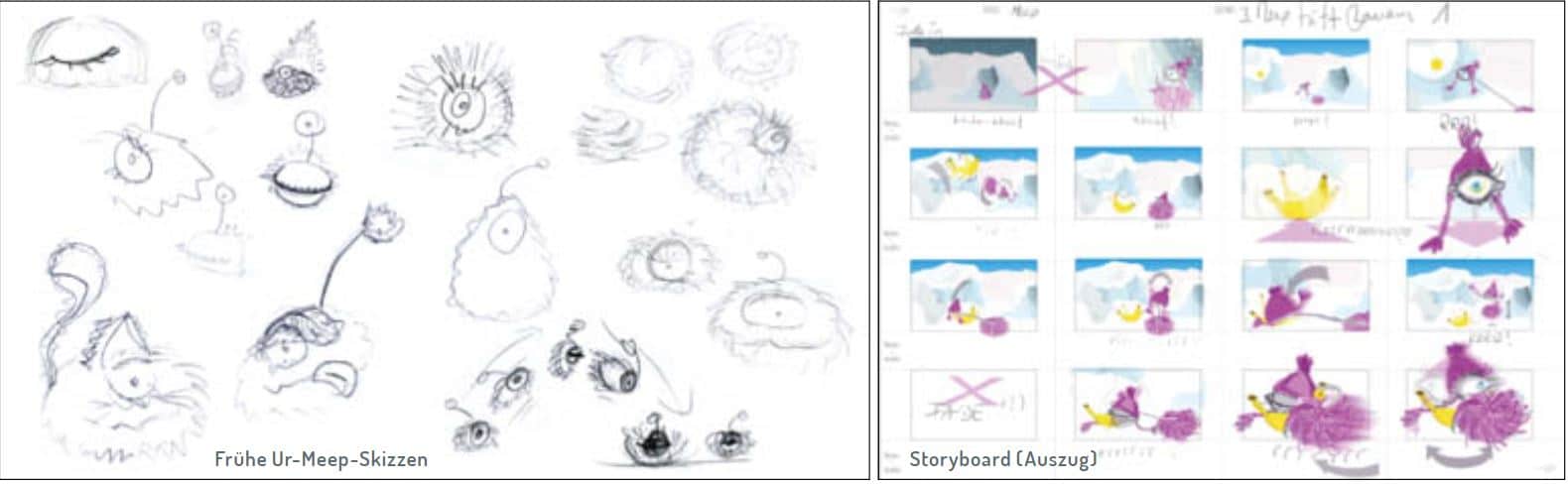
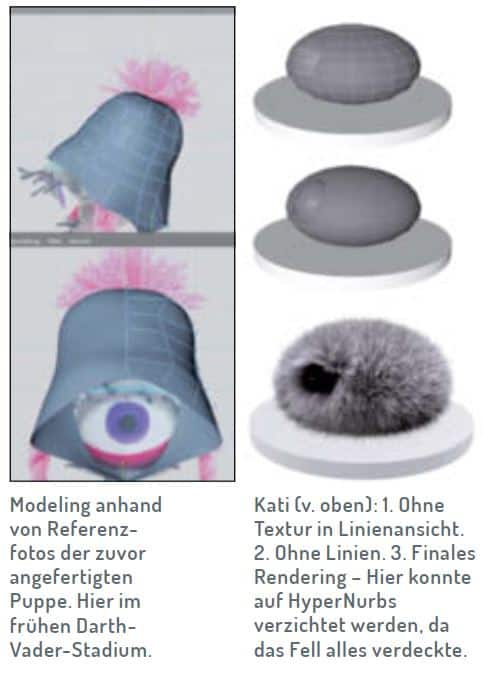
The idea of a cuddly character called Meep had actually existed for quite a long time. In a Cinema 4D beginners’ course, a first experimental Meep version was created, furry and without a hat. But with a banana. In the course of the main production, this original Meep was completely reworked once again in parallel work processes involving 3D, graphic design and a real puppet to clarify anatomical questions. Incidentally, contrary to common colour clichés, Meep is not a girl; his colour makes him a lovable outsider with a bananophile tendency, especially in the Arctic. The banana initially only existed as an exercise-related fruit garnish, but it now formed such a beautifully unadapted pair with Meep that the rest of the love story unfolded.
The script, storyboard and animatic were subsequently developed on the basis of this initial situation, with dodgy grey balls of fur coming into play as antagonists – no less fluffy and therefore not really unlikeable. And with eyes as unfathomable as the universe. The film characters had to be kept as simple as possible so as not to waste too much time on animation.
Meep’s well-insulating outfit provided an arctic environment, and no complicated plant structures had to be modelled or textured. For a beginner, it was difficult to estimate the amount of 3D work involved at first. As a result, many things were simplified and tricked – often it was simply a matter of finding the path of least resistance (= the shortest rendering time) without having to make too many compromises in terms of quality. This is where the advantage of a non-photorealistic rendering became apparent, and the snow was allowed to look like delicious cream.

Modelling and texture
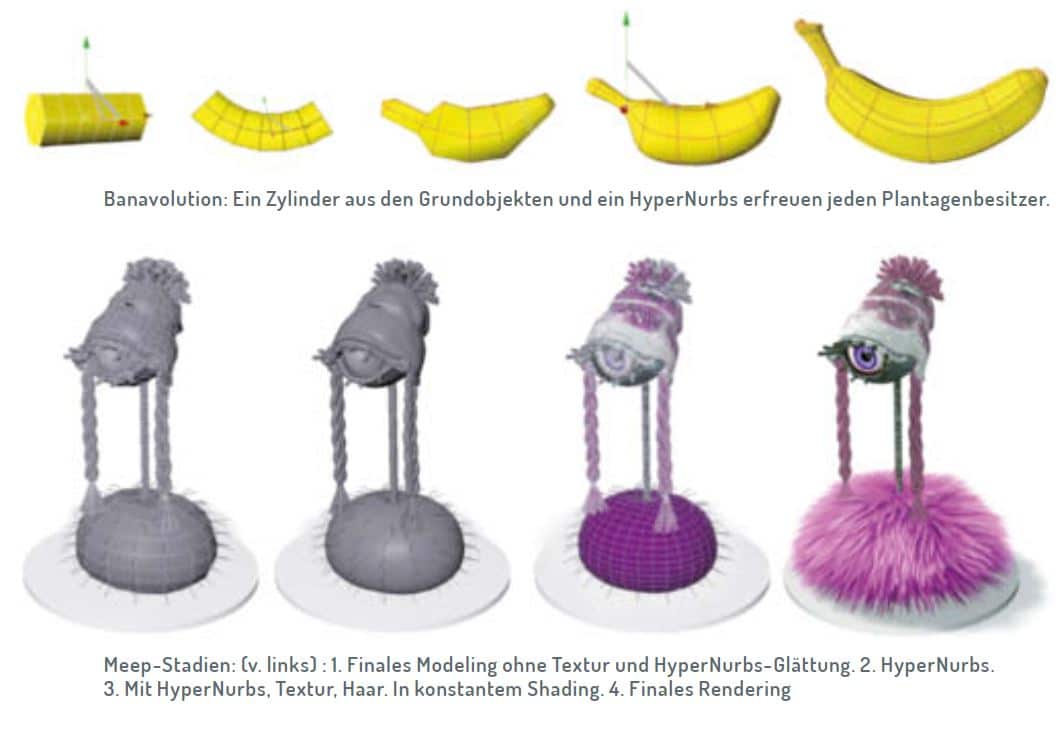
The modelling was largely problem-free. The tool palette consisting of symmetry object, sweep modelling, knife, bevel and extrude function, CNurbs, splines and hyper-nurbs for smoothing was thoroughly exhausted and, when applied to the basic objects, led quite quickly to the goal. The rather awkward structure of the braids was created using a tutorial from the net, which utilised the dark powers of formula splines.
Fine structures such as wool or terry cloth were realised using the texture and a bump map. In some cases, photographs of various socks and jumpers formed the basis, in others the textures were created directly in the programme – with shaders or, as with the banana, in BodyPaint. This did not always run smoothly, especially with regard to the UV design and suddenly multiple UVW tags. The mixture of the trial-and-error method used by beginners and a certain amount of time pressure required one or two workarounds.
Hair
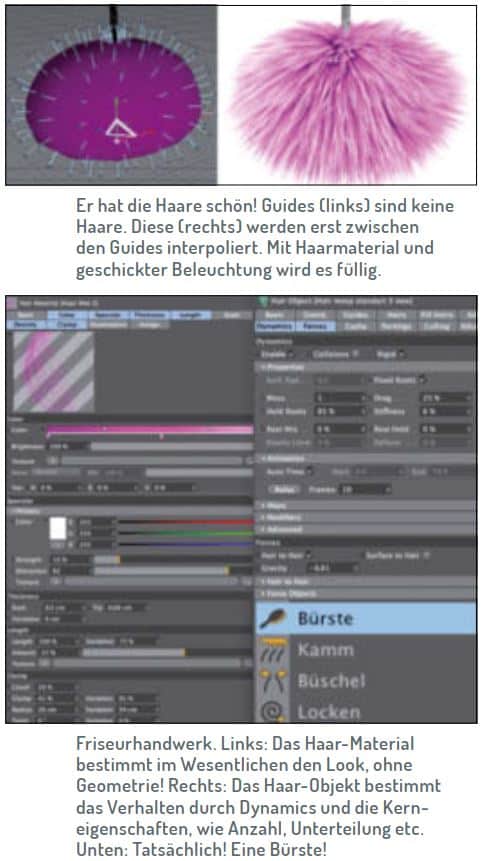
The hair functionality actually proved to be our best friend and greatest fun factor. The hair object instantly materialised in the object manager and could be designed in any number of ways thanks to the additionally generated hair material. Every now and then there were mysterious cases of circular or diffuse hair loss and spontaneous ageing, but usually a restart helped. The only serious problem was the rendering time. However, this could be controlled quite well by skilfully illuminating a reduced number of hairs.
In the hair object, we experimented with hair length, number of segments and quantity until we found a good compromise between a credible look and render time. The hair colour itself was also helpful.
The hair material can be wonderfully designed using gradients and a dark hairline and belly concealed low density. Different hair thicknesses, lengths and looks could also be simulated here. Blow-dried hairstyle or rasta – the hair material controlled all of this without any additional geometry.
In the thickness channel, the ends of the hair were set thin, as is the case with uncut hair, and slightly matted using the tuft option. To save further valuable render time, collision calculation was omitted and the hair was made more wiry so that it would not penetrate Meep’s stomach. An occasional impaling of the banana was retouched away in After Effects. In very critical cases, the hair was briefly controlled using pose morph, otherwise the hair object was responsible for simulating its movement – using secondary animation based on physical properties, the dynamics. An initial hairstyle was defined as the basic position, which was then used as the basis for further dynamic calculation.
With the hair tools, the programme developers demonstrated a droll attention to detail by actually incorporating a comb, brush and scissors. As difficult as the plunge into the cold 3D water was in places, the right decision was made when it came to hair. The desired look would not have been achieved with drawing or stop motion.
Rig and animation
Meep’s neck is long and consists of 30 joints. After a lot of trial and error, the spline IK (inverse kinematics) turned out to be the philosopher’s stone, especially once the hierarchical logic of the rig had been understood and the head finally started to move as well. The rest of the animation was a colourful mix of various tools such as pose morphs, deformers, constraints and dynamic IK for the braids. However, this only worked until collisions came into play as evil personified and jeopardised the project. In the worst cases, a spline IK had to help out here, because where a lack of collision was not very noticeable in the hair, it was simply impossible to overlook in the braids.
Light
Practical things like GI (Global Illumination) and AO (Ambient Occlusion) were out of the question for the lighting, as an extrapolation resulted in render times that were far too long. At important points, such as the points of contact between the eyelid and the cap, the AO was simply simulated and a core shadow was painted on using BodyPaint.
Apart from this, ordinary spotlights were used in conjunction with “Daylight” – part of the freely available CS Tools plug-in bundle. Based on an Expresso circuit, the entire illumination could now be controlled with sliders without having to control each individual light source every time.
Rendering
The render farm was reorganised specifically for this project. Depending on the frequency of other projects, an average of 16 iMacs, 12 Mac Pros, a brave Mac Mini and a MacBook rendered at 107.10 GHz processor power, 190 cores, 354 GB RAM memory, 19,968 MB graphics memory and a total weight of around 471.2 kilograms. The large family was controlled using the very blue NET rendering software from Cinema 4D. Unfortunately, a bug in the operating system’s routine caused the farm to stop working regularly. An update of the render engine could possibly have helped, but would have meant losing half the farm, as the master password required for this was on a well-deserved holiday. A workaround was necessary: Restarting the clients every 2 hours. Day and night.
For compositing in After Effects, depth of field information, objects and lights were output in multi-passes. As the motion vector pass did not work with hair, motion blur was generated in After Effects using Revision FX’s ReelSmartMotionBlur plug-in, which automatically recognised moving parts in the image. Cinema 4D can calculate motion blur, but at the cost of very long render times. Subsequent corrections are much easier to carry out in After Effects and are very versatile.

Music and sound
Up to this point, the project had largely been a one-woman production, with potential project partners wisely walking away when they heard “It’s all computer-animated, well, something like Pixar …”. Thankfully, however, three smart and committed guys were found to provide the music and sound support, so that Meep escaped a fate as a silent film.
As Meep’s world is not real, all the sounds had to be created and recorded in the sound studio. Wind doesn’t sound like wind if you just hold a microphone in it, the same goes for banana on snow. As it turned out, bubble wrap combined with the edge of a table sounded like banana on snow, rice in a cushion on a cushion sounded like meep on snow and the backside of an unnamed person sounded like fur balls on ice. Foley artists have a lot of fun.
Meep articulates purely meepishly, with all variations of the word RRRR. Holger Milling turned out to be a master of the meepic, who had strong vocal chords and, above all, the necessary acting skills, because it’s not easy to be a meep. Alessio Galasso and most of his kitchen utensils helped with the sounds, but above all it was thanks to him that the technology in the university’s recording studio also played along well.
In addition to a tiny little self-experiment by the filmmaker, the music in the film was composed by musician and artist Sascha Dettbarn and recorded entirely by himself, ultimately lending the film the appropriate emotional depth. We would like to take this opportunity to thank this tireless team once again for their commitment, as well as the lecturers Uli Plank, Christoph Janetzko, Paul Schwarz, the workshop managers Alfred “Freddy” Jansen and Martin Tschupke, Erika Kosch from the secretariat and, last but not least, the HBK Braunschweig and the Institute for Media Research, who made this film possible.

 Interview
DP: Where is the university?
Jasmin Döhring: About 5 to 10 minutes by bike from the city centre with its shopping mall. It’s actually around 5 to 10 minutes by bike from all the important places. There are various copy shops, discount stores, art shops and DIY stores all around. And the university is not in the most expensive residential area. The bus connections are also good.
DP: Is there a main campus?
Jasmin Döhring: There is a main campus, where the library, canteen and most of the workshops are located. Depending on the degree programme, you sometimes have to cycle the aforementioned 5 to 10 (or less) minutes to other institutes, but apart from courses for media scientists at the TU’s North Campus, everything is actually just around the corner. By bus or preferably by bike, it’s not that far.
DP: How high are the rents in the city? And are there student halls of residence?
Jasmin Döhring: Yes, there are halls of residence. You should be able to find out the rent from the Braunschweig Student Union. But you can also live very cheaply elsewhere if you can make compromises on comfort: In some neighbourhoods in Braunschweig, there are still flats without heating but with a wood-burning stove, which are usually quite cheap.
DP: How is the school equipped?
Jasmin Döhring: Several computer pools with twelve workstations each, mainly the latest iMacs and several Mac Pros, 3D software: Maxon Cinema 4D, others: Adobe CS and CC, Logic, Cubase, Final Cut Pro, DaVinci, to name just the most important ones. There are also various cameras (DSLRs, Sony EX, Panasonic, Canon) from semi-professional to Red Epic, colour grading workstations and screening with JVC-D-ILA and THX sound, photo studio, photo lab, film studio, chroma studio (green screen), sound studio, sound art lab, workshops for wood, metal and plastic, paper, CNC milling, print graphics, digital printing, digital image processing, typography ..
DP: What is the gender distribution?
Jasmin Döhring: The enrolment office should know the exact statistics, but my feeling is that it is fairly balanced.
DP: How are the professors’ support and the organisation?
Jasmin Döhring: In my experience, very good. It’s also an advantage that the university isn’t that big, you’re not just an enrolment number. The professors don’t slavishly stick to office hours, you’re actually always met with an open ear. DP: Do the professors and lecturers have current work experience? Jasmin Döhring: Definitely. And there are often also guest lectures and workshops.
DP: What other courses are there?
Jasmin Döhring: The HBK does not see itself as a classic film school. There are many degree programmes that can be studied across disciplines. Here, freelance artists sit on media studies courses and typography enthusiasts can also make films. And vice versa. There is the technical side, the creative side and the scientific side; a combination that can be studied in an interdisciplinary way.
DP: What are the career start options?
Jasmin Döhring: There is now a career service for graduates as well as courses on self-employment/KSK/taxes run by a visiting professor from the Chamber of Industry and Commerce. There are also courses on project planning.
DP: Is it possible to access the intranet and IP-connected services from outside?
Jasmin Döhring: Yes. You get the access data with your enrolment.
DP: Are there any quiet rooms for students? And how long is the university open?
Jasmin Döhring: You can book studio rooms for each semester, which are usually shared by several students. And there are workrooms that can be used on a project-by-project basis. In principle, the university is always open, but from the evening onwards you can only get in with an access card that has been authorised for certain areas. Each student is given one of these cards, and you then have to take care of activating the required area yourself.
DP: How many compulsory courses are there?
Jasmin Döhring: The HBK is Bologna-compliant. One ECTS point corresponds to 30 hours of work: lecture/course/seminar preparation, follow-up work, exam preparation. 30 ETCS points are accepted per semester. However, many of these are also compulsory electives and can therefore be modularised by the students.
DP: How much schooling is involved in the overall programme?
Jasmin Döhring: It is a university. This means that there are compulsory courses that have to be studied on a module basis. However, in my experience, the course content itself can usually be customised to suit your own needs. There are also many free projects and courses that can be studied interchangeably despite the module structure.
DP: How often does the “busybody-under-employee” trick come up in the project work component?
Jasmin Döhring: No tricks! The university expressly emphasises independent study, but does not lack support. The independent projects are designed as such and are what the students want. Of course, there are also the usual seminars and exercises in which students actively participate in a teacher’s course. Here it depends entirely on the subject matter of the course how work is done. Teamwork is generally welcome, but not mandatory.
DP: Is there someone who makes sure that the projects at the festivals run smoothly?
Jasmin Döhring: My year was provided with enough addresses. Logically, you have to register your film yourself, but there are now platforms on the internet that make the process easier.
