



Rise did a lot of VFX and visual effects studio work at the beginning and in some scenes at the end with the “book thief”: At the beginning, the camera flies through a cloud formation and then lands in a moving train. At the end of the film, Rise made houses explode. Rise has been using Houdini in its pipeline since the Hollywood production “Cloud Atlas” (see also DP issue 02/13) in 2012. Oliver Schulz was responsible for the cloud scene prologue.
DP: What tips do you have for artists to create perfect cumulus clouds?
Oliver Schulz: Many factors are decisive for the right look. Firstly, of course, the shape itself: With cumulus clouds, a basic approach with the distribution of small spheres on a base mesh is certainly not wrong. But the decisive criterion here is the variance in the structure: you should not have uniform edges and create many differently opaque parts. If artists look closely at such clouds, they will realise how many different parts a single cloud contains. The other part is the shading and the light. What a cloud looks like depends on where the light is coming from and how big the water droplets in it are.
DP: Real cloud formations are versatile and multi-faceted. What guidelines did you have to achieve which mood with the clouds at the beginning of the film?
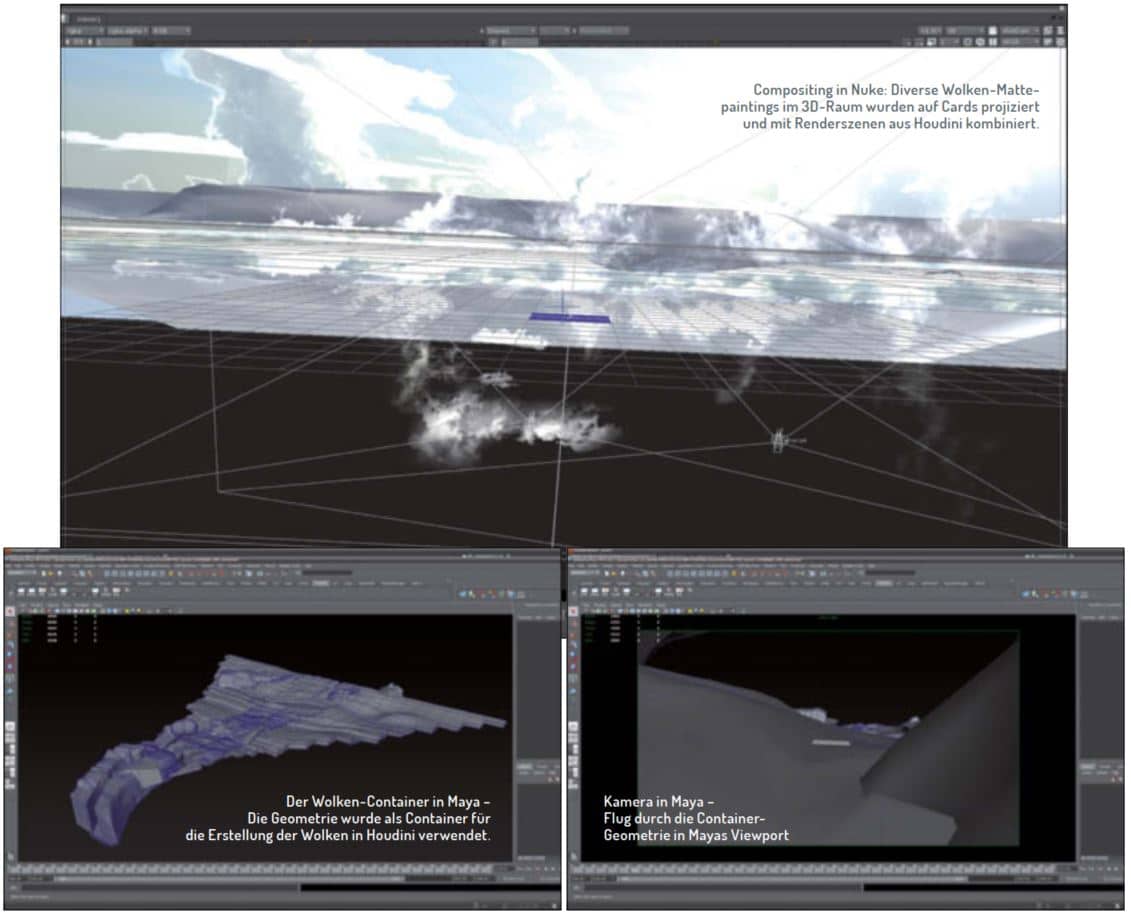
Oliver Schulz: This variety is precisely the difficulty when you want to create a convincing sky in 3D. Basically, our only requirements were that the camera should fly between two layers of clouds at the beginning and that we had to create a seamless transition to the real helicopter plateau with the train in the snowy landscape. At an early stage of production, I did the pre-vis and concept design for our shots. The first step was to create value sketches to develop the general composition, cloud types and lighting moods with our VFX supervisor Florian Gellinger and director Brian Percival. Once it was clear which elements of the design matched the production’s vision, many more concepts followed – this time in colour to further refine the lighting direction and mood. We then projected the concept painting onto geometry in Maya and the camera was blocked out in it. This gave us a relatively precise idea of what the final shot would look like right from the start.
DP: What did your cloud workflow look like step by step?
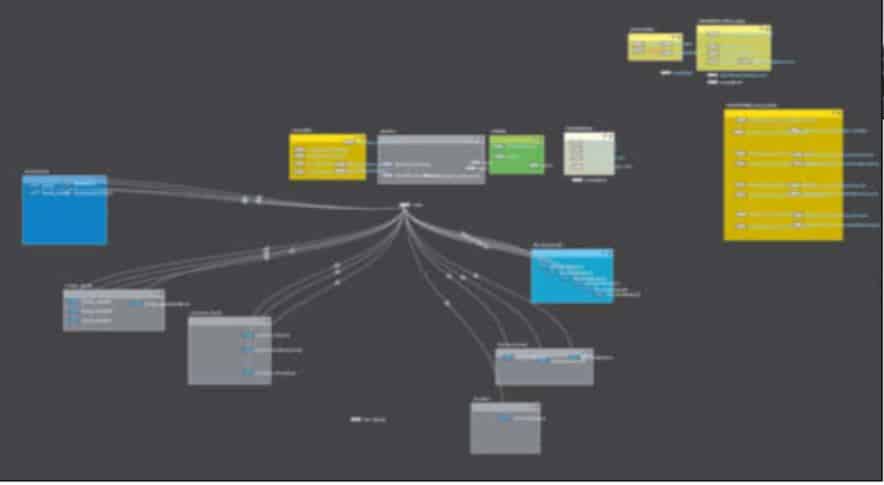
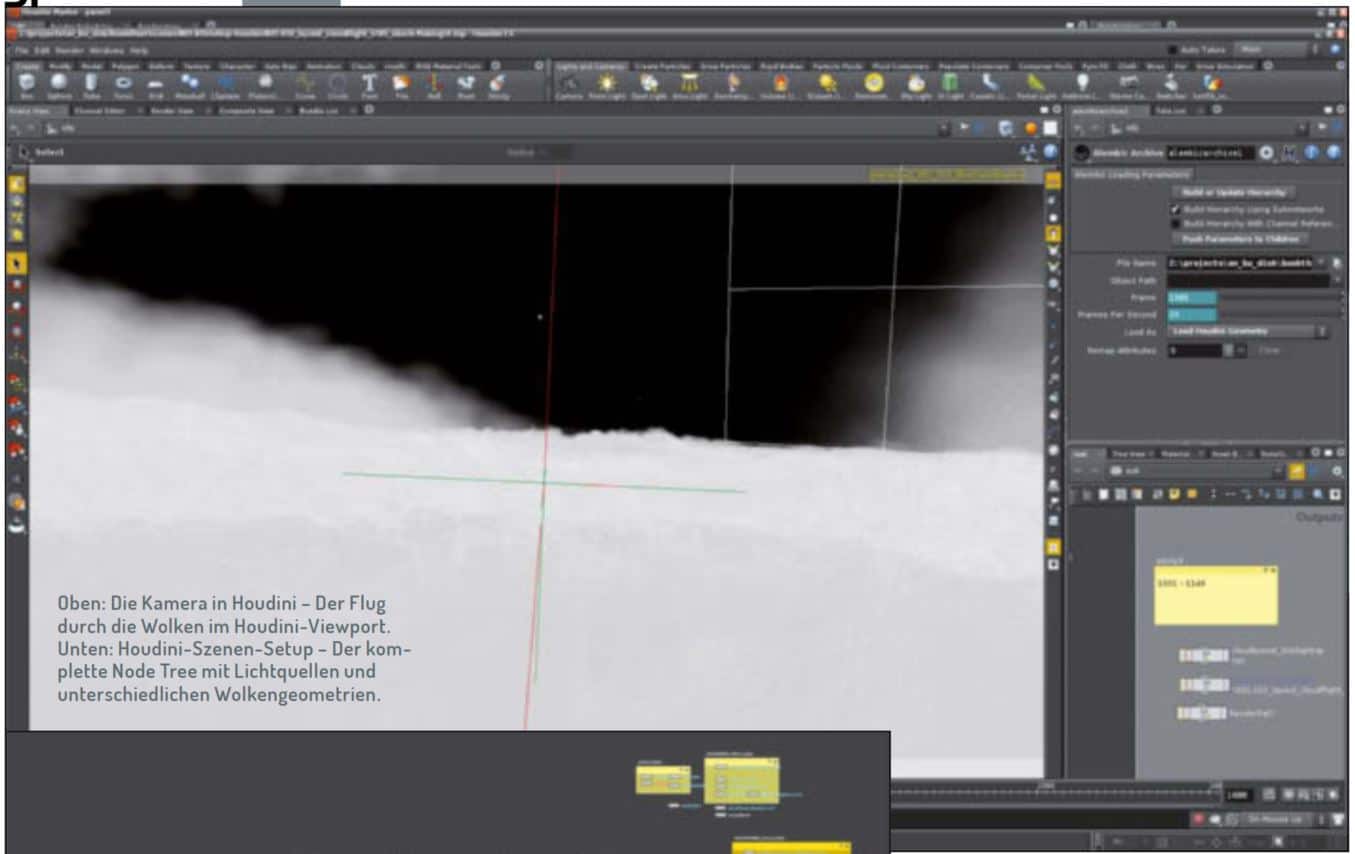
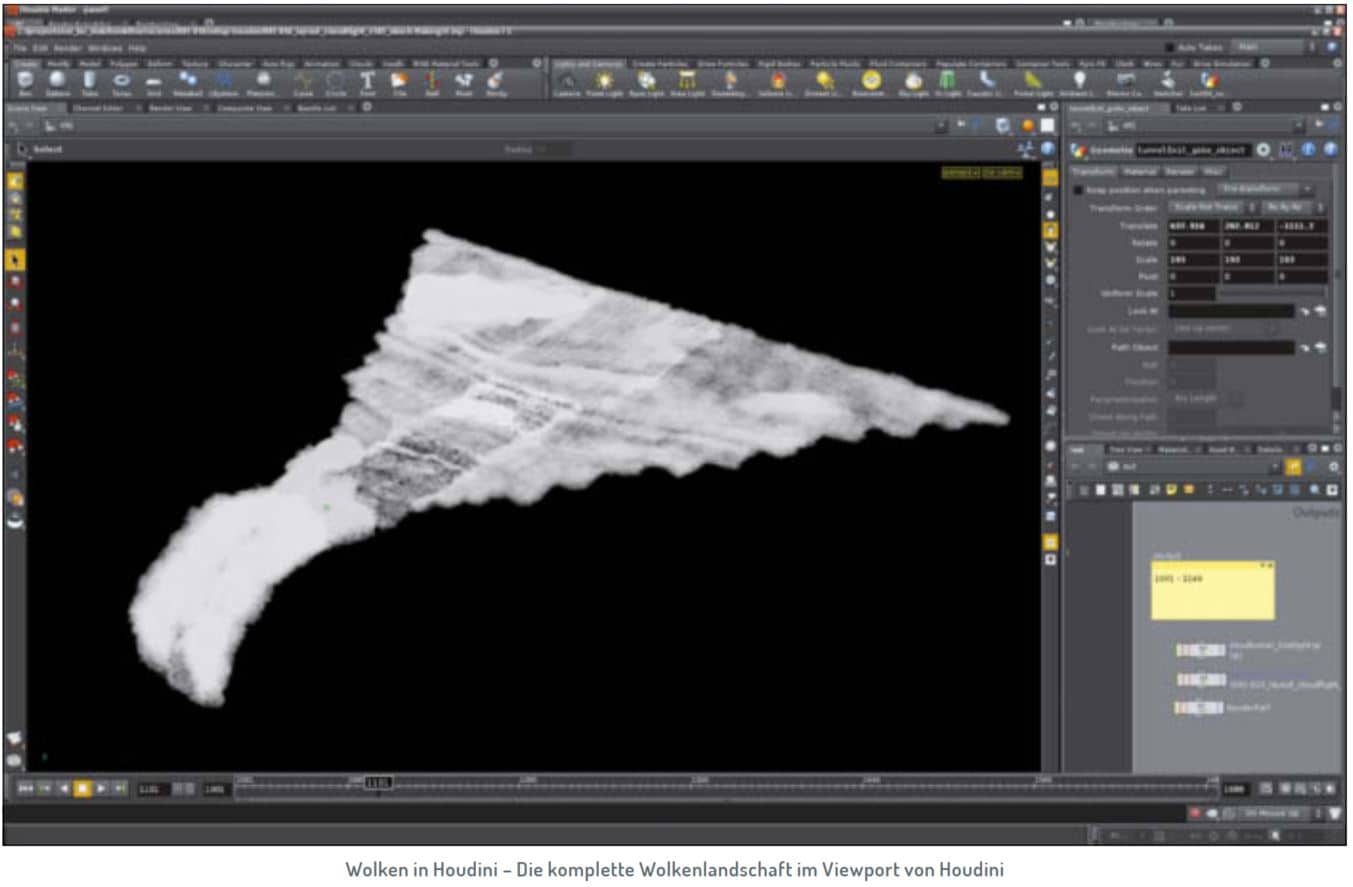
Oliver Schulz: We did the layout, polygon modelling and animation in Maya. We built the clouds as low-poly geometry so that we could precisely determine the shape of the clouds. We exported the rough geometry from Maya as an Alembic cache and imported it into Houdini. There we converted them into volumes and modified them procedurally. Depending on the type of cloud, we also distributed spheres on the geometry via the cloud node to achieve a “puffier” look. The team then converted the geometries into VDB volumes, which allow a very high voxel resolution. Depending on the type of cloud, this volume was then saved with noise displacement or directly as a .bgeo file. We were then able to use these files in procedural CVex shaders to add finer details. The background of the scene is a projected matte painting.
DP: What are the advantages of Houdini?
Oliver Schulz: The setups can be set up procedurally and it is sufficient to simply replace the input geometry in an existing setup and rewrite the volume. This enables relatively simple and, above all, very fast handling in the event of any changes.

DP: What did you use to render and what settings did you make?
Oliver Schulz: The clouds were rendered in Houdini Mantra. Originally we wanted to raytrace the clouds in PBR mode with HDR Lighting, but we had to abandon this relatively quickly after the first render tests. The render times exploded with so many volumes and were up to 25 hours per frame. As the micropolygon renderer produces a very clean and fast result with volumes, we finally decided in favour of it. The disadvantage is that you can’t render physical light natively with this renderer. However, as the look of clouds is largely based on indirect light and scattering, it was precisely these effects that were important to us.
DP: How did you solve the problem?
Oliver Schulz: With a light setup in which a photon map was generated using simple distant lights with depthmap shadows in PBR mode. This could be read into the shader to be used there as indirect light information in the Micropoplygon renderer. The advantage of this was that effects such as 3DMotionblur are free or even render faster. The final render times were around two to three hours per frame in 2K.
DP: How did you arrive at 3,000 frames in the scene?
Oliver Schulz: The length of the shot was due to the monologue that the narrator gives at the beginning.
DP: What was the resolution of the cloud scene?
Oliver Schulz: We rendered the previews at half resolution in order to keep the render times short for the time being. The final shots were rendered in 2.8K, which corresponded to the delivery format.
DP: How many artists worked on the cloud sequences?
Oliver Schulz: The compositors working on the shots were Oliver Hohn for the first shot and Jonathan Weber for the last shot. I was responsible for 3D and matte painting, with a lot of support from our Houdini TD Simon Ohler.
DP: How long did it take to work on the scenes?
Oliver Schulz: Basically for the entire duration of the production. It was very long at the beginning when we had to set up the 3D scene. Towards the end, we realised the compositing and matte painting. As it always took some time to get feedback from production and the editing room, I had time to work on other shots in parallel during this phase.
DP: What is your opinion on Vue for sky and clouds?
Oliver Schulz: I haven’t worked with it very much yet, but my first impression is that Vue has a very good atmosphere engine that makes it relatively easy to create realistic skies.
DP: Did you also use Houdini to enhance the smoke from the train chimney?
Oliver Schulz: The train was shot from a helicopter, just as it appears in the film. We didn’t add any additional smoke.
DP: And the snow that can be seen in many scenes?
Oliver Schulz: In some shots, the snowfall was enhanced with particle systems from Houdini. Other shots were enhanced with snow using matte painting.
