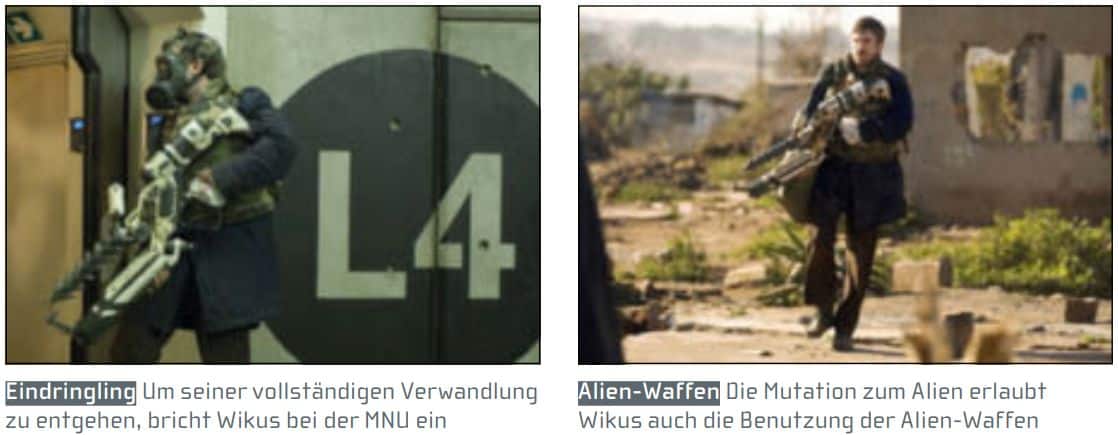
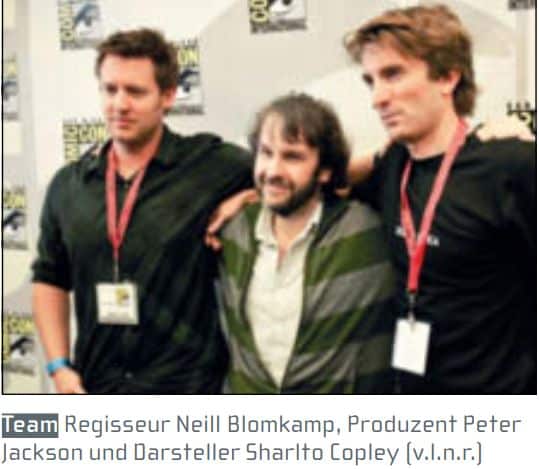
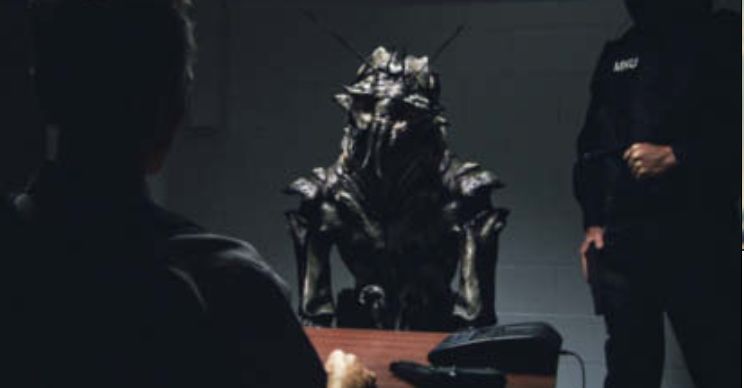
Image Engine, Embassy FX and Weta Digital skilfully created the invisible effects for District 9. The special effects in this low-budget production, in which Lord of the Rings man Peter Jackson was also involved, are as well done as if the aliens were being played by real actors. Just like the main character, a large green cross between a shrimp and a grasshopper, the other aliens are also pure CG. A good mocap and the post-production of the studios involved bring them all to life in a frighteningly real way.
After a time of spaceships, transforming robots, magical high school kids, guinea pig secret agents and the destruction of Earth, who would have thought that a low-budget sci-fi film in the style of a fictional documentary could be the surprise of the cinema year? What’s more, this is the director’s first film and the actors are anything but well-known Hollywood celebrities. What’s more, the majority of the special effects were created in a relatively small studio. Skilful viral marketing and rave reviews have already brought Neill Blomkamp’s debut film District 9, with a budget of 30 million US dollars, box office takings of over 170 million US dollars. And the end is not yet in sight.
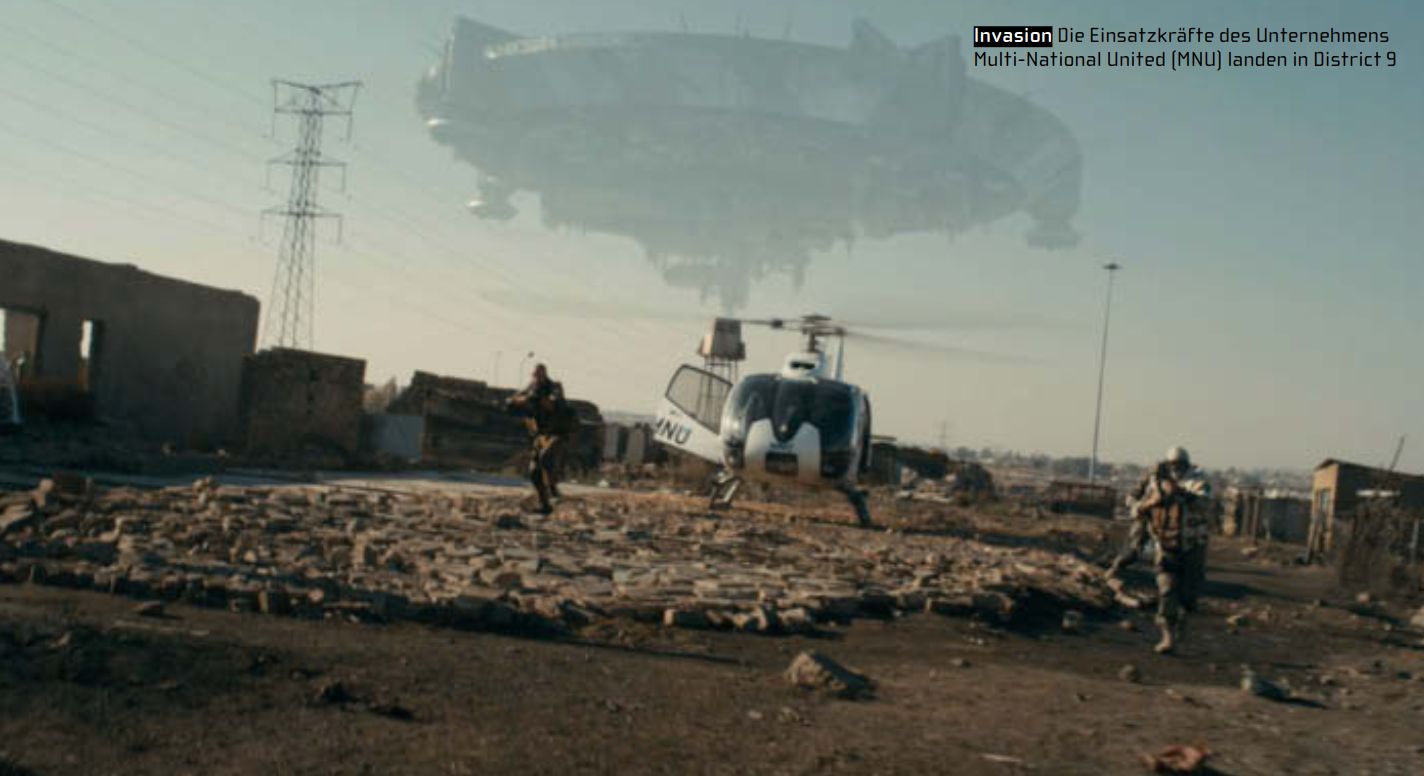
The story, which is set in Blomkamp’s home country of South Africa, centres on two main characters: the alien Christopher Johnson and the human Wikus van der Merwe, played by Sharlto Copley. Christopher Johnson came to Earth 28 years ago in a spaceship that ran out of fuel over Johannesburg. At the beginning of the film, the spaceship can still be seen hovering over the city. At the time of the involuntary arrival, the aliens inside had almost starved to death. But then the humans were brave enough to fly to the spaceship, open it and free the occupants.
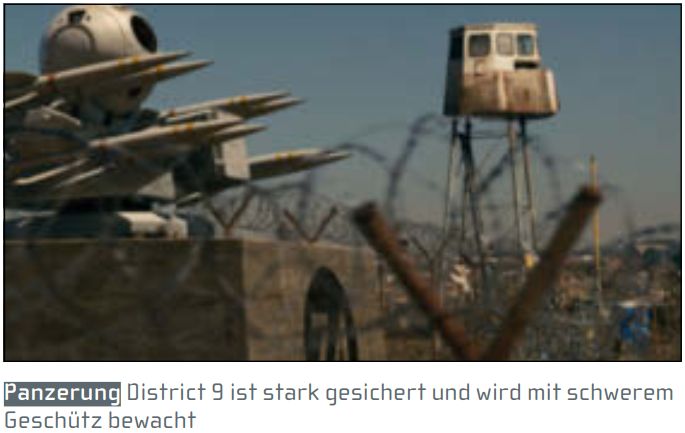
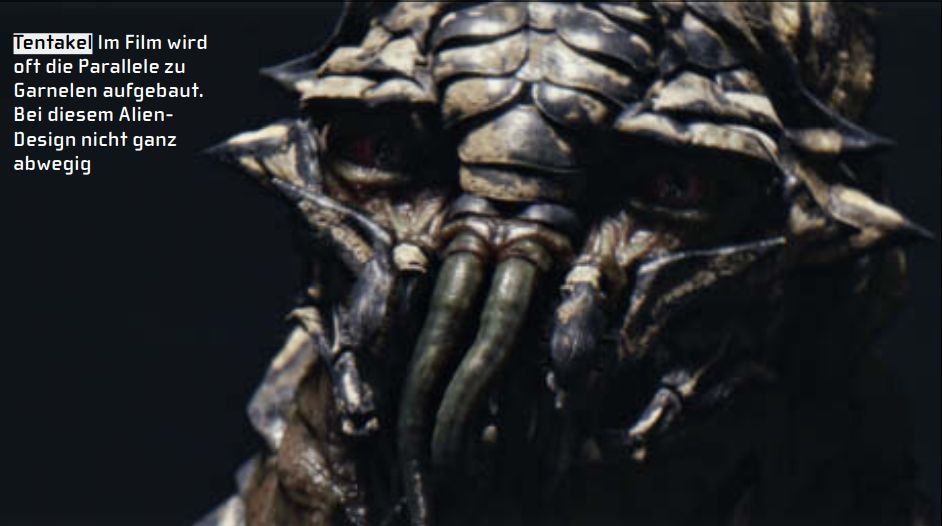
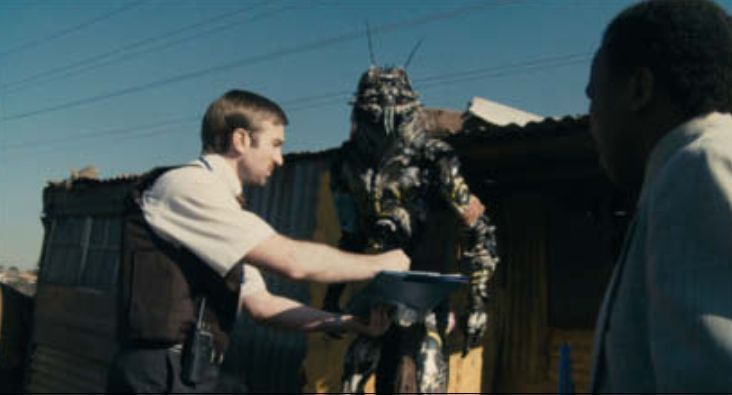
The South Africans then locked all the aliens in a segregated area and treated the inhabitants of these slums, those yellow creatures that are a mixture of shrimps over two metres tall and insects, with contempt. Tentacles attached to the aliens’ mouths wriggle when they speak. This was a delight for the animators involved with the aliens’ movements: No lip-syncing was needed. Some humans seem to have learnt the aliens’ language in recent years.
Originally, Peter Jackson and Blomkamp, a former visual effects supervisor, had Weta Workshop and Weta Digital in mind for the special effects on this film project. But the passage of time and the US screenwriters’ strike resulted in a new schedule for the film. When Weta Digital was due to start work on District 9, there were other commitments that the effects studio from New Zealand had to fulfil.
Instead, production was split between two smaller studios: Image Engine and Embassy FX from Vancouver, Canada, Bloomkamp’s new hometown. In the end, Image Engine took care of the aliens, Embassy FX realised the mech-suit combat robot and some other effects. Weta Digital came in later and contributed the mothership, a smaller side ship and the display inside the mech suit. Weta also did the previs for the battle scenes and the Hero model for the battle robot.
“Image Engine did the lion’s share of the work,” says Matt Aitken, Visual Effects Supervisor at Weta. “We are very pleased that we were able to be involved in the end. Where we had to pass at the beginning.”
On set in South Africa
Peter Muyzers was one of the visual effects supervisors for Image Engine on set for almost six months. Dan Kaufman was the visual effects supervisor for post-production, who, among other things, built the aliens into the existing film material.
Obviously, with a production like this, it’s difficult to gather enough material,” explains Muyzers, adding: “You’re always limited. Neill wanted to move very quickly. He didn’t want the traditional burden of a large crew on set to get in the way. But because of his VFX background, he understood our requirements. That made it easier for the team overall.”
 Because the aliens were in so many scenes, Muyzers had to constantly take HDRI shots as the lighting changed. “In the beginning, when the assistant director shouted ‘It’s HDRI time again!’, almost everyone responded with ‘HD what? “But after a few weeks of work, the calls for the HDRIs became routine. I always had my tripod and camera to hand.” The crew working with Muyzers collected camera data, information about the lenses and all kinds of measurement data about the set. This allowed CG objects to be created afterwards that correctly cast shadows on other creatures and elements. They could also be added to backgrounds.
Typically, productions use lidar data similar to radar to determine where the ground is not flat, as in the case of South Africa. This makes it easy to create accurate backgrounds for CG characters that later need to be built into the landscape.
The only problem was that the companies collecting the Lidar data in South Africa had never worked with film companies before. Image Engine was therefore unable to convert this data into the correct format.
“All we could do was convert the data into point clouds that were not connected to each other,” says Muyzers. “We had a good representation of the environment but no interface to render or work with. So we did it the hard way and worked with that representation, like a large amount of photographs.”
For tracking, Image Engine used Boujou, PF Track and 3D Equaliser. “None of the packages did everything we needed,” Muyzers concludes. “Some of the shots were really long, with the camera panning left to right and to the centre. Some of the shots were stock footage from a South African TV channel about unrest in South Africa. That’s where Neill wanted to put the aliens. We didn’t know where these shots came from or what format they were in. We could only roughly recognise which direction the sunlight was coming from. So we sent the material to Yannix Technologies. They did the match – moving incredibly well without having any set data.”
Meanwhile, Kaufman, a freelance visual effects supervisor, took over post-production responsibilities at Image Engine. By this point, most of the film was already in the can. Creature supervisor James Stewart had started to create the aliens by this time, having Alien Maquette scanned by Weta Workshop. “We adapted the data by lengthening the limbs and making the faces more insect-like,” says Stewart.
In the film, the aliens behave more like gang members in a slum than creatures from another planet. They rummage around in the rubbish looking for cat food, which acts like a narcotic for them. They are violent and fight with Nigerians to get food and drugs. They are easily injured and therefore mortal. “This film conveys many different impressions,” says Steve Nichols, Head of Animation, “and that was the whole point.”
On set, actor Jason Cope, who played the main alien, wore a grey suit with patterns on it. This suit allowed the camera to capture his movements for motion tracking. Unfortunately, the documentary style of the film meant that the crew had to place the cameras in many locations for triangulation. The visual effects team tried to capture the aliens with motion capture, but the aliens were too big for that. So that didn’t work out well either.
In the end, the animators started with rotomation and then used rigs with controls for the kinematics, adjusted the legs and finally added insect-like movements through keyframing.
Image Engine used Autodesk’s Maya for modelling, rigging and animation. ZBrush was used for texturing. The riggers created a basic bipedal system that could be used regardless of whether the aliens moved on two legs or all fours.
For the faces, Stewart created a system based on a combination of Blend Shapes and Correctives. “We’re really proud of this big giant grasshopper character. Christopher puts a lot of heart and soul into it,” said Nichols. “When I first saw the design, I thought to myself, ‘Ooooh boy, and this guy is supposed to evoke an emotional response?”
The animators’ favourite character, however, was CJ, Christopher Johnson’s six-year-old son. “We motion-captured Peter Muyzer’s son for a couple of shots and at the same time watched a lot of reference video footage to familiarise ourselves with the movements of a six-year-old,” says Nichols. “But at times it didn’t work very well. It was a challenge, but in the end it turned out great.”
Grainy slime
To realise the physical appearance of the aliens, Stewart referenced photos of insects. Initially, they were given an iridescent look. However, in order for them to fit into their surroundings, their exterior had to be covered in dirt and colour.
“Grain and iridescence don’t go well together,” Stewart analysed. “Also, iridescent insects only look good when they are small. If you combine this effect with large animals, it looks like they are covered in a film of petrol. To make the aliens blend in even more with their surroundings, the crew added scraps of fabric, splashes of colour and war paint. Some had skateboard stickers on their armour, others wore hats. “We were able to get inside Neill’s head,” says Stewart. “He wanted the characters to reflect what Soweto [South Western Townships] or the south-west neighbourhood of Johannesburg is. So we incorporated artefacts everywhere.”
The painters had created textures for the surfaces using Photoshop, Bodypaint and ZBrush. “We invested a lot of time in the surfaces and decided whether they should be glossy or matt,” says Kaufman. “We ended up with a kind of turtle shell that had a matte sheen but no shine. The skin around the aliens’ faces and the tentacles are slimy, like stuff is dripping off them. And we also had different levels of encrusted dust and dirt. That makes things a little more matte.” Multiple texture map layers, bump maps and displacement maps created different patterns, controlling colour, light, highlights and roughness. For rendering, Image Engine used 3Dlight, a renderer compatible with RenderMan. Nuke and various layer colour maps were used for compositing. “The main goal was to keep control of the aliens,” says Kaufman. “To make sure they walk upright and remain photorealistic so that the viewer accepts them as actors.”

Large ships
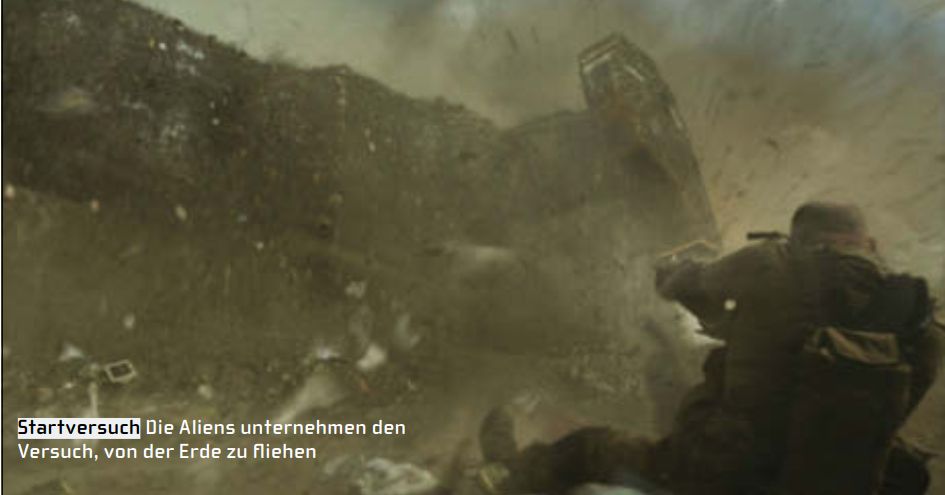
The effects created by Weta Digital, on the other hand, are much more striking to the viewer: the mother ship has a diameter of almost five kilometres. “That was our hardest work on this production, because it required a lot of complex simulations,” recalled Aitken. During one of these scenes, Christopher Johnson climbs through the floor of his barrack. The camera pulls back and looks down on the shack. The floor arches and the ship rises from the ground.
To realise this part, Weta first animated the spaceship to control the timing and determine how much dirt should be swept up. Then, using in-house solutions, the team created different levels of the floor: the top layer of concrete, the dirt below and the rocky layer further down.
Using rigid body simulation, the tar layer was broken into pieces and these pieces triggered the particle simulation for the layer below. As the soil was in layers and could be broken up piece by piece, Aitken had control over the timing. It also meant that each stage could be processed individually before moving on to the next. “These were the first shots we started with and the last ones we finished,” adds Aitken.
“For the mothership, Image Engine did the initial work on the model and the wide shots in the sky,” explained Aitken, adding: “However, we had to rebuild it to make it detailed enough for the hero mothership shots.”

The controls of the mech suit
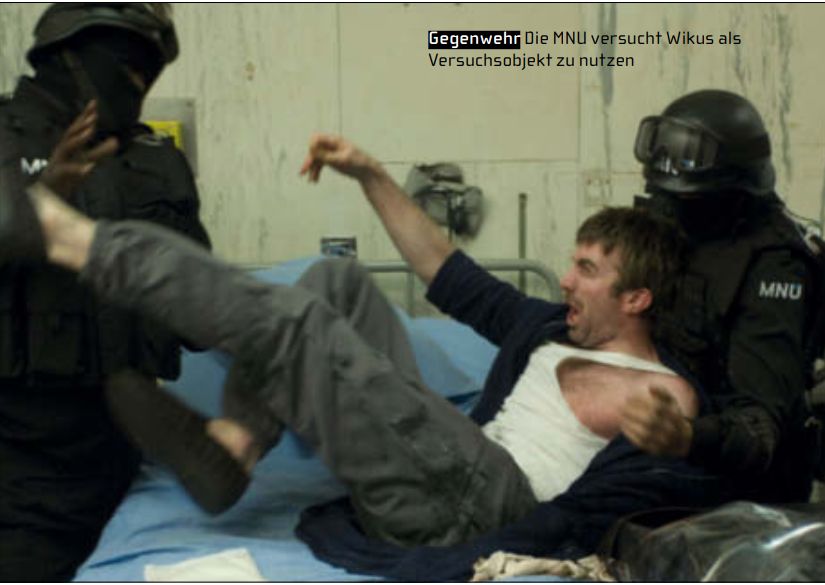
In the film, Wikus van der Merwe accidentally splashes some alien fluid on his face and becomes infected with alien DNA. This allows him to use the aliens’ bio-technology, including their weapons and an impressive, heavily armoured combat robot. Embassy FX created the robot, the Mech Suit. “It’s almost like a walking tank,” says Winston Helgason, who was the on-site supervisor for Embassy’s work. “He’s sitting inside, moving the suit, so in a way the suit extends his person.”
During this twelve-minute sequence, Wikus, who is actually the suit, stumbles around at first. But as he learns how to move, he throws a few vehicles around, shoots rockets out of his arm, hurls a pig at soldiers and kills some of his enemies.
Robert Habros was special effects supervisor in the studio while Helgason was on set. Stephen Pepper was compositing supervisor.
Working from the basic geometry of the original model created at Weta, artists at Embassy FX textured and rigged the mech suit using Autodesk’s Softimage and Luxology’s Modo for the UV maps. “We did a lot of textures in ZBrush and Photoshop. We also animated the models in Softimage, rendered in mental ray and the compositing was done in Shake,” says Pepper. Weta Digital created a heads-up display inside the combat robot. “Neill Blomkamp had very specific ideas about what he wanted from the display,” emphasised Aitken. “The film is also very humorous at times. The joke about the situation with Wikus, our hero, is that it’s alien technology that he jumps into. The heads-up display provides him with all kinds of information, but it’s basically alien technology. He has no way of understanding it. So it was an enjoyable piece of work for us.”
In addition to the suit, Embassy also created two small alien creatures that look like a combination of a scorpion and a shrimp. “The Nigerians make them fight each other and bet on the outcome of the fight as if it were a cockfight,” says Helgason. “One of the soldiers falls into a pit and the creatures eat his brains.”
“Another interesting thing about the suit was the weaponry: there was a gun on each arm. One was like a machine gun, the other was capable of firing electric shots,” said Pepper. “To top that off, the robot could fire missiles from its shoulders. When the suit shoots at soldiers, the bodies explode and fly through the frame in many pieces. “We had so-called body bags on set. Bags that were filled with blood and guts and whose contents we could spread all over the place when they exploded,” adds Helgason. “There’s a lot of graphic stuff in this film, that’s what’s cool about it.” One reason District 9 has been well-received by 90 per cent of critics (a rarity for the sci-fi horror genre) is the fact that the special effects blend so seamlessly into the film footage. While watching this pseudo-documentary, you think it should be impossible to film aliens living in a ghetto in South Africa, foraging for food and trading weapons for narcotics.
The aim of visual effects is to support a story. And one thing is certain: the special effects in this film do an excellent job of it.