



This article originally appeared in DP 07 : 2016.
You have to look closely to discover the details of the CG image “Topview”. And then you ask yourself: why a dead pig in front of the garage? Last year, “Topview” received an animago nomination in the “Best Still” category. The creator Jürgen Stein (www.juergen-stein.de) has been working as a photo designer for more than 17 years; in recent years he has also specialised in photorealistic CGI motifs. Here he talks about his work on the black-and-white piece, which was created using Softimage and Arnold.
The title “Topview” is a simple result of the chosen camera angle. The idea for the picture came from my interest in urban landscapes, suburbs and the question: what kind of environment do we actually live in? When I read the book “Disneyfication of the American City” and the reports about the riots and race riots in the media, I discovered the city of Celebration, which, according to information on the Internet, is an American dream city where everything is exemplary for the citizens and where there is no crime.
Like a film frame
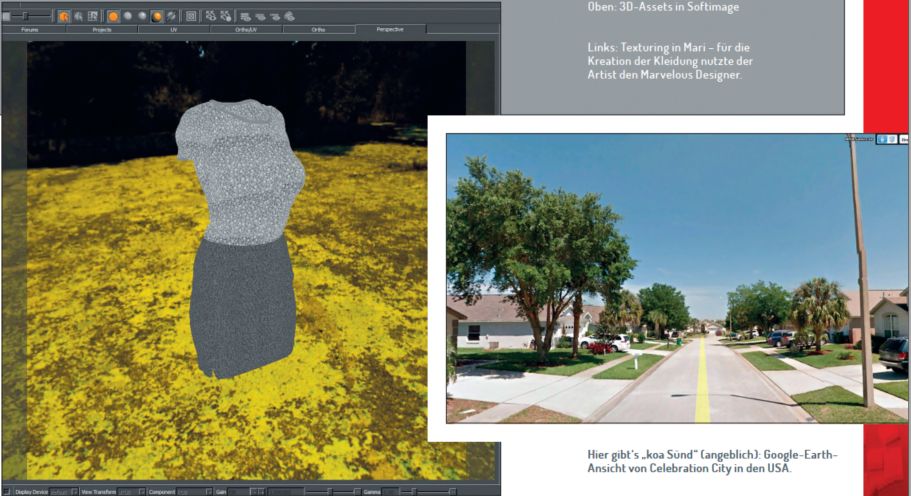
I realised the still on my own as a private project, mostly in the evenings and at weekends alongside my day job. That’s why it took me around 4 to 5 weeks to complete the picture – on top of that, I had to teach myself Marvelous Designer for the 3D clothing of the characters for the project. For a realistic recreation of the view, I searched for the town of Celebration on Google Earth and took screenshots. I didn’t want to create an action scene with explosions or anything like that, but just enough to give the viewer room for their own imagination – with an open beginning and end, like a frame from a film.
Photographed CG world
For all my stills, I always start with basic objects in Softimage: cubes, spheres, trees, etc. That way, changes can be made quickly and you don’t have to spend 4 days modelling a 3D asset that you don’t need in the end. In order to have less trouble in the rendering process – which would be the case with a 10 millimetre road – I always work on the scale of the real world.
As I want my CG works to be as photographic as possible, I use the Real Lens plug-in in the 3D process; this allows me to determine the exact camera data of a Hasselblad, for example, or the values of a focal length – only then do I define the 3D camera in the image.
Greening
Most of the trees are from Speedtree, the simpler ones in the off area are ready-made Xfrog models; I got some of the palm trees and the police cars from Evermotion. The lawns were created with the help of scattered ICE-Strands and partly with the Forecaster plug-in.

Lighting & Rendering
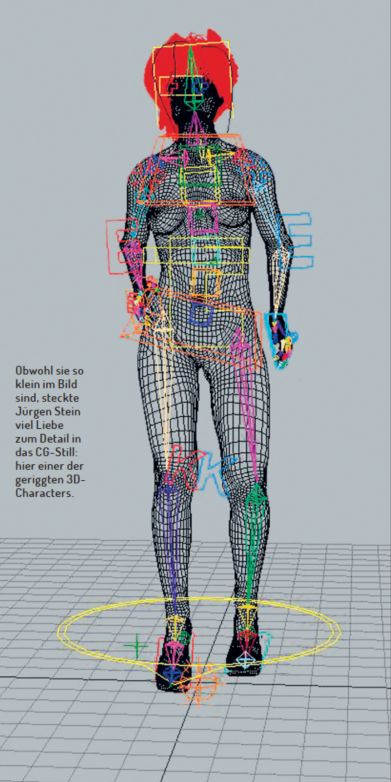
In addition to the Maxwell render engine, I often use the Arnold plug-in SItoA for Softimage – as in this case. At the start of a project, I load a chrome and a grey ball as well as a calibrated colour field into the scene as a reference. I have adopted this tried and tested technique from the Maxwell render environment. The resulting values can then be compared with the original in Nuke, giving a better overview of exposure, tonal values and much more. i illuminated “Topview” with an Arnold Physical Sky, which was merged with a self-created HDRI in Nuke and modified for the desired light. The frame buffers and additional masks and AOVs such as Point Position, Normals, Depth etc. were then applied – for Nuke in 32-bit half float. In the basic compositing in Nuke, I only had to exchange the frame buffers – depending on the progress – so that the current status was always available for comparison – for example, I increased the samples when noise was immediately visible in the GI pass. I did the texturing with Mari; the tool’s UDIM-UV mapping workflow is also supported by the Arnold plug-in SItoA. For shading, I used the standard Arnold shaders, and the 3D characters were positioned using the Softimage plug-ins Gear and Species. I used Z-Brush to adjust and reinforce the folds of the clothing created with Marvelous Designer and then wrote them out as a displacement map.
Once a prop has been modelled and damaged, I save it as a Softimage model and replace it in the scene with an Arnold stand-in (known as a proxy in other software packages). This keeps the scene light and Arnold renders even faster than it already does. When the still is finished, it goes into Nuke. There I make a few final tweaks. I created the black and white look of the image in a final step in Photoshop.
Bye bye Softimage
As the Arnold renderer is wonderfully integrated in Softimage, the Autodesk software is ideal for realising such projects. Especially when working alone on CG works of this kind, the well thought-out workflow in Softimage really comes into its own – unlike in any other Autodesk product. Even though Autodesk has decided to discontinue its best horse in the software stable, I will continue to use Softimage until something better is found on the market. Between the other Autodesk products, there is no equivalent alternative to Softimage and its options for me.
I had a lot of fun working on “Topview” – I’m thinking about realising a series and a book project on the idea.
