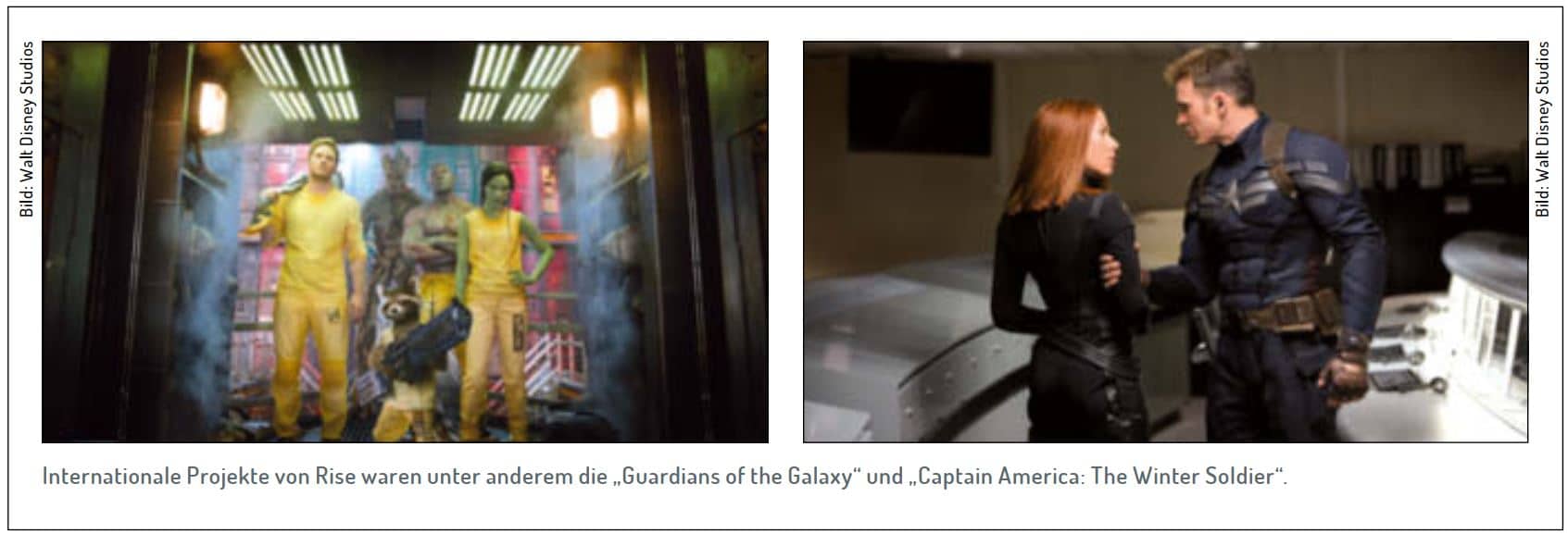
Rise | Visual Effects Studios(www.risefx.com) has been around since 2OO7 and now has four locations. With a location in Vienna, the team is even represented in German-speaking “foreign countries”. The Rise team explained to us how they managed to expand their VFX business without losing their overview.
Rise founder and VFX supervisor Florian Gellinger, who will also be on the animago jury again this year, manages the main Berlin location together with Sven Pannicke, Robert Pinnow and Markus Degen. The second studio in Cologne was initially an “on demand” location, which has since been converted into a permanent site. Its success was followed shortly afterwards by the opening of the Vienna branch. The Stuttgart location has recently been added and will be up and running by FMX(www.fmx.de) at the latest.
Rise | Visual Effects Studios is a regular guest at our animago AWARD & CONFERENCE(www.animago.com). So if you would like to meet the team in person, you should be there on 15 and 16 October. Entries for all nine categories can be submitted for the animago AWARD until 30 June.
You can find out more about Rise’s day-to-day work and pipeline in the studio portrait in DP issue 05/13.
DP: Hi Florian, why did you see the need to be represented at these locations with your studio and to expand in this way?
Florian Gellinger: We want to be as close as possible to young talent and artists. And in Germany, the industry is unfortunately spread out in all directions, in contrast to London or Vancouver, for example. Many domestic productions also make use of regional funding. The regions of Vienna, North Rhine-Westphalia and Baden-Württemberg in particular were quick to recognise the increasingly important role of digital visual effects. After all, up to 100 per cent of film images now come from computers – including the main actors.
DP: Is the first studio foundation the most difficult and all the others just routine work? Or did each studio challenge you anew?
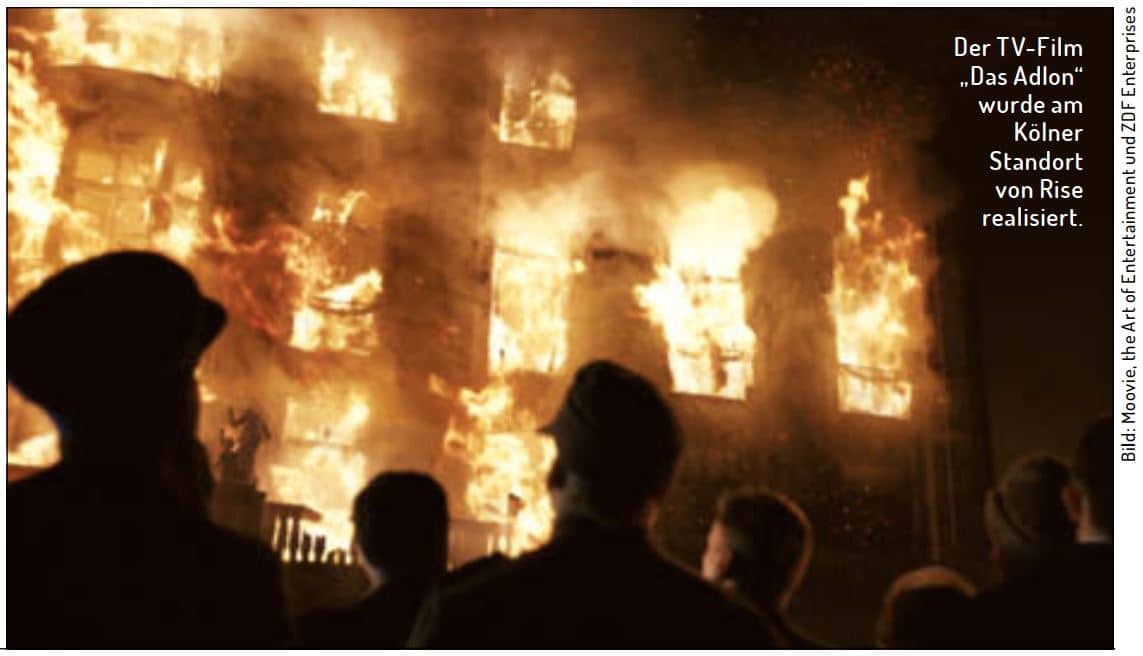
Florian Gellinger: The first studio is always the hardest. You have to acquire orders while you build up the technical infrastructure. Cologne was our “trial balloon” for all other locations. We learned a lot from projects such as “Adlon – A Family Saga” and “Night Over Berlin” and used this knowledge to expand our decentralised production environment accordingly. In practice, we have found out how work at several locations can function best and that the efficient organisation of work processes is at least as important as the work on the effects themselves. Each new branch makes the organisation of distributed projects many times more complicated – but a larger artist pool also makes you faster and more flexible.
DP: Were there regional differences when setting up a studio?
Florian Gellinger: No, not really. But we were also lucky that our first people on site were previously long-standing Berlin employees who are well connected in the industry and know our work processes. We try to completely avoid competitive thinking between the locations by removing all barriers apart from the physical separation as far as possible. This means that employees in Cologne, Stuttgart and Vienna should feel as if they are working in the same building as the Berliners and vice versa. All workstations are networked with each other via VoIP and chat and you can also simply transfer control of your own workstation to others, for example to get help.
DP: How did you manage to finance each new location?
Florian Gellinger: The new locations are created from orders placed and additional capacity required. We can also use the software developed in Berlin at all locations, which means that the development work is spread across more users, making it increasingly cost-efficient. The Berlin location is extremely important due to its proximity to Studio Babelsberg(www.studiobabelsberg.com). We can visit production offices on the studio premises at any time, giving our customers more flexibility. At the same time, the animago is ideal for finding new talent. In addition to the excellent universities, Cologne, Stuttgart and Vienna are ahead of the game when it comes to promoting post-production – although in Vienna in particular there is currently no-one else on site with a comparable programme.
DP: What criteria did you use to select the premises at the respective locations?
Florian Gellinger: We love open, large spaces. That’s why we’ve always tried to put together as many artists as possible who are working on a project as an interdisciplinary group. That way, everyone can see what is being created on the monitors of the others and be inspired for their own work. The spatial concept facilitates communication and the result looks more consistent in the end. We actually see the entire company as a virtual open-plan office, regardless of where people are working.
DP: How many permanent employees do you have in total? How many freelancers also provide regular support?
Florian Gellinger: Our network has a total of 19 permanent employees. We see our work like that of a physical film production, which grows and shrinks according to demand: a few leads work in planning, preparing the projects and setting everything up according to our guidelines. For the work on the individual shots, we book additional freelancers and after the end of the project, they either jump to the next one or we downsize again.
DP: How do the locations differ in terms of technical equipment?
Florian Gellinger: The offices are all equipped according to their employee capacities – Berlin has the largest server and the largest render farm. However, these capacities can also be made available to the other locations at peak times. Berlin also has a DI facility with 4K 3D stereo projection. Approvals for larger projects also take place here.
DP: How does the data transfer between the locations work? Do you also use online render services?
Florian Gellinger: All data transfer between the locations takes place fully automatically in the background and is highly encrypted. Each location can access all data of an assigned project at any time. Our network is otherwise completely isolated from the outside world. Even if we wanted to, we would not be allowed to use online render service providers, as the security guidelines of some of our customers prohibit us from doing so. This is another reason why automatic render farm load balancing between the locations is so important.
DP: Do you have one licence server for all studios or a separate one for each location?
Florian Gellinger: That depends on the software. In some cases, there are only nodelocked licences for special software. In some cases, however, we also have floating licences that can be loaned out from Berlin to other locations. Our licence portfolio is structured very differently – depending on the software, the type of licence available from the manufacturer and our requirements.
DP: Do you use your internal Risebase database at all locations? For what in detail?
Florian Gellinger: Risebase is still the heart of the company and its further development enables us to work across the various locations. Review notes and comments on individual shots in particular can be sent across locations. For example, if it is necessary to do a review session with a client in Berlin, but the shots are actually being worked on in Stuttgart, the notes can be entered in Risebase in Berlin and the Stuttgart artists receive the corresponding comments in real time.
DP: What exactly does your cooperation with Pointcloud9 look like?
Florian Gellinger: Pointcloud9 is a subcontractor of Rise. Customers who use our LIDAR services shouldn’t feel like they have to book the rest of Rise’s VFX apparatus just for the LIDAR service they want. However, they can expect to receive results that we ourselves would want as a VFX service provider as a basis for our work. This means that Pointcloud9’s experience in handling LIDAR raw data is also growing as a result of our own projects.
DP: Do you have any other locations planned in the near future?
Florian Gellinger: So far, we are already quite busy with the four locations. But who knows what will happen next.