



Storm makes landfall
Blender Studio has released Storm, a production-ready character rig built exclusively for Blender 5.0. The rig, developed by the Blender Studio team, merges their in-house rigging system CloudRig with a sculpt-driven facial setup designed for expressive animation. It is the latest addition to Blender Studio’s growing library of open production assets, aimed at animators and riggers seeking professional-grade tools inside Blender without third-party dependencies.
Technical build and requirements
Storm’s body rig is constructed using CloudRig, the procedural rigging system developed by Rigging TD Demeter Dzadik. CloudRig allows the modular generation of complex body setups, supporting inverse kinematics (IK), forward kinematics (FK), parent switching, and snapping options. Storm inherits this functionality, offering standard animator controls such as IK/FK toggles, stretchy limbs, hinge switches, and parent snaps. These controls are embedded in a custom UI that appears directly within Blender’s interface, requiring no additional add-ons beyond those included in the file.

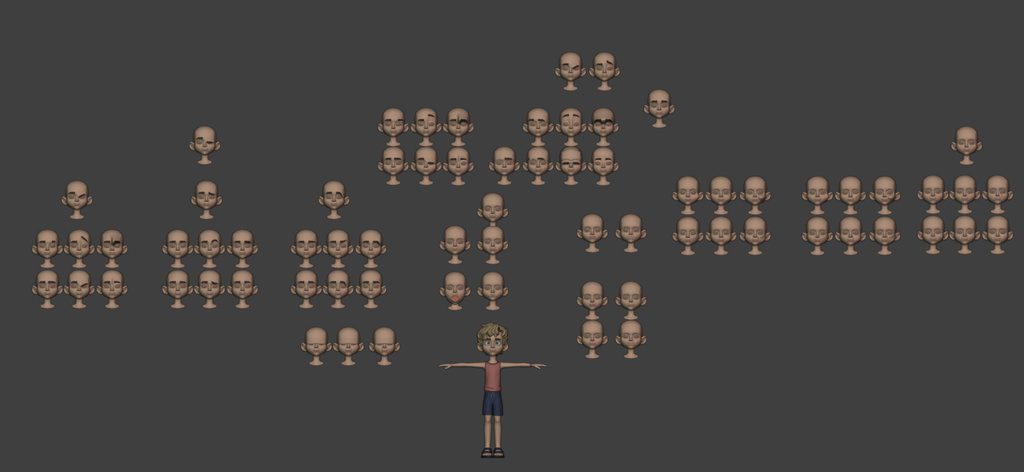
The facial rig was designed by Lead Animator Rik Schutte and takes a hybrid approach using shape keys, ribbon guides, and lattice deformers. This setup blends traditional deformation techniques with sculpted corrective shapes, enabling detailed facial performance while maintaining animator-friendly control layouts. The design provides layered control for expressions, including mouth and eye movement, with a focus on maintaining smooth deformation and preserving volume across a wide range of poses.

The download package also includes a pose library containing a comprehensive range of facial, hand, and full-body poses. These assets are integrated into Blender’s Asset Shelf system, allowing animators to quickly browse, apply, and tweak poses directly in the 3D viewport. The rig is fully self-contained; all necessary scripts and dependencies are embedded within the .blend file.
Storm requires Blender 5.0 or later. It is explicitly incompatible with earlier versions, as the rig uses new Blender 5.0 features and API changes. Users opening the file for the first time will be prompted to allow Python script execution, which is needed for the rig’s custom UI panels and tool automation.
The character and rig are distributed under the Creative Commons Attribution (CC-BY) licence, which permits both personal and commercial use with proper credit to Blender Studio.

Workflow and production context
Storm’s design reflects Blender Studio’s open-movie production workflow. By building on CloudRig, the team has transferred tools and processes developed during feature projects directly into a publicly available rig. The sculpt-driven facial system emphasises precision deformation over real-time simplicity, making Storm a strong fit for high-quality keyframe animation or performance-based facial acting inside Blender.
The inclusion of the pose library and layered control system streamlines the initial animation phase. Animators can access predefined poses for facial expressions or full-body gestures, modify them on the fly, and store custom versions within the Asset Browser.
Unspecified technical data
While the Blender Studio pages document Storm’s rigging approach and dependencies, several technical metrics remain unpublished. Polygon count, vertex count, rig complexity (number of bones and controls), and viewport performance benchmarks are not stated. Similarly, no formal details are provided about compatibility with motion-capture systems or real-time retargeting. Users seeking to integrate Storm into hybrid pipelines or game-engine projects should therefore conduct their own compatibility tests.
Suitability and testing
For animation and VFX professionals working within Blender, Storm provides an immediately usable, high-fidelity character asset. Its rig structure, UI controls, and deformation fidelity place it at a professional standard similar to Blender Studio’s production characters such as Rain or Sprite Fright’s Ella. However, as with all production assets, the rig’s suitability should be verified in real workflows.
