



For those who don’t know the tool: OpenPBR sits in the material and shading layer, feeding lookdev and final-frame rendering. It can travel between CPU and shader code thanks to a shared macro layer, and it plugs neatly into a broader Substance 3D style workflow.
A reference library you can actually drop in
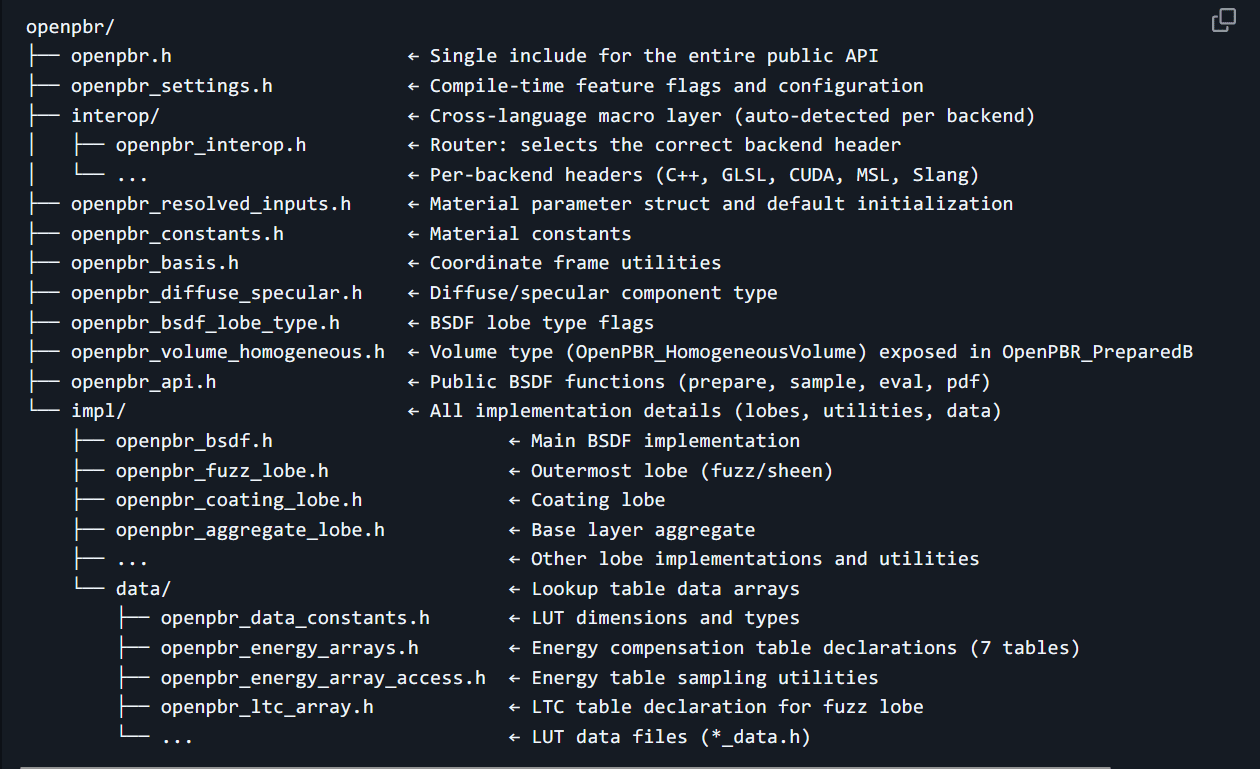
A public reference implementation of the full OpenPBR 1.0 BSDF is now available, released as a small, self-contained library built to mirror a production implementation used in an internal engine. The package is designed to be simple to integrate. It is delivered as a single header include named openpbr.h, aimed at teams who want to evaluate, sample, and ship consistent shading behaviour without hauling in a larger framework. The licensing choice matters for production teams and tool builders. The library is licensed under the Apache License 2.0, which is commonly used for permissive reuse and redistribution.
The API is small and very on purpose
The exposed interface is intentionally compact. The API surface is described as prepare, sample, eval, and pdf. That kind of shape is familiar to anyone who has wired a material model into a renderer, a path tracer, or a real-time shading stack. You prepare state, you sample directions, you evaluate response, and you compute the probability density for whatever sampling strategy you picked.

The key point here is not that these names exist, but that the implementation is a complete production implementation of the full OpenPBR 1.0 BSDF, then refactored into a tighter library form. That implies the library is meant to be used as a working baseline rather than a toy example.
One source, many targets
A core design goal is portability across multiple compilation targets. The library includes a GLSL style macro layer so the same source can compile as C++, GLSL, CUDA, Metal Shading Language, or Slang. For pipeline folks, that is the headline hiding behind the headline. A single code path that can be shared between CPU side reference evaluation and GPU side shading variants can reduce mismatches between offline and realtime looks, reduce duplicated bug fixing, and cut down on the inevitable drift that happens when implementations fork.
This release is presented as a reference implementation, but it is also explicitly described as the physically based production implementation that ships in an internal engine. That is a different promise than a pure spec document. It is code that has been used in anger, then packaged to travel.
What this changes for lookdev and realtime teams
The practical value for working artists and tech artists is consistency. A reference implementation offers a common baseline for how OpenPBR 1.0 behaves across tools and targets, especially when the same source is intended to compile into CPU and GPU contexts.
For realtime teams, the goal of compiling into shader languages and shader adjacent toolchains is the kind of detail that can save weeks. If your renderer uses GLSL and your tools team validates materials in a C++ baker or previewer, sharing one library can reduce the odds that two implementations disagree in subtle ways.
For offline teams, a compact library with a clean API can be easier to wrap into a renderer plugin, a USD shading adapter, or a testing harness that validates renders across builds. Nothing in the provided facts claims any of those integrations exist out of the box, but the library shape is clearly aligned with that kind of usage.
Some of the most valuable wins in shading are painfully unglamorous. Deterministic results across targets, fewer implementation forks, and clearer testability can be the difference between a stable material library and a never ending parade of look diffs.
One reminder that applies to every new shading drop, no matter how solid it sounds: new tools and innovations should be tested before use in production.
The vendor angle
Adobe is positioning this as a public release of a production OpenPBR 1.0 BSDF implementation, repackaged into a minimal single header library with a cross target macro layer.
