



This article by Bela Beier originally appeared in DP 06 : 2012.Luis Alonso, Senior Technical Artist at BioWare, spoke at FMX about the game “Mass Effect 3” – DP was there and grabbed Luis Alonso after the presentation to ask him a few questions.
The game “Mass Effect 3” is the furious finale of the game saga about Commander Shepard. The third instalment of the series, which began in 2007, concludes the storyline that began there and relies on legacy storytelling like almost no other game: team members and NPCs from all the instalments appear again and again and have a strong influence on the plot. “Mass Effect 3” was first presented with a trailer at the Spike Video Game Awards on 11 December 2010. The multiplayer was developed by BioWare’s subsidiary in Montreal, while Digic Pictures from Budapest was responsible for the cinematic trailer. DP spoke to Luis Alonso, Lead Technical Artist at BioWare Montreal for “Mass Effect 3”, about the game and its challenges. He began his career eleven years ago and has since worked as a modeller, in special effects, animation and rigging. On “Mass Effect” he was responsible for the setup of the pipelines and the development of various tools.

DP: What were the challenges with “Mass Effect 3”?
Luis Alonso: Firstly, the legacy management. Since practically everyone who plays “Mass Effect 3” has also played “Mass Effect 2”, we had to be very careful here, both with the code and with the pipelines and setups. One example where we had to develop a lot was character customisation. There was a veritable cornucopia of problems here. For example, during testing it was possible in some areas to make the cheekbones protrude so far that they penetrated the helmet. We then had to try out all the variants to avoid this. Because there’s always someone who just pulls all the sliders to the maximum to create the ugliest character. In addition, we generated a code for the adjustments to the face that practically describes the deviation from the starting position and with which you can share your “face” with others – and there are now sites on the net, for example http://www.masseffect2faces.com. The codes for the faces were exchanged here – so if you wanted to play the game as “Kate Beckinsale” Shepard or as “Obama” Shepard or something similar.

So we asked ourselves at the beginning how we should deal with this: Do we add more customisation options or do we limit them to make it easier to program the characters, or because it’s just out of date. Because if the fans have already created databases with faces, as a developer you naturally want them to be able to continue using them. So if we no longer support these codes, the players are disappointed because they can no longer use them. If we don’t change anything, others who were hoping for something new will be disappointed. In the end, we went with an interim solution – even if that means that we still have to “Realism depends on the details” in the update after the release Luis Alonso Senior Technical Artist, Bioware had to make some improvements because the hair colour or eye colour could not be changed in some setups. And this is where Legacy becomes an important point in development.
DP: And what was the challenge for you personally with “Mass Effect 3”?
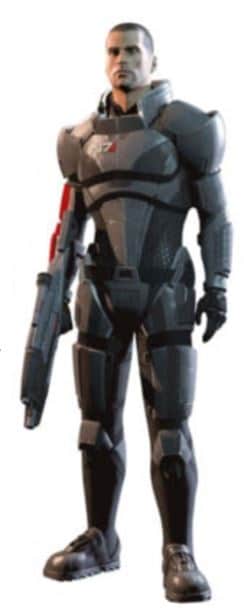
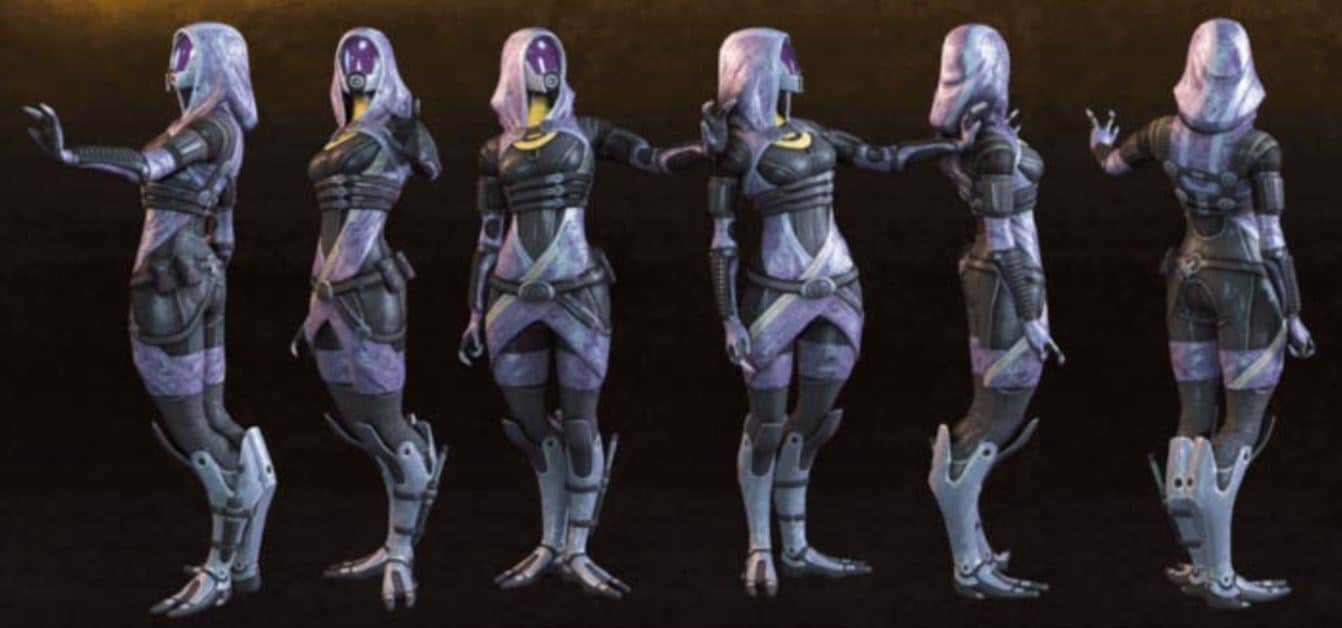
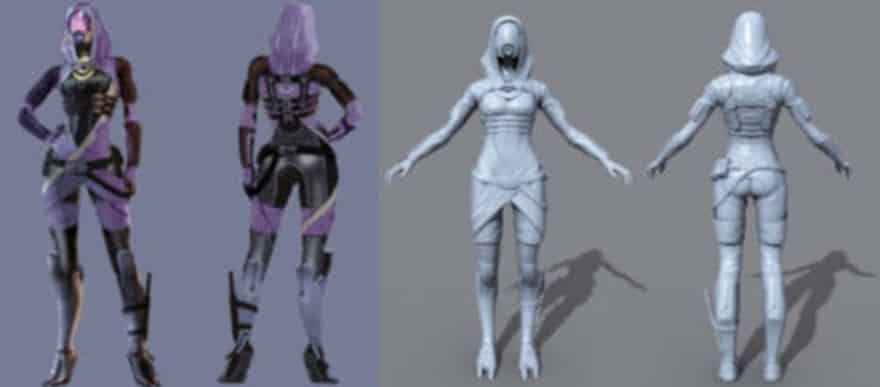
Luis Alonso: For me, the armour was the biggest challenge, because parts were constantly pushing into each other. The Reckoning armour with the spikes in particular cost us a lot of effort. The armour plays a major role in the story – especially the battles. The different classes and species have as many different armours in the third part as the first and second parts combined.
DP: And how are these classes structured?
Luis Alonso: On the one hand, we have the flexible armour – that is, armour for characters that can assume many different poses – and on the other, characters with relatively little armour. The biotic class (which is found in almost all species), for example, has powers like the Force from Star Wars, which it uses in contortions, but hardly any armour. In contrast, the soldier class is heavily armoured. And here’s the problem: How does it move? How much of the armour is flexible, and how much can be flexible at all and remain “armour”?

DP: Can you show us an example of this?
Luis Alonso: No problem. For example, the Geth (see the Geth character model at the bottom left of the first page of the article) have cables protruding from the neck. When I saw the concept, my first question was of course: Do I have an extra bone or do I have to think of something special for the deformation? Of course there was no extra bone in the model. But we are creating a character that has an overall structure. The bones result in the movements and deformation of the model, and we can’t just add bones at will. If things go wrong, this can affect missions or even the entire game.
DP: Do you think we will be able to work with 300 or more bones in the next generation of consoles? And where is the limit where it still makes sense to use them?
Luis Alonso: At the moment, we have more than enough with 140 bones – perhaps even too many. I think it’s much more important to develop twisting further. For example, if you take a twisting forearm, you currently only need two or three bones to get a twist with acceptable volume – including the twisting. To expand that from “acceptable” to “good”, we’re adding more bones that aren’t actually necessary to avoid the “candy wrapper” look. And I think in the future we will make such adjustments more via progress in skinning.
DP: How do you design at the moment?
Luis Alonso: My workflow is – in stark contrast – to create systems that prevent exactly that, minimising interpenetration and managing flexible elements. This is also the big “creative” decision period in my job – to decide which parts are flexible, also taking into account that it is “space technology”, and which parts are not allowed to be flexible at all as “armour”. In “Mass Effect 3”, for example, we included various non-flexible plates in the main character’s belly armour, which then overlap and overlap in places.
This creates the impression of a solid material that can still be flexible within certain parameters. If you overdo it with something like this, the armour will eventually look like a swimming costume. The realism of a character depends very much on the consistency of the details.
DP: So when is the Mass Effect Swimsuit Edition coming?
Luis Alonso (laughs): Fans have already designed it.
DP: How are these ideas being received by the players?
Luis Alonso: They naturally ask – especially in the test phase – why some pieces of armour look so flexible, and then we know that we have to improve the design. For example, making the individual parts inflexible – which of course means that the parts penetrate each other when the character moves. The classes already existed in the first part. Depending on this, we defined the animation and how the individual types and classes move, and then developed the armour from this.
However, this doesn’t always work, because users can not only select the class, but can also buy armour or take it from other games such as “Dragon Age”. And combine this with the character, which has also been customised. And suddenly we have huge spikes on the shoulder piece that protrude into the head, which of course quickly becomes a bug.
DP: Would it be possible to include a “misdevelopment” in the game that affects the player?
Luis Alonso: That would definitely be interesting – it could also be incorporated into the game design, and these restrictions would not be so difficult to implement. You then have to see whether the players recognise such errors and enjoy adapting them or whether this becomes a disruptive factor beyond personalisation.

DP: In “Mass Effect 2” there was also a reset from “Dragon Age”. Would it be possible for the studio to standardise all assets and prepare crossover events?
Luis Alonso: The “Dragon Age” armour in “Mass Effect” is based on the design, but was created and implemented by the “Mass Effect” artists. Even though we would like to do this, I don’t see it happening at the moment.
Most of our games use different engines. So it’s not just about a Maya or 3ds Max-based workflow, but the fundamentals of the games are completely different. “Mass Effect” uses the Unreal Engine, and “Dragon Age” uses an in-house engine called Eclipse, which the team worked on – with all the assets – for seven years.
“Mass Effect was only built on the Unreal Engine from the beginning, so we can share some assets between the projects, but unfortunately not everything. During the “Mass Effect” series, we used Aurora, Eclipse and Infintiy, among others, in parallel with Unreal. We are trying to harmonise this in the near future, but it will take some time. And if we include “Star Wars: The Old Republic”, for example, it will be difficult – because it uses a completely different engine that is designed for MMOGs.
DP: And what about the aliens or other species? For example, the various Husk variants?
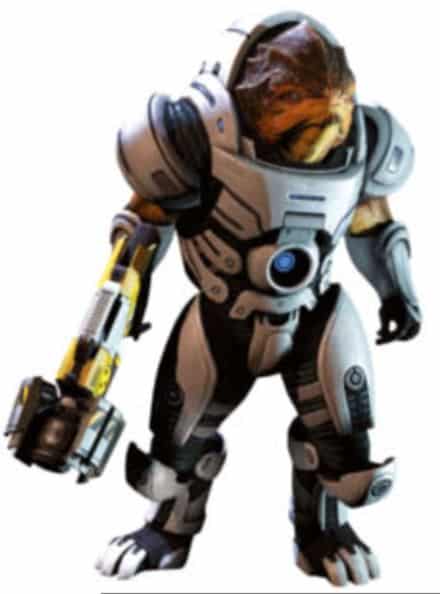
Luis Alonso: It’s always the case that the closer you are to humans (as opposed to aliens), the more critical and attentive the users become – the “Uncanny Valley” is not only relevant for faces.
And with aliens, you’re a bit “freer”..
DP: And human-like figures, for example the Banshees?
Luis Alonso: The Banshee rig was made by Ray and Kevin in Edmonton – but what I’ve seen of it is very similar to the usual “female rig”. The difference with these characters – apart from the obvious different proportions – is not in the rig, but in the animations we created especially for them.


DP: Do you make sure that the rigs will still be usable in five years’ time?
Luis Alonso: Definitely. I would say that you can still work with the existing rigs in a few years’ time, or at least use them as a basis for further developments. Of course, Legacy has been a big point now, and that certainly creates exciting problems – but I generally think it’s better to tie a “franchise” to a character and then not dilute everything further here – as other stories have done. But technically, we could definitely continue working on it straight away.
DP: How many revision runs did you need for the more technically complex parts, for example the hair?
Luis Alonso: As with every major project, we organised this in stages and also formalised it very well. At the end of the first design/drafting stage, we can say whether the character – to stay with the example – has any hair at all. It would be completely out of place to consider the dynamics of the hair and its technical realisation at this stage.
With simulations and physical contexts in particular, it is important to ensure that development runs in parallel and that the various departments do not overtake each other. Otherwise corrections will be extremely time-consuming. To stay with the example: We tried procedural hair in the second phase of implementation. We were able to do quite a lot there, for example side characters. But once we had passed it on to the animators, we realised that this wasn’t the case. After that, we first did the setup for the simulation, because it could have been that the procedural solution was sufficient.
DP: What is it like to work at BioWare and how can we imagine the daily routine and the employees?
Luis Alonso: Working for us is something special. On the one hand, there is a pleasant atmosphere in the company. What I also find very good is that we hardly have any freelancers. Those who are with us are with us and stay with us. This means that it takes us longer to find new employees, but they are better integrated into the workflow and the team. I don’t think much of these two-weekly colleagues. And the few who are really freelancers have been with us for a long time and are all from the region. After all, working together also involves physically meeting up, discussing things and sometimes going out partying together.
DP: Canada is slowly becoming one of the focal points of game development. How strong is the community, and can you still throw stones without hitting VFX artists?
Luis Alonso: In Montreal, it’s often the case that you meet up in some clubs or pubs. In an industry that is so mixed, everyone knows everyone, so it’s normal to meet people from other companies. But realistically, it’s still a relatively small society within Montreal, where practically everyone knows each other. And then there’s the fact that Montreal isn’t that big.
DP: And what is it like to work as a studio for EA or Microsoft?
Luis Alonso: Since I used to work directly for EA, it’s quite easy. And especially with the second and third parts of “Mass Effect”, we were able to work very independently. We proved that we were good at it, and now we could do it the way we liked it.


DP: Can you describe what the relevant qualifications are for your job?
Luis Alonso: There are many terms for it – but in the end you are the interface between animation, technology and design. This means that you are always involved in how the visuals are implemented and realised, and how the programmers and animators deal with them. In addition, there is the transfer of data and communication – and that’s why you ideally need to have worked in this area yourself – as a programmer or animator, so that you understand what the people who build the assets are talking about. Because you are always a kind of support for this step, you have to be able to make the leap between the different programmes and therefore know and understand the work of both the artists and the animators.
Normally, this is the career path of an artist or animator who at some point wonders how everything works in the background and how it can be linked and used efficiently. Before you know it, you’re working on the things that nobody wants to do – implementing the assets in the game.
And little by little, you become the artists’ best friend – because you are the one who brings their content into the game and programmes the tools they need to work well.
On the other hand, the programmers are happy to see you because the assets you deliver usually work. So if you do it well, you’re their best friend at every point in the workflow – and that’s nice.
DP: How do you feel about the decision to offer “Mass Effect” on Origin, EA’s Steam competitor?
Luis Alonso: I believe that competition brings something – a monopoly always becomes sluggish quite quickly, doesn’t bring any new features and rests on its laurels. And we as gamers are left staring down the tube – while two providers try to outdo each other.
DP: “Mass Effect 3” was one of the few games where gamers physically protested in front of the development studio for a different ending – and 300 people is not exactly a small number…
Luis Alonso: Yes, that was interesting. Personally, I would never have believed that anyone would actually leave the forum discussion or the customer service/feedback forms. That’s why we reacted to it and explained the ending in more detail with the extended cut. It has to be said, of course, that our fans are generally relaxed, civilised people – so it was a protest, but neither stressful nor aggressive. And there were also student demonstrations in Montreal at the same time, and the contrast couldn’t be greater.
DP: How do you see the ending? Is there ever a perfect ending for a game?
Luis Alonso: Of course you always wish for a fourth, fifth or sixth instalment. You’ve already spent an enormous amount of time with the character at this point, and you’ve grown fond of both his environment and his “personality” – otherwise you wouldn’t play it for so long – and then it becomes extremely difficult to let go.
But I think there were two problems with our ending in particular: Many people didn’t realise that there were not two, but three choices. However, these only became accessible if you had expanded your “readiness”, i.e. the number of allies, accordingly in the game.
In addition, “Mass Effect” is simply a different kind of game. Solving the entire conflict alone in a Rambo-like manner contradicts the basic idea. Even a science fiction universe can stick to the basic premises of consistent stories.
And then to have an ending that comes as a finale after such a story, and the hero simply walks off whistling into the sunset? That would be inappropriate.
