



With every release, a wave of joy goes through the community – the new update of the open source favourite is here! As announced, Blender now offers more stability with over 1250 bug fixes in the 2.83 LTS version to be truly production-ready for larger projects. Other new features include VR support, OpenVDB import, noise reduction in the OptiX viewport and a new Cloth Brush! In our upcoming DP issue, which will be published on 26 June, we will show you more useful details about the tool!
Loooong Term Support
To ensure that your projects with longer production times can be completed within one version without stress, the LTS versions will receive critical bug fixes over a period of two years. The developers do not want to make any new features or API changes. Blender 2.83 LTS is the pilot programme of the new strategy – more information can be found here.
OpenVDB Import
It burns, it smokes and it speaks better OpenVDB: Blender can now import corresponding files and render them with the new volume object. The files can be created with Blender’s fluid simulation cache or, as usual, with other tools such as Houdini.

Sculpting features
There are also many new features in the modelling and sculpting tools: In particular, this includes the release of the new Cloth Brush tool. With the help of a physics solver, you can quickly create realistic wrinkles that can be customised with “Mass”, “Damping” and other parameters. You also get different ways of creating deformations: Drag, Push, Pinch Point, Inflate, Grab, Expand and more. It’s up to you whether you use this as intended for items of clothing or conjure up a really nice, wrinkled face for your grandpa character.
Another feature is called the “Face Sets” system. If you’ve worked with Zbrush before, you’ll recognise strong similarities with the polygroups. With face sets, you can divide your sculpting model into different areas and differentiate them by colour. The sets can be created according to material, UV Seams, Normals, “Loose Parts”, Edge Creases or Sharp Edges, for example, and then used for editing.

Virtual Reality in Blender
With the new “Scene Inspection” feature, it is now possible for the first time to view your scenes in VR within Blender without a 3rd party plug-in. However, it is not yet possible to edit assets or scenes. The implementation is based on the OpenXR standard – you can find more information here in the release notes.
Rendering: Denoising, Eevee and more!
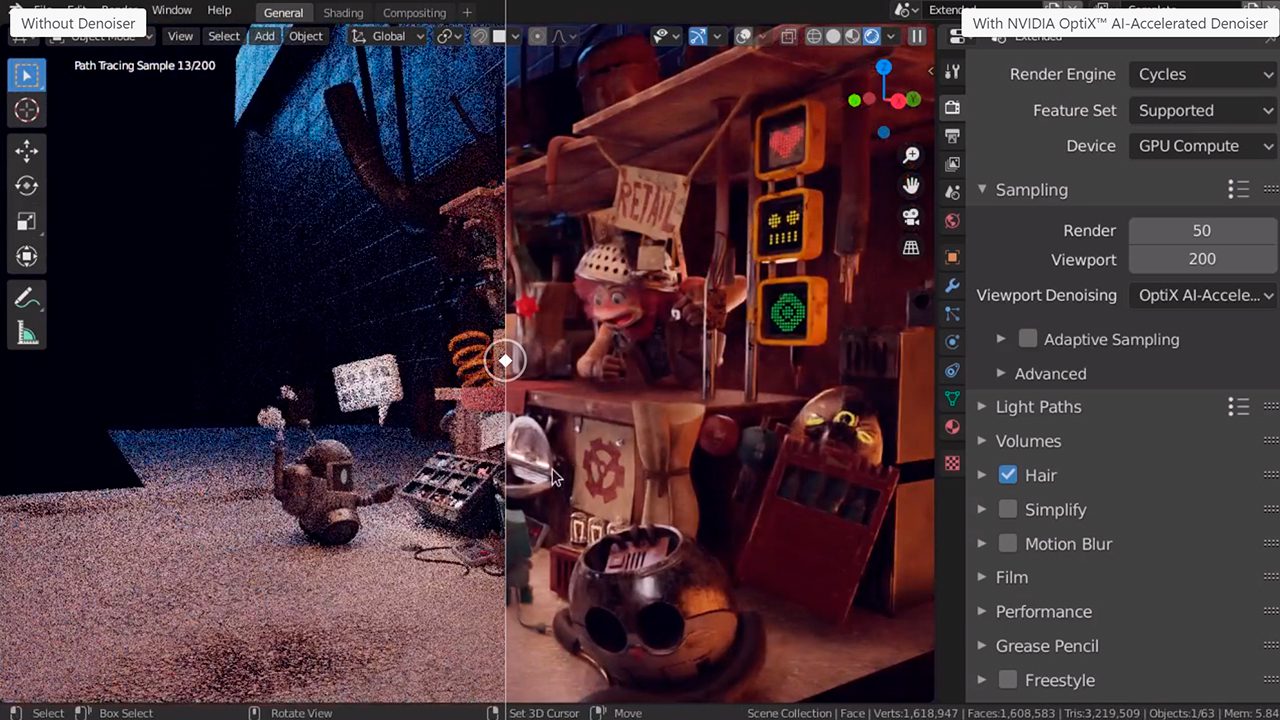
Until now, the OptiX denoising feature was only available in the final render mode of Cycles – with the new release, this is now also possible in the viewport! The real-time render engine Eevee receives a major light cache update to reduce artefacts, support for high quality normals, as well as new render passes and hair transparency features.
Further innovations
And if that’s not enough – you can take a look at the list of other new features: First and foremost the revision of the Video Sequencer with a new disc cache, Blade Tool and more. You will also find the following updates in Blender 2.83:
- Modifier updates for Solidify, Ocean, Surface Deform, Remesh and more.
- Shader Nodes updates for Volume, Vertex, Noise Roughness and more
- Grease and Pencil with Vertex Paint, new Mark System, Smooth Corners and better performance
Further information: To the Blender Foundation Website (Relase Notes)
