



Version 2.19 of the Unigine engine brings improvements and new functions – the most important new features include performance optimisations, improved integration with OpenXR for immersive VR experiences and support for the widely used USD file format. With these features, Unigine aims to make the engine even more flexible and powerful for demanding projects.
Further development of the animation system
Unigine’s animation system is constantly evolving and version 2.19 offers a number of experimental improvements for ObjectMeshSkinned. The most important new features include the implementation of LookAt chains, which enable bones or objects to be automatically aligned in the direction of a target point. In addition, rotation constraints for bones have been introduced, further refining control over animations.
Another update concerns the management of morph targets. This has been adapted for ObjectMeshSkinned to optimise performance and handling. Several interpolation modes for bone rotation have also been added, giving artists more flexibility when animating characters and objects.
One significant change is that ObjectMeshSkinned no longer supports mesh geometry modification. Instead, there is a special procedural mode in which a custom mesh can be set. This change is aimed at improving performance in real-time applications.
Finally, Unigine 2.19 offers the possibility to register the animation retargeting for ObjectMeshSkinned. This is now done by using pairs of animation path and mesh path, which simplifies and speeds up the process of transferring animations to different characters.
Improved performance and new features
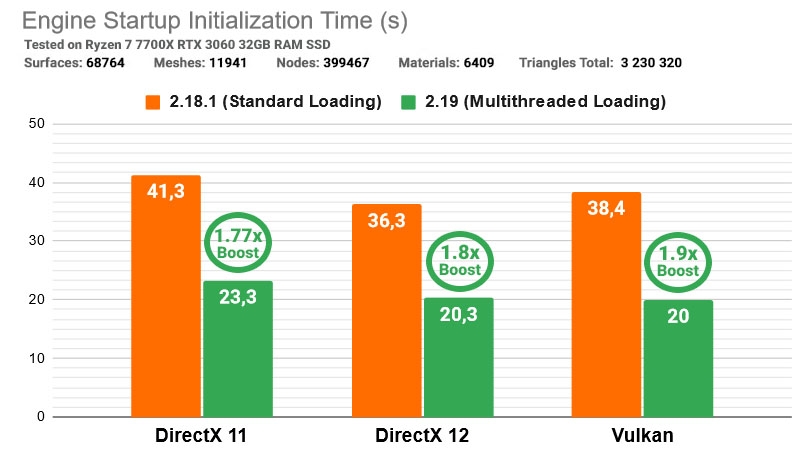
The update to Unigine 2.19 focuses on performance optimisations, which are particularly important for artists working in real-time environments. The engine now uses techniques to reduce latency and optimise memory management. These improvements are intended to increase the frame rate in complex scenes and make the overall experience smoother for the user.
One feature of the new version is support for OpenXR. This open interface for virtual reality (VR) and augmented reality (AR) makes it possible to use Unigine with a variety of headsets and VR setups. OpenXR standardises VR and AR development and makes it possible to seamlessly port projects to different platforms. This innovation should be particularly important for users who develop immersive VR experiences in real time.
In addition, Unigine 2.19 now integrates support for USD (Universal Scene Description), a format that is increasingly establishing itself as the industry standard in 3D production. The USD format, originally developed by Pixar, allows for efficient management of complex scenes and supports multiple layers and variations within a project. Through this integration, artists can now work with USD directly in Unigine, which greatly facilitates compatibility and the exchange of assets between different software environments.
With the integration of USD, Unigine can now natively handle this file format, which is especially important in the VFX and animation industry. USD files are known for their ability to efficiently store and edit complex scenes and animations. This makes them ideal for use in films, games and virtual reality applications.
In addition to the major new features, the update also offers smaller improvements, such as extended script integration options and adjustments to the user interface, which further simplify the operation of the software. However, users should bear in mind that, as always, these new features should be carefully tested before integration into current projects in order to avoid possible incompatibilities.
Relevant file formats and applications
The support of OpenXR significantly expands the application possibilities of the engine in VR and AR projects. OpenXR is supported by many leading VR headsets, including devices from Oculus, HTC and Valve. This extension makes Unigine an attractive choice for developers who want to optimise their projects for different platforms and devices.
Prices and licence models
Unigine offers various licence models that are geared towards the different needs of users. The Free Community SDK is aimed at indie developers and small studios, while the Pro and Enterprise licences are designed for larger teams and companies. The Pro licence offers additional features and support options, while the Enterprise licence includes customised solutions and more extensive support services. It is important to check the licence terms carefully to ensure that the option chosen meets the requirements of the project.
For more information and technical details you can visit the Unigine website.
