



In October 2024, the Blender Foundation conducted its first user feedback survey, gathering insights from over 7,000 participants worldwide. The survey aimed to understand user satisfaction, demographics, and areas for improvement in Blender’s development.(Blender – Survey)
Demographics and Participation
The majority of respondents were between 19 and 35 years old, with significant participation from the United States, India, and Germany. English was the primary interface language for most users, followed by Chinese and Spanish. Interestingly, older demographics placed higher importance on Blender’s mission to provide free tools for content creation.
User Satisfaction
When asked about their satisfaction with Blender, 66% of users rated themselves as “very happy,” indicating a strong approval of the software’s capabilities and development direction.
Community Engagement
While the majority of participants did not have any Blender ID community badges, the “30 years” campaign badge was the most popular among those who did. This indicates a strong sense of community and engagement among long-term users.

First 3D Software Experience
The survey revealed a roughly even split between users who started their 3D journey with Blender and those who began with other software such as 3DS Max, Maya, and Cinema 4D. This diversity highlights Blender’s ability to attract both newcomers and experienced artists from other platforms.
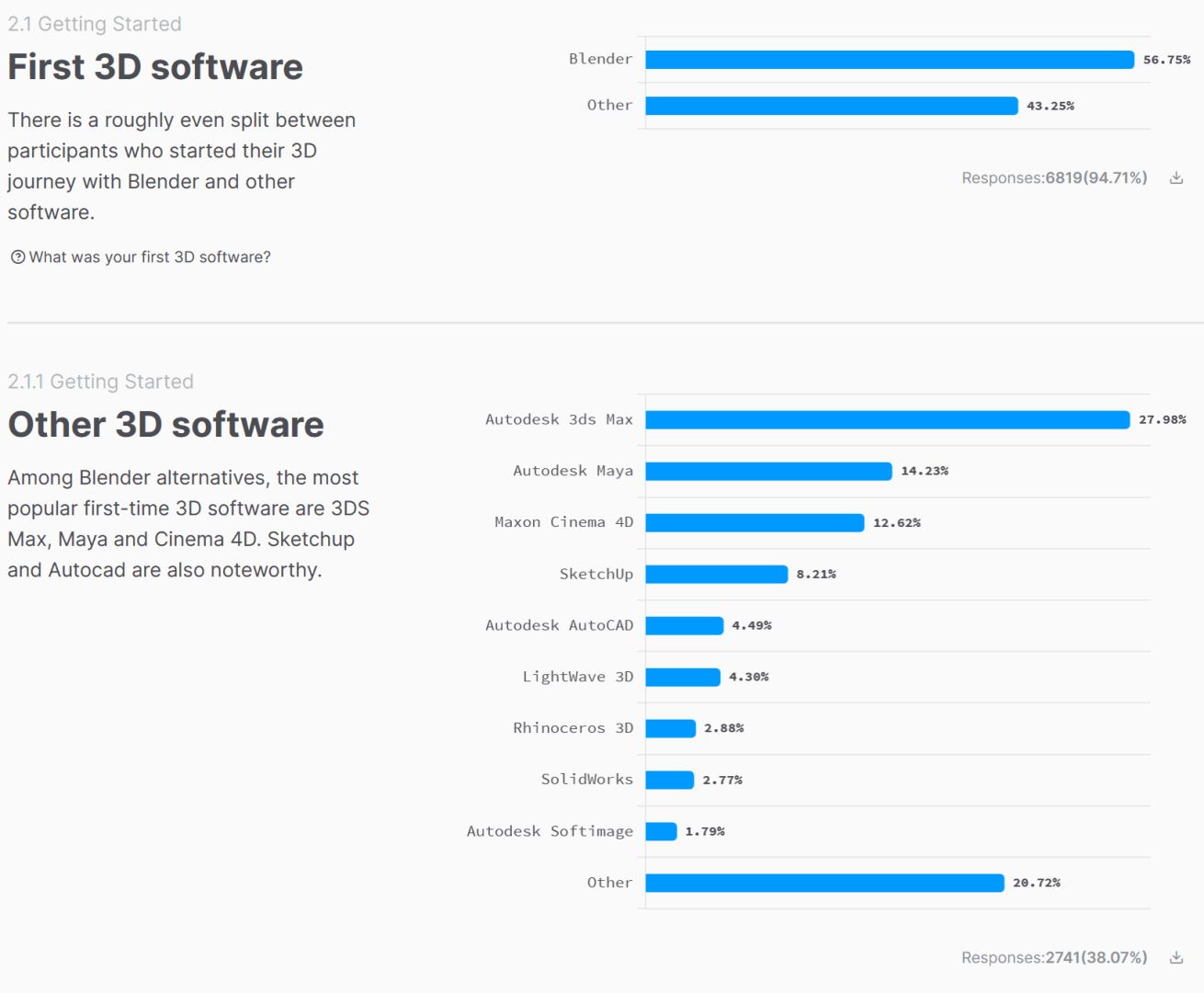
Other 3D Software in Use
Blender may be the go-to tool for most respondents, but it’s far from the only one in their pipeline. According to the survey, over half of all participants use additional 3D software alongside Blender. The top mentions? Autodesk Maya and 3ds Max still hold ground, especially among users who migrated to Blender. Cinema 4D makes a strong showing, particularly in motion graphics-heavy workflows. Houdini appears frequently, mostly among users handling procedural content and simulation-heavy tasks. Unreal Engine, while technically not a DCC (digital content creation) tool, also ranks high due to its integration in real-time workflows and game development. This mix underlines Blender’s role not as a lone wolf, but as a highly cooperative tool within hybrid production environments.
Why Users Choose Blender
When it comes to motivations, the most common reason users gave for adopting Blender can be summed up in one word: freedom. The open-source model is more than a philosophical point—it’s a practical one. Survey participants value not just the zero-dollar price tag, but also the transparency of development and the availability of the source code.
The second most popular reason was Blender’s all-in-one workflow, meaning users can model, animate, shade, light, render, and even composite in one environment—without needing to jump between applications. Other motivators included the supportive community, the high cadence of new releases, and the sheer fun of using the software. Apparently, Blender is one of the few production tools that doesn’t make its users scream into the void—at least not daily.
The Top 5 Most Used Add-ons
Blender’s flexibility shines through its add-on ecosystem, and the survey’s data backs that up. Topping the list of most used add-ons is Node Wrangler, an indispensable tool for shader work that dramatically speeds up node-based workflows. Close behind is LoopTools, loved by modelers for its suite of mesh editing tools. BlenderKit comes next, serving as a library for ready-made assets, materials, and brushes—popular among users looking to speed up asset production.
The fourth spot is held by F2, which enhances face creation during modeling, particularly useful in low-poly workflows. Finally, Rigify rounds out the top five, giving animators a fast way to generate rigging systems without diving into manual bone hierarchy madness. Together, these five add-ons show what users actually rely on—not flashy plugins, but pragmatic tools that cut time and cognitive overhead.
Conclusion
The 2024 Blender user survey provides insights into the community’s satisfaction and areas for improvement. With a strong base of happy users and a commitment to free, accessible tools, Blender continues to be a leading choice for 3D artists worldwide. For more detailed results, visit the Blender Feedback Survey 2024 Results.
