



by Peter Beck, Field Product Manager Workstations
and Rugged at Dell Technologies in Germany.
This new approach to filmmaking has revolutionized the industry by blending digital technologies with traditional techniques. It merges virtual environments with live-action filming, allowing studios to project ultra-high-resolution backgrounds onto LED walls where actors can perform in real time. Camera tracking allows virtual backgrounds to react to camera movements in real time, making the scenery appear fully realistic. Studios can simulate buildings or landscapes that exist in the real world, as well as completely fictional worlds such as imaginary planets or fantasy cities. Studios can replicate real-world locations, such as buildings or landscapes, or create entirely fictional worlds, from alien planets to fantastical cities.
The benefits of virtual production are extensive. Post-production work is often reduced, and overall costs are lower since crews no longer need to travel to global locations like New York, Paris, or London to shoot on site. This also helps reduce CO₂ emissions, which is a clear environmental advantage. Directors and film crews can adapt virtual environments quickly, make last-minute changes, and experiment visually without being tied to external factors.
Freed from concerns like weather, natural light, or time-of-day constraints, teams gain greater control over planning and execution. Virtual environments are also far easier to reuse than physical sets. This facilitates so-called pickups, i.e. additional or supplementary shots that are recorded after the main shoot to improve, supplement, or correct certain aspects of a scene. But even the next sequel to a successful blockbuster series can be produced much faster and more efficiently.
Workstations as a Central Component
Software tools like Blender and Unreal Engine make virtual production possible. Artists often use Blender to design photorealistic 3D models and animations, while Unreal Engine renders these assets on LED walls and enables real-time interaction between actors and digital content. For these tools to operate effectively, they require equally capable hardware. This is where workstations come in, especially those outfitted with high-performance GPUs. These machines are the backbone of the virtual production process.
Workstations render the digital environments live and display them on LED walls. They also handle compositing, the process of blending actors and physical elements with the virtual background. These workstations allow directors, cinematographers, producers, and department heads to hold virtual scouts; collaborative sessions in a shared digital environment used for pre-production planning. By interacting in real time within the virtual assets, teams can explore camera angles, lighting setups, and set design long before principal photography begins.
One reason workstations are so effective is that they harness the specific strengths of modern GPUs. While CPUs generally produce higher-quality final renders, GPUs are much faster at generating real-time previews. This performance difference stems from their underlying architecture. CPUs are designed for complex, sequential tasks and typically include a few very powerful cores. GPUs, by contrast, excel at parallel processing and are equipped with thousands of smaller cores that can handle many simple calculations simultaneously. This enables rapid on-set rendering during virtual production. More detailed work, such as final colour grading or complex simulations, can then be completed during post-production using CPU-intensive data centres.


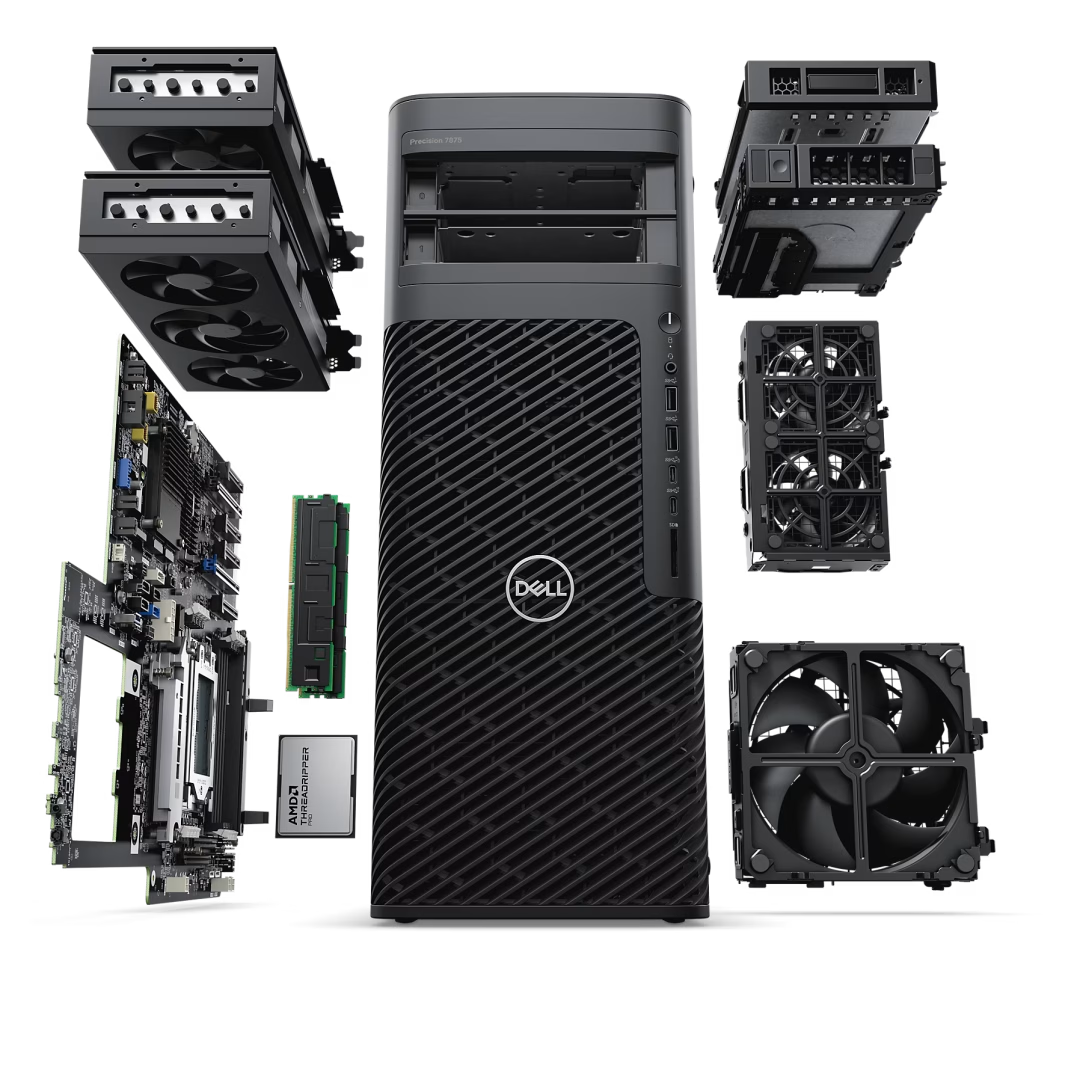
Dell Precision 7875 Tower Workstation: Purpose-built for Virtual Production
The Dell Precision 7875 Tower Workstation (SpecSheet) is a standout hardware solution for real-time rendering. Designed specifically for professional use in virtual production, it supports up to two NVIDIA RTX 6000 Ada GPUs. This graphics card delivers extremely high computing power for real-time rendering. Its architecture includes RT cores that accelerate ray tracing and Tensor cores that specialize in AI calculations. It also has a large graphics memory. This combination enables complex 3D scenes with numerous details and high-resolution textures to be displayed smoothly without delays. With this level of hardware, filmmakers can make creative decisions in real time and integrate highly realistic virtual sets directly into their production workflows.
