



Table of Contents Show
Hoon Kim is the founder of Beeble, the company behind SwitchLight, with a KAIST pedigree (B.S. and M.S. in Electrical Engineering) and prior research stints at Lunit and Krafton, where he led a voice-synthesis team. See his background on his personal site and connect via LinkedIn. His academic track record spans machine learning and computer vision, from the AAAI paper “Crash to Not Crash” to recent work on relighting; browse a full list on his Google Scholar.
DP: Let’s kick things off with a bit of background: What actually set you and your crew on the path to AI relighting?
Hoon Kim: Four other technologists and I founded Beeble as a selfie relighting app after seeing a gap in the market for AI-powered lighting tools. It received a great reception and went viral, but the real Eureka moment happened next. We found that VFX artists would hugely benefit from a similar tool that relights video instead of still imagery. We knew it would solve many time and budget issues, while enabling professionals to fix lighting in post, without having to reshoot.
DP: With Switchlight 2.0 being released versus 1.0: What’s the “wow, that’s new!” factor?
Hoon Kim: Switchlight 1.0 already had a huge level of detail in terms of PBR map generation, but this update brings it up a notch. It boosts the quality of our normal, basecolor, metallic, roughness, and specular passes, thanks to training on 13 times more data. We’ve now also extended these maps to background objects and environments, as well as the central video subject.
DP: For anyone curious to jump in: How does the pricing and licensing for Switchlight 2.0 work?
Hoon Kim: All our pricing is credit-based, giving you a set amount of content to process each month. The Starter plan is free and allows you to run 15-second video passes, ideal for testing the software. For ongoing use, the Creator plan is $19/month and the Professional plan is $75/month, with discounted rates available on annual subscriptions. All pricing details are available on our site.

DP: If you think about Switchlight landing on the desk of a busy VFX artist or colorist: Where does it shine?
Hoon Kim: Put simply, it delivers the level of quality a VFX artist would expect. Additionally, they receive AOV passes almost instantly, a significant shift from the traditional, manual CG rendering process, making it ideal for quick fixes.
DP: Deflickering temporal noise is a game-changer for a lot of us! Can you give us a peek into how your new approach works, especially for fast-paced or multi-source lighting?
Hoon Kim: SwitchLight 2.0 operates on an image-based model, utilising PBR maps that mitigate temporal noise deflickering. Our next update, SwitchLight 3.0, takes things further: a native video model that removes the need for special deflickering. More details coming soon!
DP: Speaking of standards: What’s your support like for things like ACES, Rec. 709, P3, and other pro color spaces? Are you outputting true 16-bit or 32-bit float EXRs, so no one’s losing data along the way?
Hoon Kim: Our AI is trained on the Rec. 709 colour space, which is the recommended format for best results. That said, you can still apply the generated PBR maps to your original ACES footage without losing any detail.
DP: What kind of shots or material have you seen Switchlight absolutely nail and where does it still sweat?
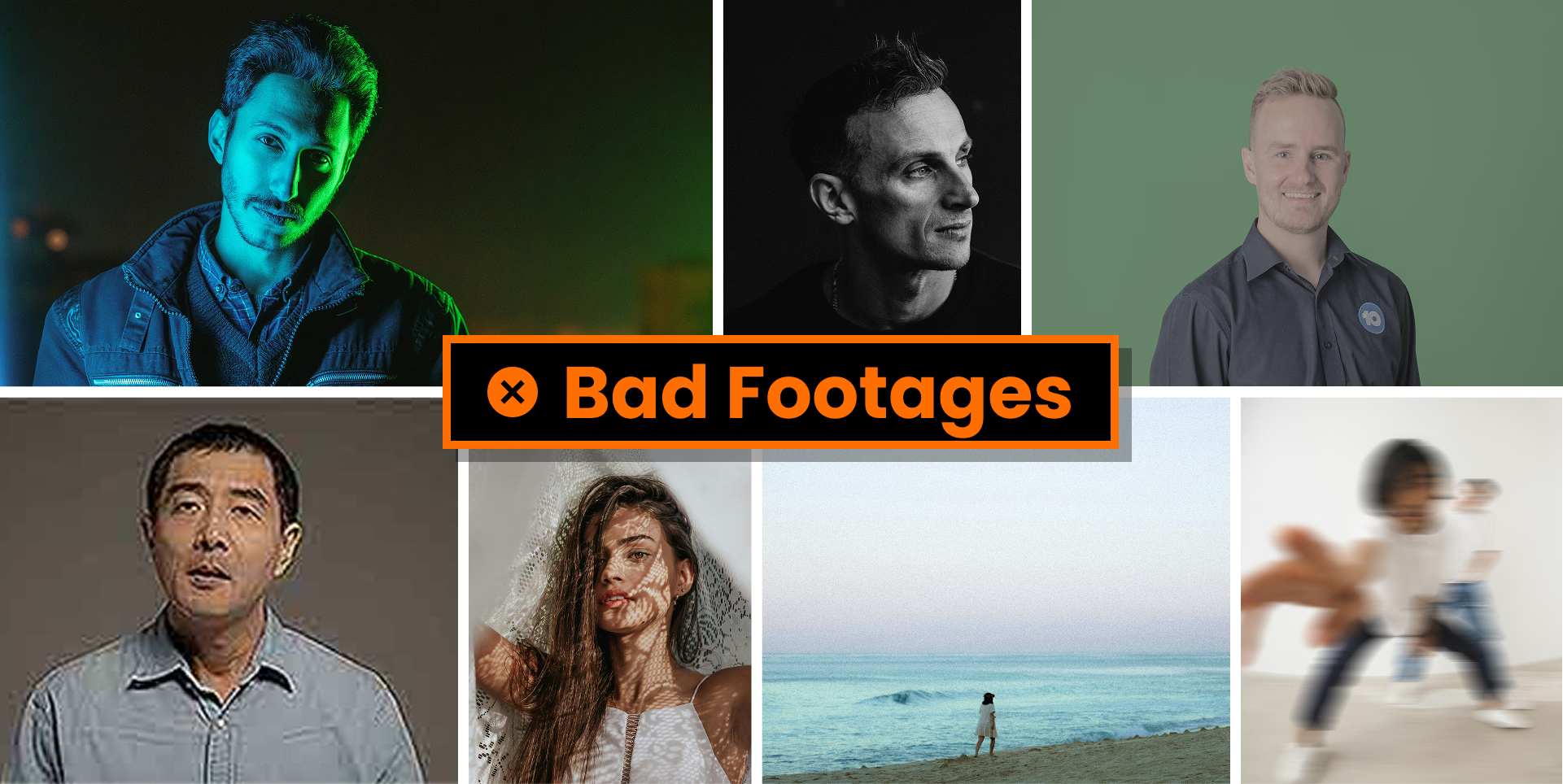
Hoon Kim: SwitchLight 2.0 is built to handle footage from any camera, whatever the quality, lighting, or style. Of course, high-definition, steady shots with flat lighting will always give you the greatest control.
DP: When you’ve got those nightmare shots with crushed blacks, low-res and ancient TV rips: Do you have any hacks?
Hoon Kim: For that kind of challenging footage, it helps to upscale before running it through Beeble, and then apply a separate deflicker pass on top of the generated PBR maps. Tools like Nuke Copycat make that step straightforward and can dramatically improve the result.
DP: Any “dos and don’ts” from what you’ve seen in the wild?
Hoon Kim: AI upscaling is definitely a “do”, it could massively improve poor-quality footage and makes it easier for SwitchLight to generate accurate PBR maps. But avoid heavy denoising, which strips away detail the AI needs, and hold off on strong LUTs or oversharpening until after relighting, as they can distort the data and lead to unstable results.
DP: Is there a “Switchlight for Dummies” checklist for prepping shots?
Hoon Kim: We actually put together an article on this! However, my main advice is simple: aim for even, level lighting when shooting. Beeble can handle almost any condition, but flat lighting gives you the most flexibility and control later in post.

DP: Alright, time for a technical deep dive! How does Switchlight 2.0 whip up those depth maps?
Hoon Kim: At its core, it’s a neural net doing the heavy lifting. That’s about as far as I can go! You can more information via these links: https://beeble.ai/research/switchlight-2-0-is-here or the paper on the technology: SwitchLight: Co-design of Physics-driven Architecture and Pre-training Framework for Human Portrait Relighting
DP: Under the hood, what kind of AI are we talking about?
Hoon Kim: We are always improving the network architecture, so “monster hybrid” would probably be the most accurate description. However, the beauty lies in integrating the Cook-Torrance BRDF model, which enables the AI to learn how light bounces off a subject. Paired with physically based rendering, the system can generate a relit scene that looks physically convincing.

DP: The classic pain point: specularity. How does Switchlight tease out reflections and highlights?
Hoon Kim: We’ve made specular maps flexible enough that you can dial them in however you like. Want more gloss, less sweat? Just tweak the strength directly in-platform, or plug the maps into a third-party shader like Blender or Unreal Engine for full control. You can even isolate high- or low-specularity regions, so you decide exactly how shiny or matte things should look.
DP: What about your reference data?
Hoon Kim: All of our training data is created in-house using scans of real humans and objects. We train only on safe, clean, and fully licensed datasets, ensuring professionals can use our service with complete peace of mind. We do not use movies, films, or any third-party content that could raise copyright concerns..
DP: Platform time! So you’re solid on Windows, Red Hat, Ubuntu. Any dreams of a Mac version for the “Final Cut Victims”?
Hoon Kim: Right now, SwitchLight 2.0 and the Beeble platform are web-based. With 3.0, we plan to introduce a local version, one that better aligns with the security and workflow standards of major post-production studios.
DP: For anyone building a new Switchlight workstation: What’s the minimum gear to get real-time, and what’s your dream setup?
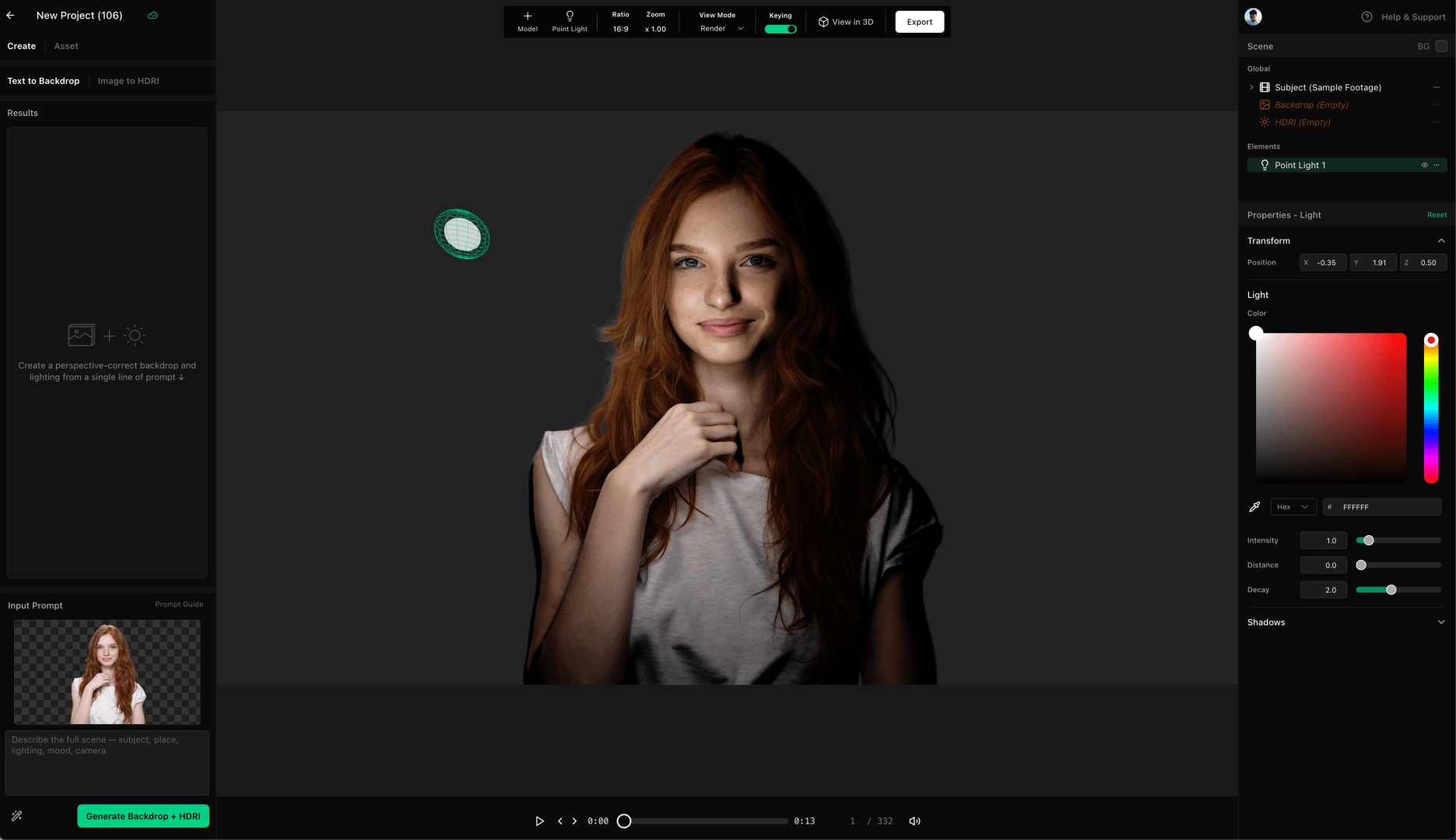
Hoon Kim: We’ve designed Beeble to be accessible to anyone, whether you’re a content creator on a laptop with phone footage or a studio running complex plates. At the entry level, all you really need is a laptop and some footage to upload; the platform handles the heavy lifting and generates the VFX passes for you. Bigger studios will naturally push higher-res material through, but it’s not a requirement. And for anyone wanting to get started right away, we’ve just released Beeble Camera: a free app that brings camera tracking to Beeble.
DP: Looking into the crystal ball: Where do you see Switchlight and AI relighting going, say, five or ten versions from now?
Hoon Kim: Looking ahead, our goal is to keep pushing the detail and fidelity of the PBR maps while advancing motion capture, camera tracking, and depth generation. Ultimately, we want to break footage down into its most detailed components so every frame can be reconstructed, relit, and reimagined with complete creative freedom.
DP: For the tech-heads and code nerds: Are there research papers or blog posts you’d absolutely recommend to get your head around the science powering Switchlight?
Hoon Kim: Absolutely. Our paper is here for anyone to read. It provides a detailed overview of the methods behind SwitchLight, from self-supervised training to the physics-based models that underpin our approach.
DP: What’s the most fun or jaw-dropping thing you’ve seen Switchlight do that made you stop and say: “Okay, that’s actually impossible—except now it isn’t”?
Hoon Kim: A standout for me was a father-and-son duo who made a fan film called Star Wars: Entrenched, with Beeble helping along the way. Navaz Dowling, who runs Bad Beetle Entertainment, taught his son the basics of VFX and brought in friends for costume design and relighting. The trailer’s already out, and the post-production community has responded really positively.
At the same time, we’re seeing larger post-production studios integrate Beeble into their pipelines. The work Boxel Studio did on Superman & Lois is a great example of this. With SwitchLight 3.0 introducing a local version, that side of adoption is only going to grow.

1 comment
Comments are closed.