



Nikos Kalaitzidis started at Digital Domain in 1996 for „T2 3-D: Battle Across Time”, a short movie shot on the set of Terminator 2. Since then he has worked as digital effects supervisor on many of DD’s most acclaimed shows – from Titanic (as Digital Ocean Artist) to Fast and Furious, from Tron: Legacy to the X-Men, as well as Marvels Antman and the Wasp, along with ”Free Guy” and many more.
DP: Finally, a Superhero who’s showing bones! How was the transition from “Free Guy” to the DC Universe?
Nikos Kalaitzidis: Black Adam and Free Guy are both heroes! Both universes were creatively demanding and rewarding for myself and our teams. I learned so much working on Free Guy in regards to contributing ideas to the filmmakers, and that helped us come up with more ideas on how to approach the challenges on Black Adam.
DP: How did you get involved in Black Adam, and what was the basic Principle on which you started your process?
Nikos Kalaitzidis: Digital Domain’s visual effects supervisor, Jay Barton, bid on Black Adam beginning in 2020, and we were in discussion with the production-side supervisor, Bill Westenhofer. Then in March 2020, COVID-19 infamously changed everything. Our bid on Black Adam went on hold, like so many other things.
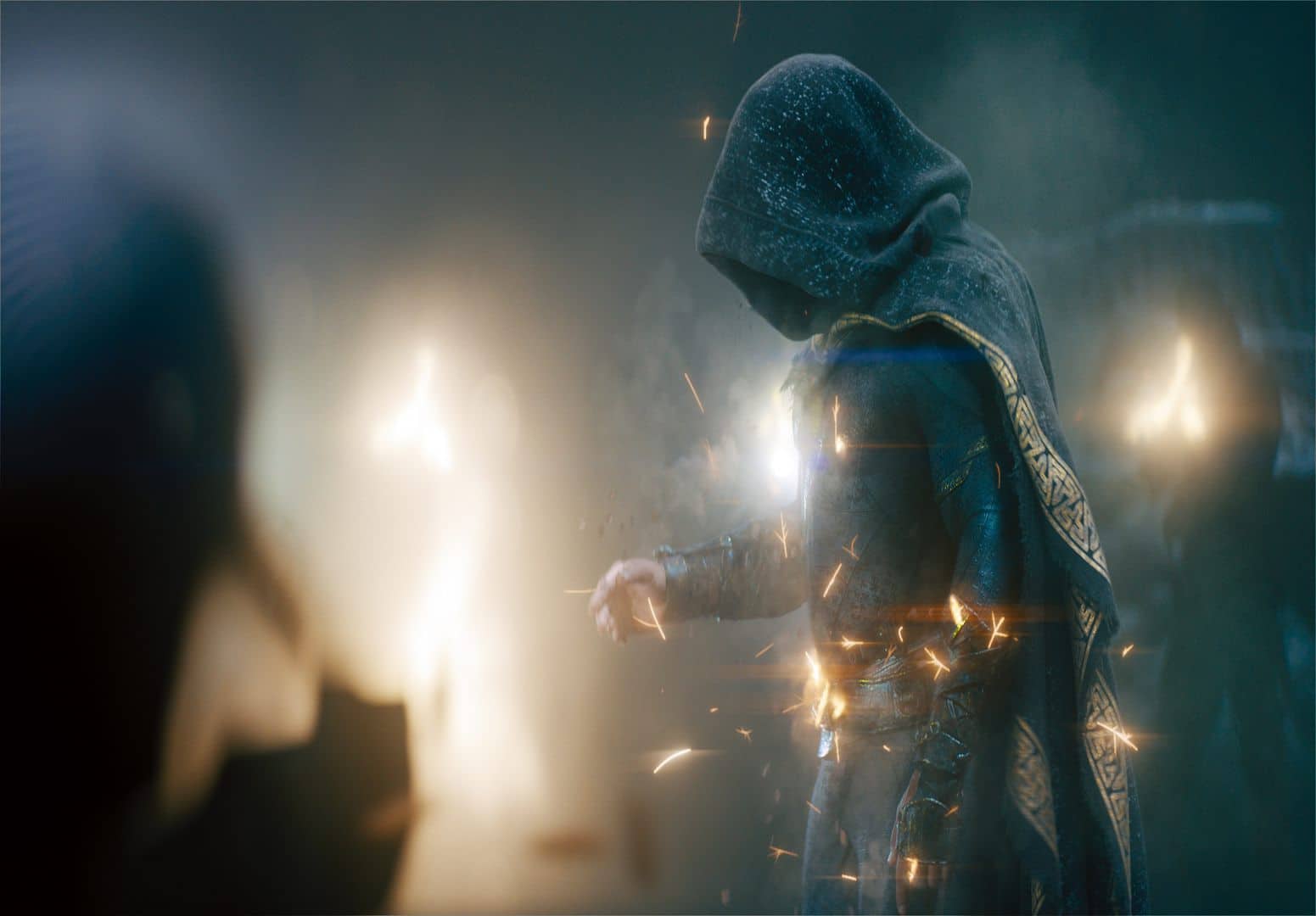
During that time, however; Bill kept working and refining the pre-vis for the film. In the fall, Bill came back to Digital Domain to continue the bidding process, using Unreal Engine rendered pre-vis. Even with COVID-19, show-side production adapted so they were able to start shooting live-action photography in spring 2021. At that point, Jay had begun work on a different show so he was unavailable. Fortunately for me though, I was able to take the baton and continue our bid-to-award for Black Adam at Digital Domain.
DP: How big was the team on this show?
Nikos Kalaitzidis: From March 2021 to August 2022, Digital Domain employed 290 artists and production staff around the globe for Black Adam, primarily from Vancouver, British Columbia, Montreal, Los Angeles, Hyderabad and Beijing. Since we were all working from home, we were also able to employ great artists from different regions including US states like Oregon and Florida, major cities like Toronto and even Germany.
DP: Could you tell us about your pipeline for Black Adam?
Nikos Kalaitzidis: Houdini is like an operating system. Not only did we use SideFx’s Houdini for all of our FX simulations, we also used Solaris for rendering our assets in the “Mine Rescue” sequences. We were able to simulate destruction in large data sets from Houdini, and then pass it to Solaris in an efficient workflow for final renders.

We also used Houdini with our environment team to create façades for buildings laid out in a procedural manner for our Shiruta city build. We rendered all of our hero character assets in V-Ray via Maya, but had a separate look-dev in Mantra for interactive light from the lightning bolts created by our Houdini FX artists. For a specific cloth task to build Black Adam’s cloak asset, we used Marvellous Designer. We also used Unreal for LED content delivered at the head of the schedule during principal photography, and, of course, Nuke for our compositing.

DP: Did you add any tools during for Black Adam?
Nikos Kalaitzidis: It feels like we used every tool available! The last couple years, we have been recording actor performances for data sets to use for machine learning, which we can then use to create digital replacement faces. It’s a proprietary tool developed by Digital Domain that we call “Charlatan.”

For Black Adam, we recorded a specific performance from Dwayne Johnson during our live-action shoot as a safety net, in case we needed to help our Black Adam digi-double face performance look more photo-realistic. As it turned out, we used it for a couple of shots.
DP: When we look at your last movie, Free Guy, Black Adam is far darker – does that make it easier?
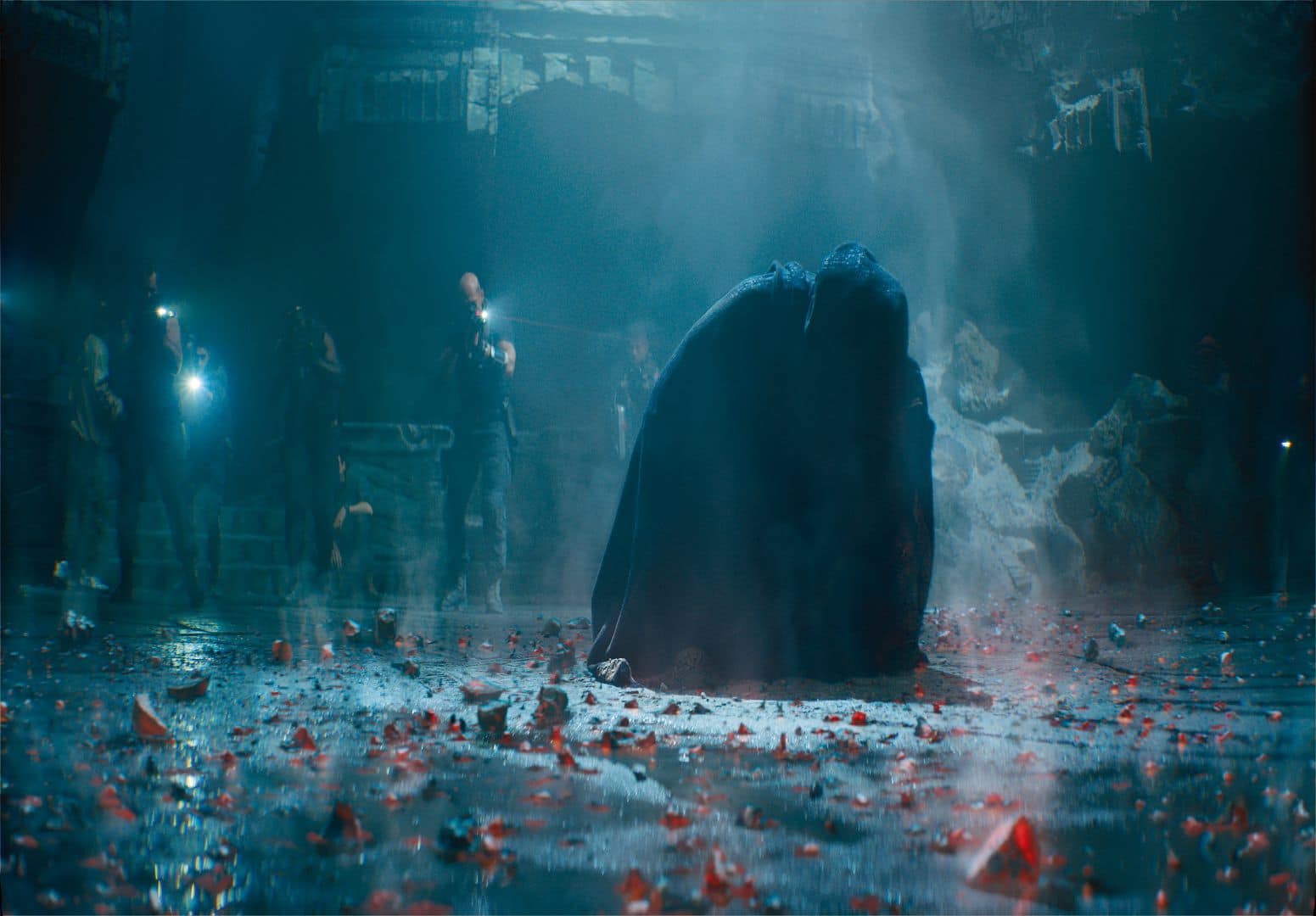
Nikos Kalaitzidis: You would think. We had a mixed bag of sequences where we see Black Adam in dark environments, as well as brightly lit. When creating our digi-double assets, we certainly built our Black Adam for any lighting scenario. In the end, there was no cheating – our assets needed to hold up on their own.
DP: If you compare the pipeline to your earlier movies, like Tron: Legacy or Daredevil, has something fundamentally changed about your approach?
Nikos Kalaitzidis: How times have progressed from the sophistication of third-party software, to the fast render times of GPU rendering, to deep-fakes, to Unreal Engine reviews. The call for visual effects is more demanding in regards to creative and the volume of work. Even though it’s faster to get to 85% completion of a shot, it still takes many iterations to get the shot to FINAL. This much hasn’t changed.
DP: Let’s get to the crispy part: How did you roast the mercenary?
Nikos Kalaitzidis: We called these the “Electrocuted Baddy” shots. The director, Jaume Collet-Serra, wanted the shot’s length to be long and for it to be viewed up close, so the audience can get a good chance to see the effect. Immediately, we knew it would be best to execute the shot entirely as CG, instead of taking it over from live-action photography to CG.

The baddy had to shake, burn and lose volume in order for us to get him to a skeleton. From there, Black Adam could snap his skeletal neck. We were fortunate that the actor who played the electrocuted baddy was able to perform on set. As he was getting shocked, all of his body parts shook in a very high-frequency manner. We matched his performance and modelled different shapes, from his regular, normal-sized self to an emaciated version of the actor.
That model was used in animation as a blend shape in Maya. The animation was handed off to our cloth simulation team to shake his clothes, and then passed to FX to burn them. We used Houdini to create the burn, singe, smoke and embers off the CG cloth generated by Black Adam’s lightning-arcs.
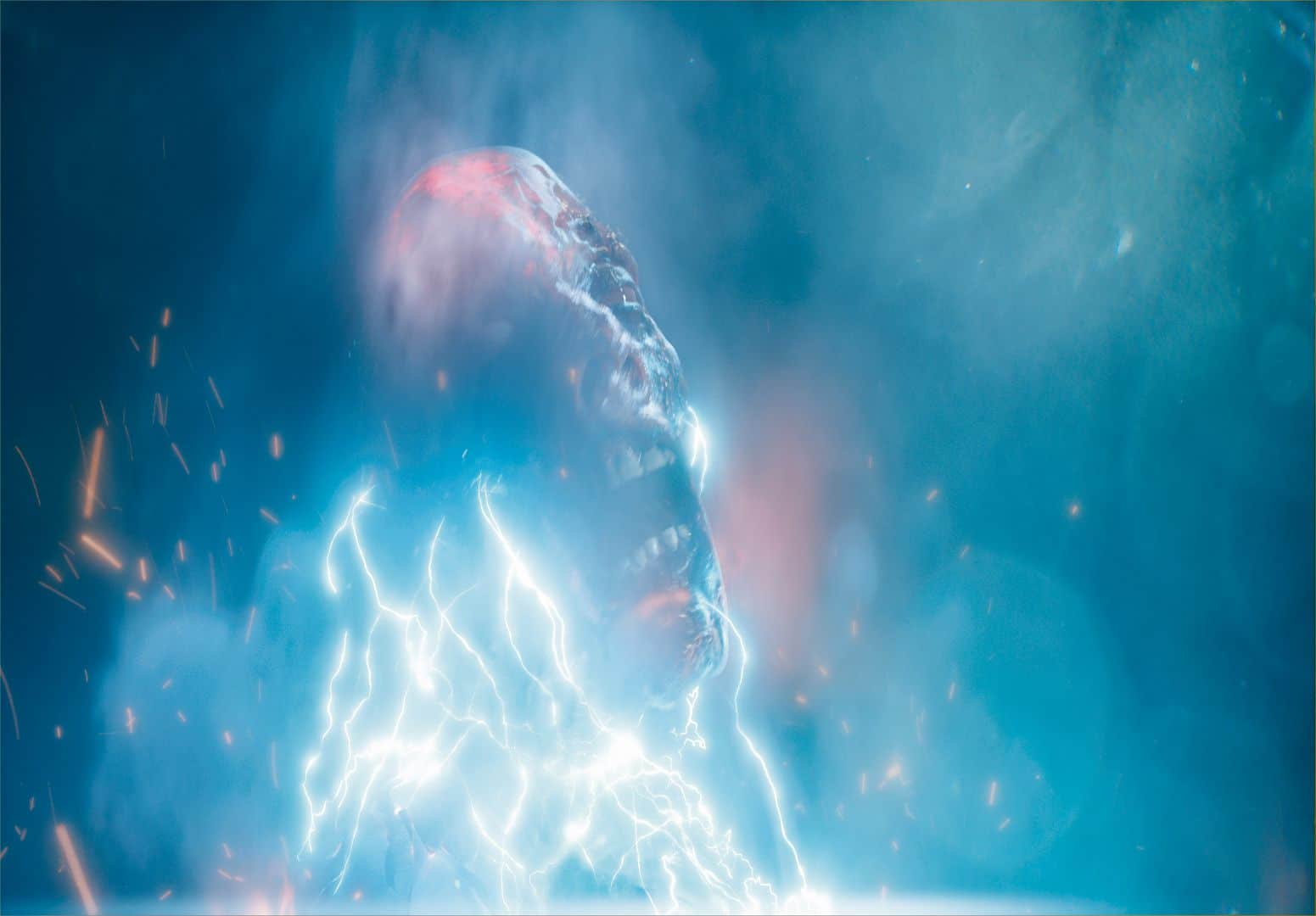
When we created electrocuted baddy’s face and body, not only did we need to make his skin photo-real, we also needed to create sub-dermal anatomy, like muscles, capillaries, bones and skull. The director wanted the skin render to be translucent so the audience can see this anatomy, as it would be in the spirit of the comic books. Our look-dev team created skin textures that we called “BBQ layers,” as if we cooked up burnt steak on the BBQ.

The layers of BBQ would be activated and revealed when a lightning arc would collide against it. We created animated textures in Houdini that we passed off to our look-dev team to render in V-Ray. Our compositor had many complex layers to assemble in his Nuke script. One fun fact about the effect is that after working so hard not to cheat the look, we had the MPAA come back to us and request that we hide some of this face melting to pass the PG-13 rating.
DP: You also did the “super-speed” scenes in the beginning – I assume it was more work than just dropping frames?
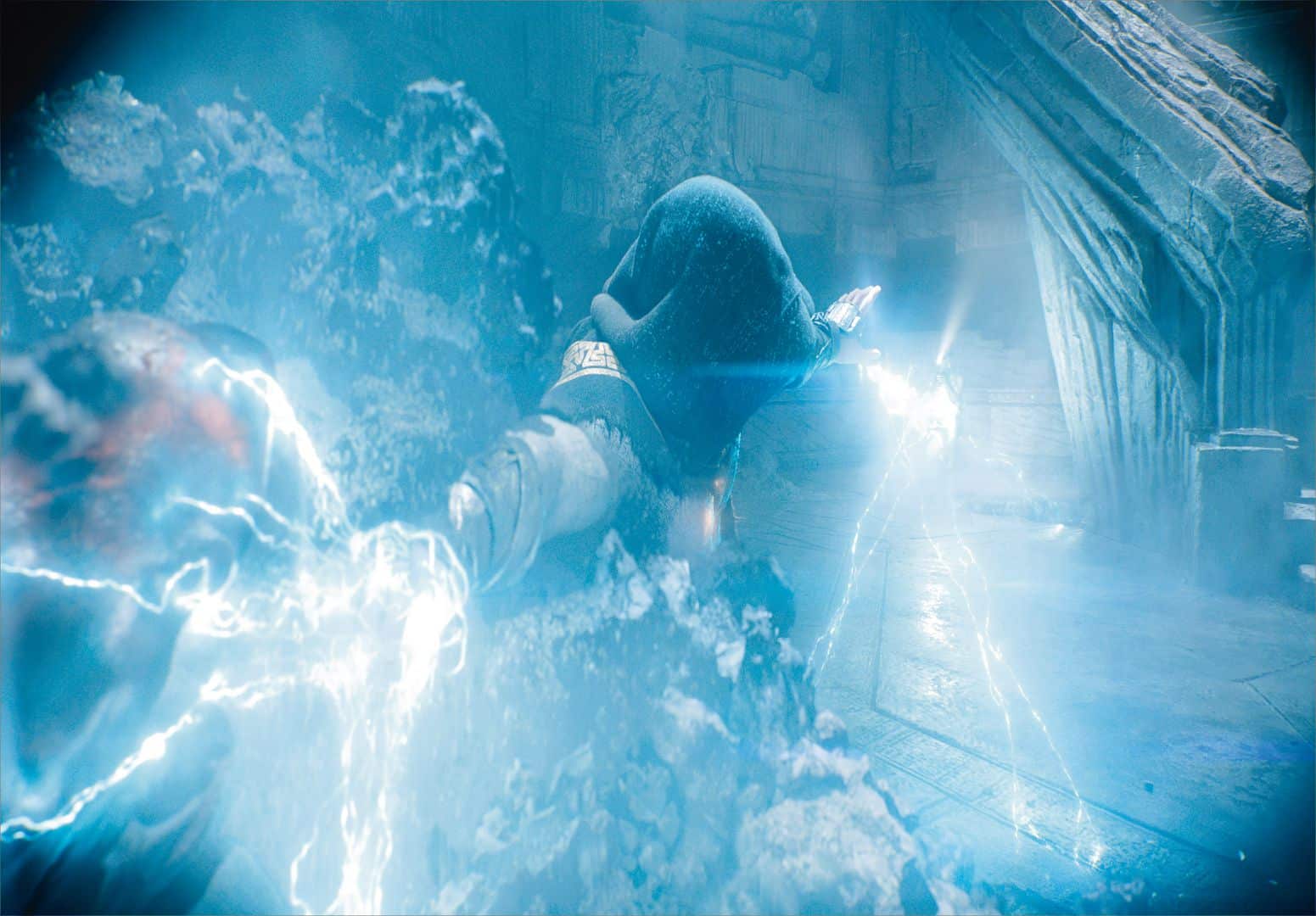
Nikos Kalaitzidis: Our animation supervisor, Arda Uysal, helped come up with the look by carefully crafting in between key frames. We not only hit the key frames with strong poses, but also animated in between two frames with proper action, like his steps or anticipations. Once rendered with motion blur, these invisible animations suggested a particular action. We designed the motion blur for each frame.
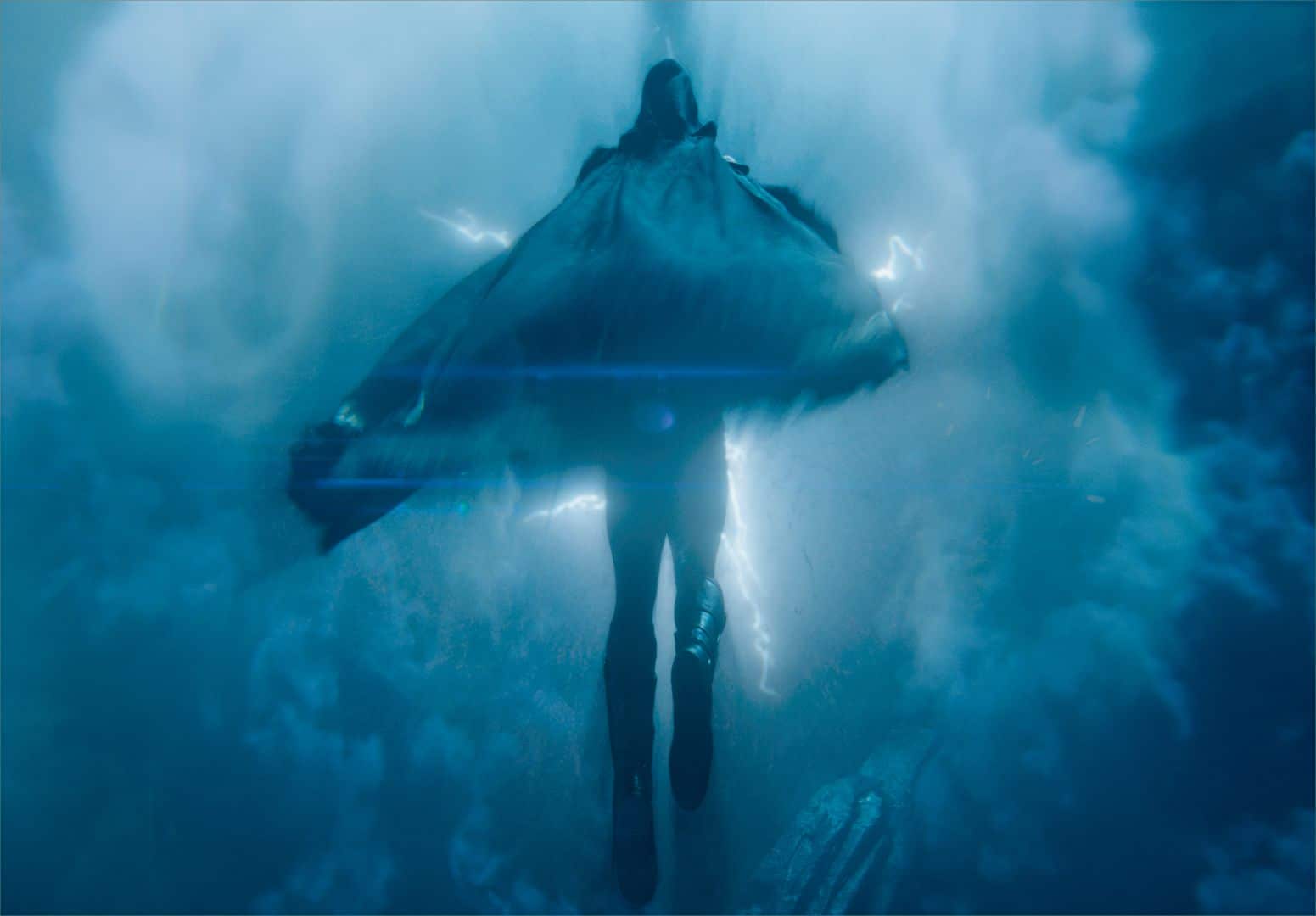
Black Adam’s cloak also helped with the super-speed effect. When he came out of his fast zipping speed, his simulated cloak would carry the inertia of his movement in real time. We would also help the effect by kicking up some dust from the ground courtesy of our FX department. Comp also had a major role in defining the look of this trailing refraction from the motion blur renders. We biased a subtle look, but enhanced the colours of his streaks to make sure the viewer can see the effect
DP: If you’d start again on Black Adam, what would you do differently?
Nikos Kalaitzidis: It’s not all about technology. Working on a project for so long that is so large, I’ve come to the conclusion that it all comes down to the artists, production crew, sups, leads and clients. I was fortunate enough to have worked for, and with such a stellar team on Black Adam. We were able to capture lightning in a bottle on this one. I’m not sure exactly how to recreate that feeling in the future, but I will endeavour to do so. It really is about the people and, you’re only as good as the ones you’re with. Camaraderie transcends technology.
DP: Now that Black Adam sits on the throne of his country (so to speak), what are you up to now?
Nikos Kalaitzidis: I’m on a mission to explore all different universes. Anything (in VFX) is possible.
