



Maxon has unveiled Redshift 2025.3, the latest iteration of its GPU renderer, bringing a suite of enhancements tailored for professionals in film production, VFX, CGI, and post-production. This update focuses on refining lighting controls, volume rendering, and expanding compatibility with industry-standard workflows.
Enhanced Lighting Controls
In this release, Redshift reimagines the behavior of Area and Dome lights. Now, these lights can be configured to be visible within a scene without casting shadows, or conversely, to remain invisible while their effects are perceivable through transparent materials. This flexibility offers artists more nuanced control over scene illumination, ensuring that the light behaves as intended without unintended visual artifacts.
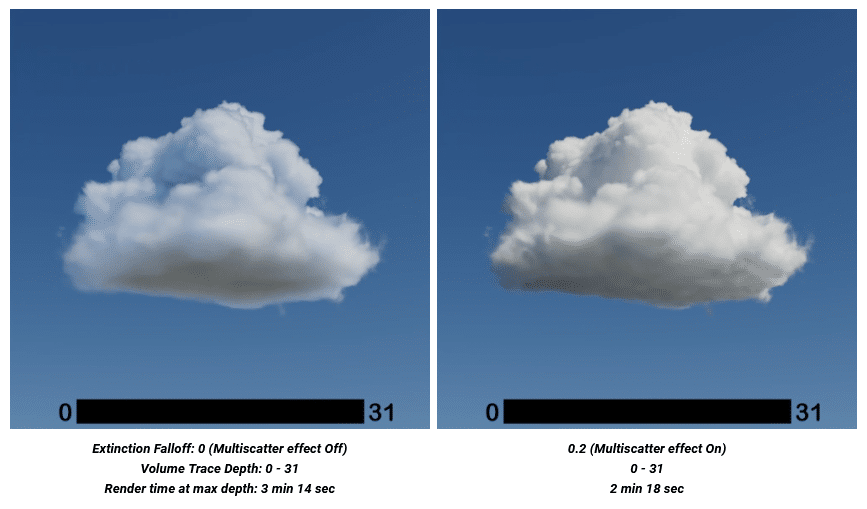
Improved Volume Scattering
Volume rendering sees a significant upgrade with the introduction of the Extinction Falloff parameter in both the Standard Volume and classic Volume shaders. This feature reduces scattering and transmittance with successive bounces of volume rays, enabling the simulation of numerous bounces without compromising performance. Additionally, the Standard Volume shader now includes a unified Displacement input, allowing simultaneous application of volume displacement to both the volume and emission channels.
Expanded USD Procedural Support
Redshift’s USD (Universal Scene Description) procedural capabilities have been extended to Autodesk Maya, complementing existing support in Houdini and Katana. Artists can now load and render USD files using the RS Proxy, ensuring that USD assets are only loaded at render time, resulting in a more streamlined and efficient scene file. The USD Procedural also now supports UsdPreviewSurface materials, as well as denoising and post effects, further integrating Redshift into modern production pipelines.
Experimental GPU Compatibility
For those eager to leverage the latest hardware advancements, Redshift 2025.3 introduces experimental support for NVIDIA’s GeForce RTX 50 Series GPUs, based on the Blackwell architecture. As these GPUs become commercially available, users can anticipate enhanced rendering performance, though it’s advisable to validate this innovation in test environments before deploying it in active projects.
Platform and Pricing Details
Redshift 2025.3 is compatible with Windows 10+, glibc 2.28+ Linux, and macOS 13.3+. Integration plugins are available for 3ds Max 2018+, Blender 3.1+, Cinema 4D R25+, Houdini 18.5+, Katana 4.5+, and Maya 2018+ (Maya 2022+ on Linux). The software is offered on a subscription basis, priced at $46 per month or $264 annually. For a comprehensive list of changes and detailed information, visit the Redshift forum.
As always, while these enhancements promise to elevate your rendering workflow, it’s prudent to thoroughly test new features in your specific production environment to ensure stability and compatibility.
