



What’s Material Maker and why this matters
Material Maker is an open-source, node-based procedural texturing tool built on the Godot engine. It enables artists to create PBR texture graphs, paint directly onto 3D meshes, and export materials for engines such as Unity, Unreal, or Godot itself. The software has long served as a free alternative to commercial node-based texturing tools, offering a lightweight and extensible workflow.
Version 1.4 represents a substantial technical milestone. The entire tool has been ported from Godot 3 to Godot 4, involving a near-complete rewrite of shader generation, UI layout, and core rendering systems. Because this migration changes the internal architecture, older graphs and projects may not behave identically after conversion.
Godot 4 port and shader engine rewrite
The move to Godot 4 is the heart of this release. Developer RodZilla notes that he “seriously underestimated” the scale of the migration effort. The new engine required rewriting many components from scratch, including the shader generation logic. Unused functions are now pruned automatically, and generated code includes node references for improved debugging. The output is smaller, cleaner, and executes more efficiently inside Godot 4’s rendering pipeline.
The switch to the new rendering backend also made compute shaders more reliable. This stability, in turn, allowed the introduction of new parameter types such as Splines, Pixels, and Lattice, as well as distortion controls that were previously impossible or unstable on Godot 3.
32-bit precision textures
With version 1.4, Material Maker gains support for rendering textures at 32 bits per channel. This improves numerical precision in generated maps, reducing banding and quantisation artefacts. The improvement is particularly relevant for heightfields and normal maps, where small gradients often reveal rounding errors when limited to lower bit depths.
Artists can now choose 32-bit buffers in the rendering pipeline. This is the first time Material Maker achieves such precision, made possible entirely by the Godot 4 backend.
MeshMap node and smarter Smart Materials
The release also introduces the new MeshMap node, designed to bake and manage mesh-dependent textures directly within a material graph. It automatically generates per-mesh maps such as position, normal, tangent, curvature, occlusion, and thickness. When a user switches to a different mesh in the 3D preview, the node rebakes all associated maps automatically.
This capability strengthens the Smart Materials workflow, allowing procedural materials to react intelligently to the model’s geometry without leaving Material Maker.
RodZilla remarks that the painting tool has been partially re-implemented in this release, now using compute shaders to handle all channels in a single pass. He acknowledges, however, that this is an experimental solution and may evolve in future versions. The developer is considering a more layer-based UI for texturing workflows, where graphs could be abstracted into a simplified stack view.
UI overhaul and preview improvements
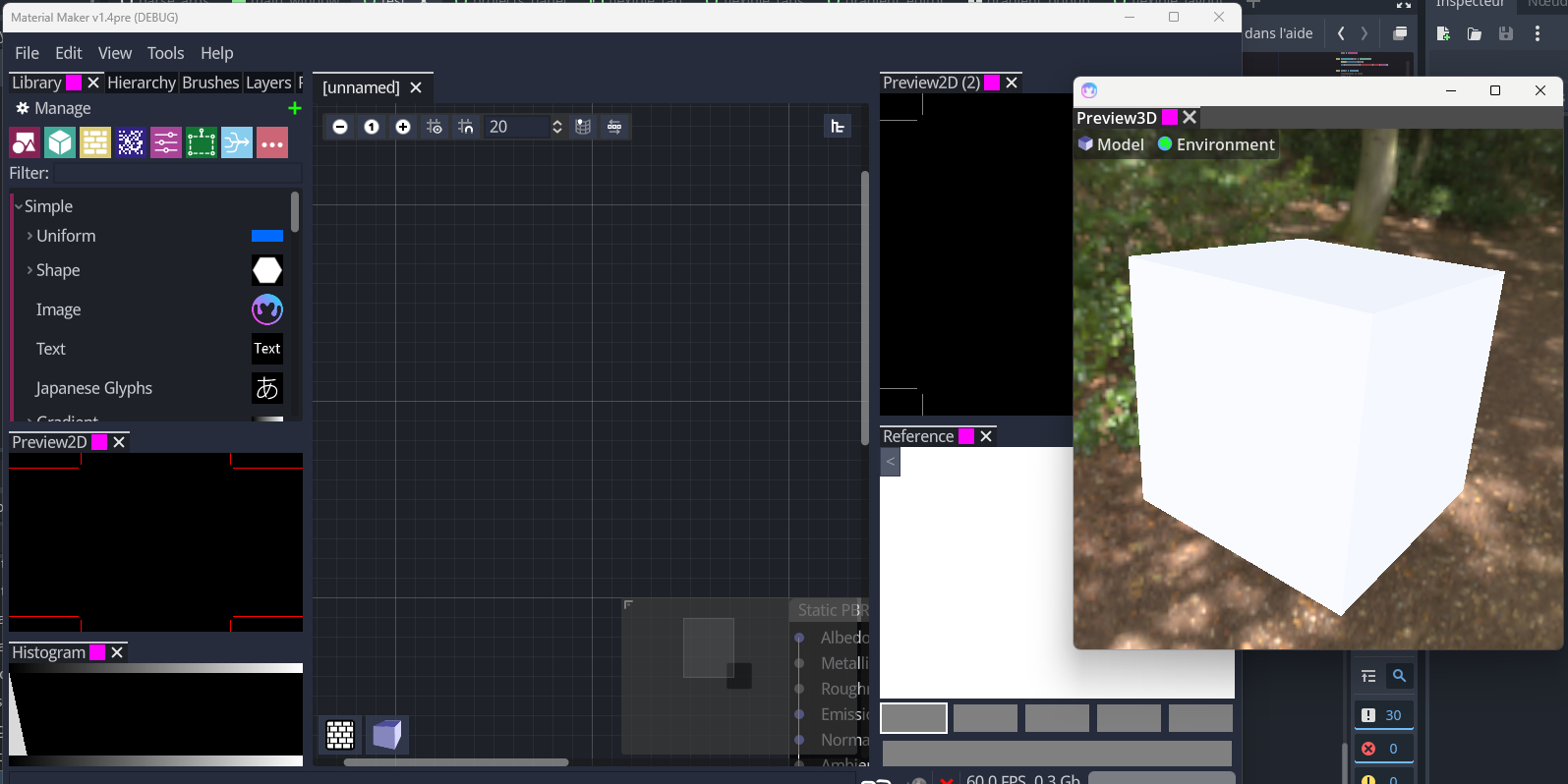
Material Maker’s user interface has been extensively redesigned. Panels can now be undocked, rearranged, and saved as custom layouts. Two default configurations are provided: one for material authoring and one for mesh painting. A new “Modern” theme has been added, and theme switching is now handled dynamically.
The 3D preview gains AgX tonemapping, along with controls for exposure and white balance. Shader errors are displayed in a dedicated console, and clicking an error message highlights the offending node directly in the graph. Additional refinements include a searchable “Add Node” popup and expanded Find/Replace functionality in the shader editor.
Overall, the UI changes make Material Maker less monolithic and more comfortable for artists accustomed to complex, multi-panel environments.
Expanded node library and parameters
Version 1.4 adds numerous new nodes and parameter types. Spline and Pixel parameters have been introduced, along with associated nodes for smooth pixel operations and curve-based modulation. The new Lattice parameter provides a grid-based deformation system for procedural distortions.
Signed Distance Function (SDF) workflows have been significantly expanded with new 2D and 3D SDF primitives and operations. The EasySDF editor now supports more shapes and axis parameters in Extrude and Revolution nodes. The Blend node gains additional blend modes for hue, saturation, colour, and value operations.
Material Maker now also supports Unity’s Universal Render Pipeline for static material export, improving compatibility for game developers.
These new options collectively make procedural authoring in Material Maker considerably more expressive. Artists can create more organic or structured materials without resorting to external maps or sculpted geometry.
Miscellaneous and platform updates
Material Maker 1.4 targets Godot 4.4.1 and includes optimisations across all supported systems. macOS packaging has been simplified for easier installation. The splash screen now features user-made materials or shaders from the community. A startup option allows deletion of unsaved “rescued” projects, reducing clutter for long-time users.
Under the hood, numerous fixes have been applied to library handling, export logic, environment editing, and popup placement. Shader exports for Unity, Unreal, and Godot have been refined, particularly in handling dynamic arrays and HLSL code generation.
Availability and stability
Material Maker 1.4 is available now for Windows, macOS, and Linux, distributed as open source under the MIT licence. The developer warns that despite months of testing, the Godot 4 port introduces major internal changes. Artists are encouraged to test thoroughly before deploying it in production.
RodZilla describes the painting workflow as experimental and continues to regard version 1.3 as the safest option for mission-critical work. Users should verify compatibility of existing graphs, node libraries, and shader exports before full migration.
Implications for production pipelines
For texture artists and look-dev specialists, the shift to 32-bit channel precision delivers measurable benefits in map quality. The MeshMap node shortens the path between procedural generation and mesh-aware baking, reducing dependency on third-party tools. The flexible UI layout accommodates multi-screen workflows common in larger studios.
At the same time, the deep architectural changes mean that conversion of existing node graphs may not be straightforward. Production users should test carefully before committing to version 1.4 in live pipelines. As always, no software, particularly one built on a new rendering core, should be adopted without validation in the specific studio environment.
