



Unreal Engine 5.5 has arrived, ushering in significant advancements across animation, rendering, and in-camera VFX. Epic Games has fine-tuned UE 5.5 to serve both high-demand production scenarios and exploratory real-time graphics. This release sharpens workflows in areas such as virtual production, real-time SMPTE 2110 support, and camera calibration, providing digital production professionals with new control over complex workflows.

Virtual Production Reaches New Levels
Unreal Engine’s virtual production tools take another leap forward in UE 5.5, with in-camera visual effects (ICVFX) features now considered production-ready. This toolkit, crucial for virtual production in film and TV, gains broader support with SMPTE 2110 integration. Designed for real-time IP video workflows, this standard includes stability enhancements for framelock maintenance, auto-repair of timecode disruptions, and OpenColorIO (OCIO) support. For real-world productions relying on ICVFX, the SMPTE 2110 protocol compatibility could streamline workflows significantly, though testing is recommended to confirm project suitability.
Camera calibration tools are likewise now production-ready. Improvements include refined lens and camera parameter estimations, enhancing image accuracy for lens distortion adjustments, and enabling overscan—a vital feature for compositors using lens effects or post-production camera shakes.
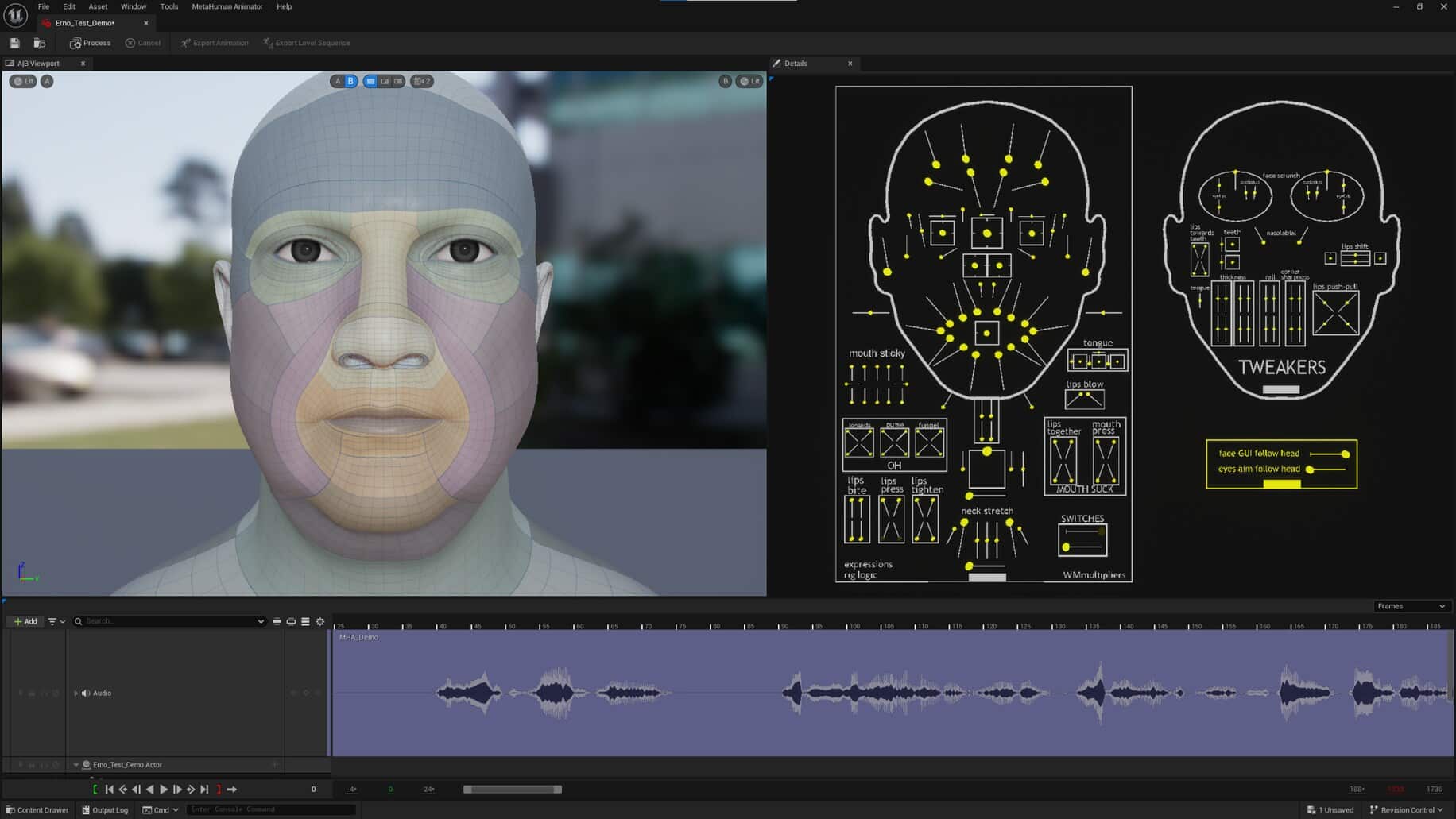
MetaHuman Animator: High-Fidelity Facial Animation on Audio Input
With MetaHuman Animator, animators can now produce detailed facial expressions using just audio input, with even upper facial gestures inferred from the data. Though labeled as experimental, these upgrades could make realistic facial animation more accessible, especially for indie teams lacking access to full performance-capture setups. The MetaHuman Animator’s enhanced character customization options, now incorporating dynamic skeletal meshes, textures, and materials, create real-time character adjustments with improved memory efficiency.
Color Grading Panel: Artistic Control Within Unreal
The Color Grading Panel, previously restricted to the ICVFX Editor, is now universally available within the Unreal Editor. This tool offers artists an intuitive interface for color adjustments across post-process volumes, cine cameras, and localized color correction regions, making it ideal for previsualization and VFX work. The panel brings greater flexibility to color workflows, and its user-friendly design could streamline processes typically reserved for external grading software.
Unreal Engine’s DMX tech stack, now production-ready, extends its functionality beyond virtual production to broadcast and live events. Key updates include improvements to the Control Console, Pixel Mapping, and Conflict Monitor, offering greater control and precision. Additionally, the DMX Plugin now supports GDTF compliance, enabling seamless integration with GDTF- and MVR-compatible control devices and software, among other refinements.
Expanded Tools for Animation Authoring and Sequencing
UE 5.5 also enhances its animation authoring toolkit. In Sequencer, Unreal’s non-linear animation editor, users now have more refined control over animation properties and filtering. Animation deformers bring more realistic effects, such as squash-and-stretch, while the Modular Control Rig supports varied body types, quadrupeds, and vehicle rigs. Animation professionals can now author deformable effects within Control Rig, enabling character adjustments with a single click in Sequencer.

Technical Innovations for Mobile and Virtual Scouting
Mobile development benefits from a revamped Forward Renderer, now supporting enhanced lighting and shading, including decals, capsule shadows, and Niagara particle lights, enhancing visual fidelity on Android and iOS. Meanwhile, virtual scouting—introduced in UE 5.4—adds VR Content Browser and asset placement capabilities, enabling OpenXR-compatible headsets to interact with assets directly in VR. This update broadens scouting capabilities for cinematographers, with Oculus and Valve Index support included out of the box.

Also new is the Unreal Zen Server, an optimized cached data storage and network system introduced in UE 5.4. Now production-ready, the Zen Server acts as a shared Derived Data Cache (DDC) and can stream cooked data directly to target platforms, from PCs to mobile devices, making it easier for developers to test and adjust their projects on various hardware. Additionally, tools like the Unreal Zen Loader, Unreal Build Accelerator, and Unreal Horde Continuous Integration enhance asset loading, speed up C++ and shader compilation, and scale remote execution, creating a more fluid workflow for complex projects.
Integrated with these tools is Fab, a new content marketplace within Unreal Engine 5.5, allowing users to drag and drop assets, like Quixel Megascans, directly into scenes for faster asset management and deployment.
Conclusion
Unreal Engine 5.5 represents a technical expansion aimed at facilitating complex, real-time digital production. While several features, such as MetaHuman Animator and the SMPTE 2110 protocol, mark significant steps toward integrated, high-fidelity production, testing for project stability is recommended, as many of these tools remain experimental. Digital production teams now have more powerful tools at their disposal, though care should be taken in verifying these new additions’ reliability in high-stakes production environments. For more details and to check the full range of improvements, visit the Unreal Engine blog.
