



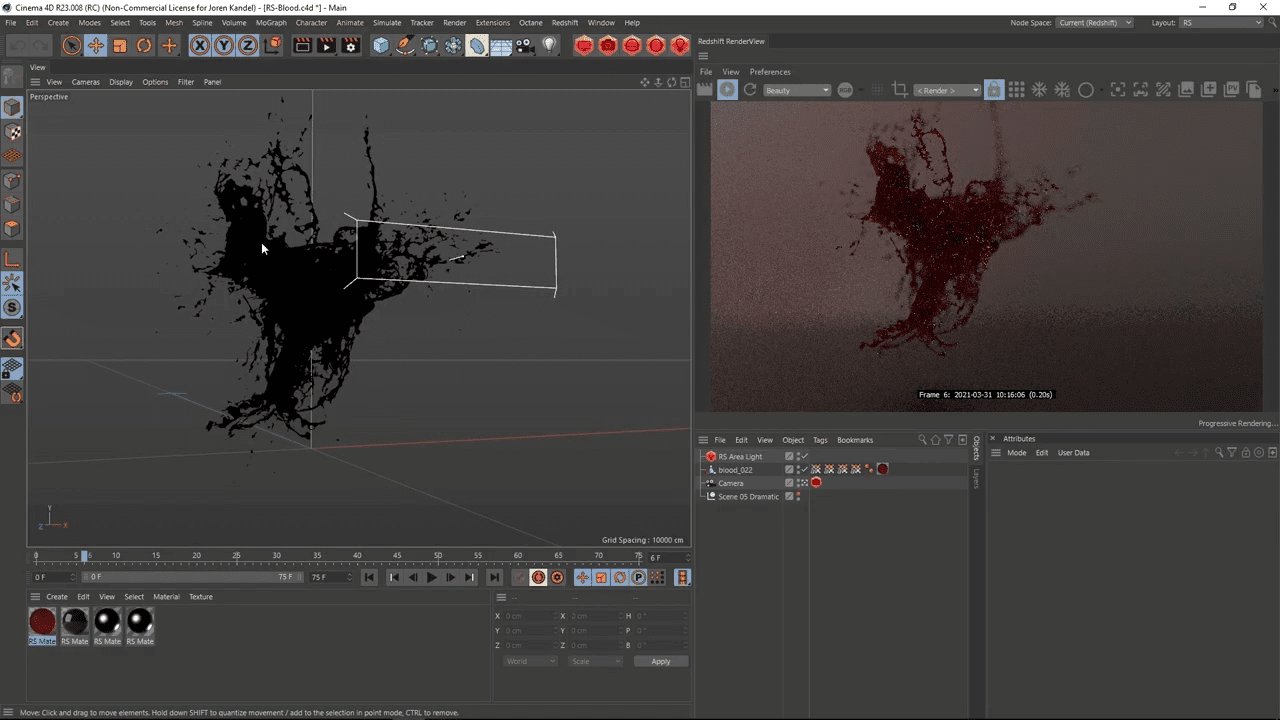
The free Blood Hit 3D Asset lands as an Alembic animation, pre-simmed and intended to drop straight into a project. That matters because it keeps the asset squarely in the world of import, shade, light, render, comp, rather than asking you to set up a fluid sim, cache it, and hope your deadline shows mercy.
The asset targets broad compatibility by leaning on Alembic, a format widely used for baked geometry animation interchange. The file is positioned as something you can use in almost any render engine or 3D app, as long as your toolchain can ingest Alembic and you can assign materials the way you like.
This is very much a VFX elemnet style freebie in spirit, but it ships as 3D animation rather than a 2D flipbook or a stock plate. You get geometry motion you can place in space, aim at camera, frame with lens choices, and match to lighting cues. The messy bit becomes a scene object, not a comp sticker.
Two quality tiers, one timeline, and a choice of speed
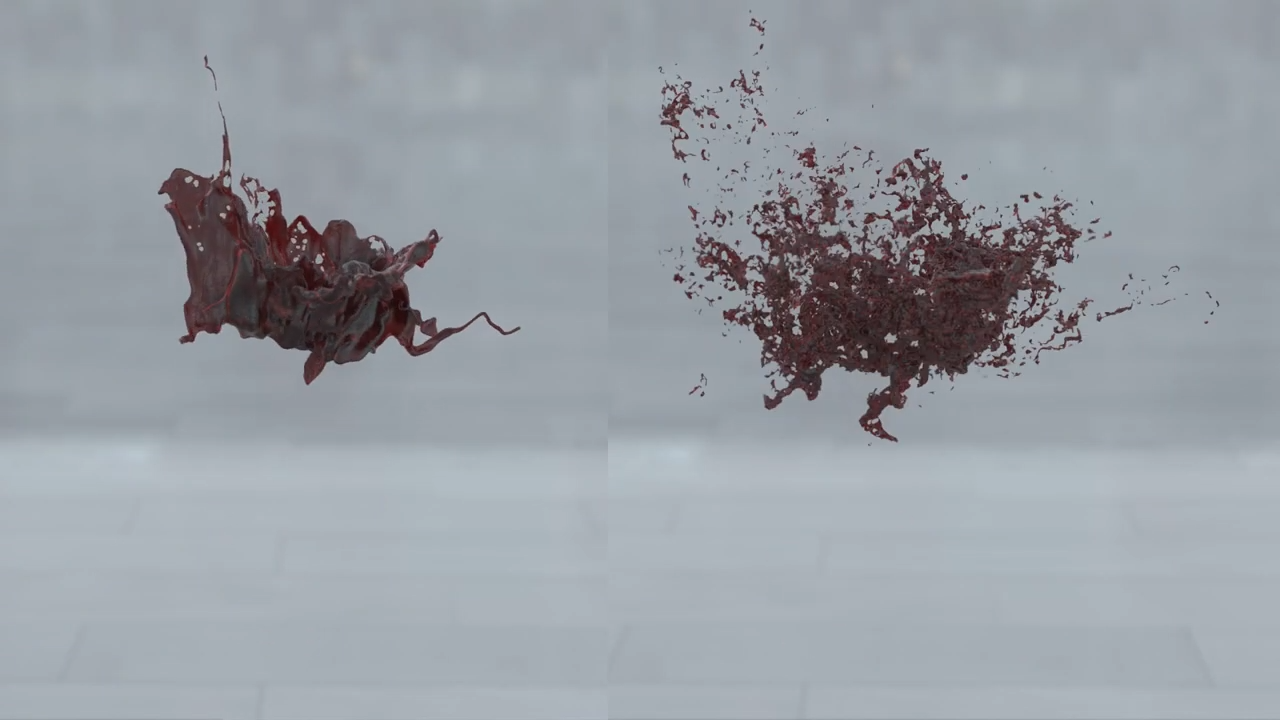
The download includes two quality versions: a lower-quality option for faster renders and a high-quality option for hero shots. The animation runs at 24 fps, keeping it aligned with common editorial timelines and shot contexts.
There are also two speed options: a base speed described as slow motion and a fast speed option. Practically, that gives you two starting points for timing without forcing you to retime a single cache into wildly different beats right away. If the shot needs a long, readable splatter moment, the base speed exists. If you need a sharper hit that sells impact and gets out of the way, the fast option exists.
Because this is a pre-simmed Alembic cache, your artistic control flows through placement, scale, camera distance, shading, motion blur choices, and render settings. Your control does not flow through sim parameters, since the simulation work is already baked.
Where it plugs in across engines and DCCs
The broader compatibility pitch comes with specific examples of tools and engines that can be used with the paid pack the freebie points toward. The supported examples include Blender, Houdini, Unreal Engine, Arnold, V-Ray, OctaneRender, Redshift, and Cycles.
That list spans both DCC hosts and renderers, which is a useful reminder of how Alembic assets tend to travel in real productions. Sometimes you import into a DCC and render there. Sometimes you import into a DCC and export again into another context. Sometimes you bring it straight into a real-time environment like Unreal Engine for previs, cinematics, or interactive content, then either render there or use it to inform final lighting and comp decisions elsewhere.
If your pipeline already handles Alembic caches for crowds, cloth, or destruction, this should feel familiar: it is another baked motion asset you treat like a shot-specific prop. If you are new to geometry caches, the main idea remains simple. Import the cache, scrub it, and make sure it lines up with your timeline and scale before you start shading and lighting.
How you actually get it
Access to the free Blood Hit 3D Asset requires joining a newsletter, after which an email provides download instructions. If you are already on the newsletter list, previous emails are described as containing the same download instructions. The freebie is also positioned as part of a larger library described as 500+ other free 3D freebies. That bundle access is tied to the same newsletter workflow, rather than a one-off anonymous download link.
If your studio policy treats marketing email lists as a procurement step with paperwork attached, that is the moment to loop in whoever manages vendor communications. If you are an individual artist, it is simply a question of whether you want the asset enough to do the email round trip.
The paid pack it points to, and what it costs
The free asset sits alongside a commercial product called VFX Elements Volume 03: Blood Hits. That is containing 25 blood hit animations, delivered as Alembic files intended to load into render engines and 3D apps that support them. The listed price for the pack is $69.00, and it is as an instant download. The same engine and application examples show up here as well, including Blender, Houdini, Unreal Engine, Arnold, V-Ray, OctaneRender, Redshift, and Cycles. The pack is also shown with low-resolution playblasts used to preview the animations. That detail matters because it frames expectations: previews exist to show motion, but you should still evaluate how the cache behaves in your own render context, shading approach, and lighting setup.
Any new asset needs testing before you drop it into production shots. Import it into a sandbox scene first, confirm the scale, check frame-rate alignment, and verify how your chosen renderer handles motion blur on geometry caches. Do the same for both quality versions, because render cost and cache behavior can differ in ways that only show up once you hit real lighting.
Shading is the other big practical checkpoint. A blood hit cache does not automatically become convincing just because the animation looks good. You still need materials, spec response, and lighting that sell wetness and thickness. Your comp workflow also matters, especially if you plan to integrate the hit with interactive lighting or lens effects. This freebie gives you motion, but the final look still lives in your scene setup.
The Pixel Lab appears to be using this free Blood Hit 3D Asset as both a standalone giveaway and a doorway into the larger VFX Elements Volume 03: Blood Hits collection. If the one free hit covers your immediate need, great. If your work calls for a variety of impacts and angles, the 25 animation pack exists with a clear price tag and the same Alembic foundation.
https://www.thepixellab.net/free-vfx-element-blood-hit-3d-asset
