



Table of Contents Show
OK, nearly all, but directly from the Deliver page, based on FFmpeg. There used to be a free solution for Windows, called Voukoder, but it became commercial now and is still in beta for MacOS. The new solution is called InterX by its author Andrew and we had the chance to try it out thoroughly under MacOS. It has no connection with Inter-X by Liang Xu, which is nevertheless an interesting software in its own right, see here.
What can it do for you?
Users of DaVinci Resolve (DR for short) have been asking for more output codecs and more control over the existing ones for years. While Blackmagic has added quite a few over time, you still don’t get all the possibilities offered by the free multimedia framework FFmpeg. Why is not everybody using it? Well, there are still a few humans left who don’t like to type command lines. While there are GUIs for FFmpeg, like the excellent Shutter Encoder, you can’t use those directly out of DR.
If you wanted a codec or container not offered on the Deliver page, you had to export your footage in another codec first. To avoid stomping too hard on your video quality, this would have to be a high quality codec like ProRes, DNxHR, or CineForm. That path did cost you time and storage space, even if just temporarily, with the latter only rising in price recently. Once you open it in FFmpeg, you could treat it with anything offered there, like their excellent encoders for H.264 and H.265, called x264 and x265. Already see the catch?
Installation
Yes, they are not even called by their official names, since nobody is paying licenses for them. Or look at ProRes in FFmpeg, which is even reverse engineered. Being a non-commercial software, actually even open-source, this is tolerated by the right holders for personal use. Those companies offering some codecs based on FFmpeg with their commercial products have either licensed them or just stripped the installation of those codecs that might trigger a court case. H.264 or H.265 are supported in hardware on Apple silicon or recent GPUs for PCs. Sure enough, they have paid licenses for such hardware, but these encoders neither offer the full flexibility nor the full quality of software versions.

The author of InterX wants to give you the whole range, so you’ll have to pay a humble fee of 29,- € for using InterX. But he will not risk installing a complete version of FFmpeg with his software installer. The installer he’ll send you is also not ‘blessed’ by Apple, which would generate extra costs, so you’ll need to override protection. On older systems it was just a right-click away, and you could confirm “Open anyway”. Recent systems hide it under “Privacy & Security” in the System Settings, all the way scrolling down to “Security”. You’ll need to try the installer once, which will fail (don’t move it to the trash), and then allow it there.
Andrew will not risk installing a complete version of FFmpeg with his software installer. That is simply up to you before you can use InterX. But don’t panic at the necessity to paste a few commands into the terminal, it’s all prepared for you with a separate script he’ll send you, and then you’ll just need to wait a while – it’s a lengthy process. We did it a dozen of times before, and we swear it’ll not let your machine go up in flames (but you need admin rights).

The plug-in called “InterX.dvcp.bundle” will be moved into a folder called IOPlugins, which the installer generates if you’ve never installed this kind of a plug-in. You can try InterX to your hearts delight for an output of up to 5 minutes, and if desperately needed for your tests you can kindly ask him for some more. And if you don’t trust strangers: Andrew is a regular, very helpful and knowledgeable contributor to the Blackmagic forum.
You’ll need to buy a license for unlimited duration, which goes into /Library/Application Support/InterX. As usual, it needs to be in the main Library if you want to make it available to all users, and you’ll have to restart DR. Restarting the whole system is always a good idea after any such installations. And if this sounds overly complicated, be glad if you didn’t have an overprotective mother as a kid.
Possibilities
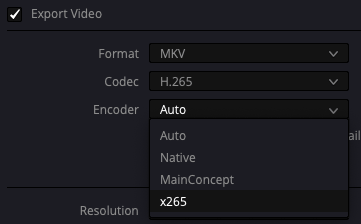
The new containers and codecs can be accessed through a long list of containers with “InterX” added to their names. Some can also be found in the regular containers, like MOV or MXF, by first choosing the codec and then the encoder. For these you’ll get a list of settings below, under “Plugin Settings”.

Some highlights are streams following the specs for BluRay, even in UHD (but without authoring). XDCAM adhering to specs, as it’s still in use by many TV folks in Europe. Added codecs include WEBM, JPEG XL, plus support of codecs existing in DR, but not supported in containers like MKV. Now you can use Apple’s native ProRes codec in MKV, for example, where native means hardware acceleration in recent Macs. Audio is not neglected, there are a few more codecs, like Opus, which is the right one for WebM.

Each and every parameter offered in command lines by FFmpeg can be set in a simple HTML interface. If those parameters still make your heads spin, don’t despair: there a well thought out presets. Additionally you can check specification adherence, like gamut check for R103, or analyse your HDR version before inserting HDR metadata. Sound can be checked for EBU R128 compliance, which is for loudness audiences perceive and not simply levels as measured by an instrument.

Of course 5.1 surround tracks are supported both in home cinema sorting and DCI standard, with the latter labeled as 5.1 Film. Timecode can come from the timeline or be defined by the user. And markers to chapters? Check, including colors. But the biggest point in the professional arena might be the far better support of metadata than in DR (support for DDPs as a separate product will soon come).

Caveats
While all Macs support native ProRes, recent ones even accelerate it in hardware, you need to be careful using it on a PC. The author is already working on a Windows version of InterX, but the ProRes encoder in FFmpeg is reverse-engineered. While its quality is perfectly fine, broadcasters’ quality control may reject it because it lacks the headers blessed by Apple. You can use it without issues for uploads to services like YouTube, since they re-encode anyway.
Oh, and when you are adding the encoding to the batch list, it may complain about insufficient space. Don’t worry, that is calculated based on the highest possible data rate, so if you estimate you have the space, just add it.

Finally, H.265 is a minefield of licensing issues. To circumvent these, AV1 was developed, and it is quite efficient in quality and size. Unfortunately, until now there are only decoders in hardware. Encoding it by software is considerably slower than H.265 in hardware (but that’s licensed anyway, see above). But it’s even at higher quality a bit faster than software encoding by x265, and much faster than its awfully slow precursor VP9. InterX supports it in several containers, like MP4, MKV and WebM, but set the right codec for audio. Only Opus will work in WebM, but it is widely supported in all modern browers.
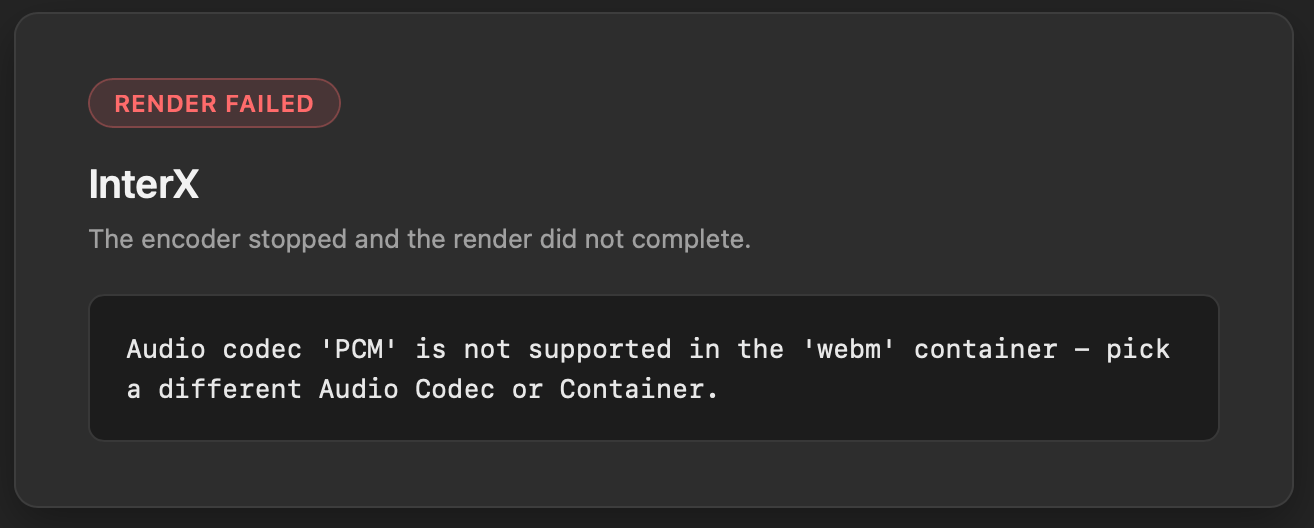
So, while x265 will give you small files of excellent quality for personal use, the open codec AV1 will be the safer choice if you are earning your money with the output. Both x265 and AV1 offer CRF among their parameters, which means Constant Rate Factor, and it’s normally the best choice if you want to balance size and quality. Attention: lower numbers mean better quality and larger files. There is one catch with AV1 too: The faster SVT version is limited to 10 bit and only 4:2:0, which is normally good enough even for HDR in final distribution. The reference codec is offered by InterX as well. It has all the options, up to 4:4:4 plus alpha , but it is incredibly slow. This is caused by inefficient programming, not by InterX, the encode didn’t max out our CPU or GPU cores by far. If you need an alpha channel, rather resort to ProRes or JPEG-XL.
Speed
We tested on a Mac mini M4 Pro and found that most other codecs fully loaded our CPU cores and the GPU cores to about 2/3 for maximum speed. We tried a 5-minute piece of video in UHD @ 25 fps, so you can compare speed on your machine with the free trial. Differences to encoding with the same codec and parameters and transcoding a file directly in FFmpeg were marginal. Of course, hardware-encoded codecs are much faster, like 1 minute 36 seconds for H.265. But rendering x265 wasn’t too slow at only 9 seconds over real time, while AV1 was done in 2:52, by software anyway. When VP9 indicated an hour (and still rising), we cancelled that.
But if you need H.265 for compatibility with those hardware decoders lacking AV1, x265 is a great alternative: the size is about one fourth of H.265 generated by hardware. Even at High Quality (CRF 20), your files will be less than a third the size, but it takes about twice as long to encode. You may not want to work on anything demanding in parallel, maybe just some typing or browsing, but the icon for DR will show the progress.
Conclusion
InterX adds to DaVinci Resolve what so many have been asking for: more codecs and more control over all their parameters. By direct rendering, you’ll save a lot of storage space, and that alone should justify those humble 29,- € in these times of greedy AI. And then, there are those compliance checks, which can avoid work being pushed back at you.
You can reach out to the author by Interx.post@gmail.com or via the Davinci Resolve forum. And he has more in his pipeline, you can follow his work here.
